Returning to PHP After Years Away
You wrote PHP once. Maybe a lot of it, maybe in 2008, maybe in 2015 on a project that was already old. You remember mysql_query, array(), require_once at the top of every file, and a language that let you get away with anything. Now you are back, and the first thing to know is this: almost every habit you remember has a modern replacement, and most of the old forms are deprecated or gone.
This chapter is a list of pairs. On the left, what you remember. On the right, what you write today. The rest of the book explains each replacement in depth; this is the map.
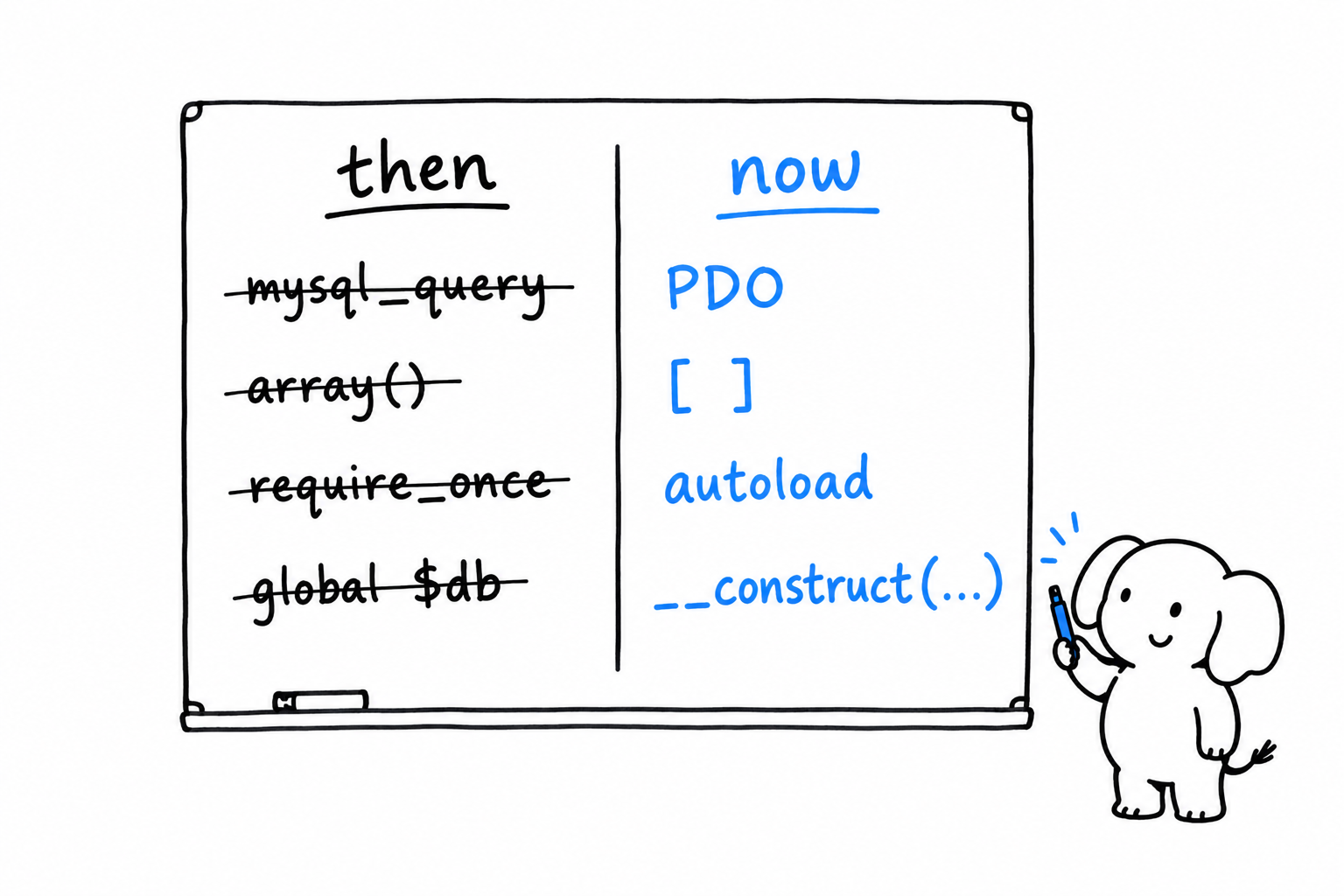
The database
You remember building SQL by hand and passing it to mysql_query(). The mysql_* functions were removed in PHP 7.0. Code that calls them does not run on any supported version of PHP. The replacement is PDO with prepared statements, which also closes the injection hole the old style opened:
<?php
declare(strict_types=1);

// then
// $result = mysql_query("SELECT * FROM users WHERE id = " . $_GET['id']);

// now
$pdo = new PDO('sqlite::memory:', options: [PDO::ATTR_ERRMODE => PDO::ERRMODE_EXCEPTION]);
$stmt = $pdo->prepare('SELECT * FROM users WHERE id = :id');
$stmt->execute(['id' => (int) ($_GET['id'] ?? 0)]);
$user = $stmt->fetch(PDO::FETCH_ASSOC);
mysqli still exists and is fine, but PDO speaks to every database with one API. A Web Request, Without a Framework shows it in context.
Loading code
You remember a wall of require_once lines, or a home-made __autoload() function. Today one line loads everything: require __DIR__ . '/vendor/autoload.php';. Composer generates that file from a namespace-to-folder map in composer.json, and __autoload() itself was removed in 8.0. Classes live one per file, named after the class, and are found on first use. Namespaces, Composer, and Autoloading covers the setup, which takes five minutes.
Composer also replaced the habit of copying a library into your project. Since 2012, composer require vendor/package fetches it from Packagist, pins the version in a lockfile, and updates it when you ask.
Syntax that got shorter
Small changes, but you will see them on every line.
// then
$list = array(1, 2, 3);
$name = isset($_GET['n']) ? $_GET['n'] : 'anon';
$double = function ($x) use ($factor) {
    return $x * $factor;
};
$callback = array($obj, 'method');
call_user_func_array($callback, array(1));
// now
$list = [1, 2, 3];
$name = $_GET['n'] ?? 'anon';
$double = fn($x) => $x * $factor;
$callback = $obj->method(...);
$callback(1);
[] arrived in 5.4, ?? in 7.0, arrow functions fn in 7.4, and the first-class callable syntax $obj->method(...) in 8.1. String callables like 'Class::method' and call_user_func() still work; nobody writes them anymore because the new form is checked by the editor and the analyser, and a callable is simply called with parentheses.
Types
You remember functions that accepted anything and returned whatever. Today functions declare their types, and one line per file makes PHP enforce them.
<?php
declare(strict_types=1);

// then
// function total($items, $rate) { ... }

// now
function total(array $items, float $rate): float
{
    return array_sum($items) * $rate;
}

total([10, 20], '1.2'); // TypeError: must be of type float, string given
Scalar types came in 7.0, return types with them, nullable ?int in 7.1, union types in 8.0, and typed properties in 7.4. declare(strict_types=1) switches off silent coercion for calls made from that file. Types has the precise rules.
Control flow and constants
You remember switch with its fallthrough and loose comparison, and a class full of const STATUS_ACTIVE = 'active';. match replaced the first, enums the second.
<?php
declare(strict_types=1);

enum Status: string
{
    case Active = 'active';
    case Archived = 'archived';
}

function label(Status $status): string
{
    return match ($status) {
        Status::Active => 'In use',
        Status::Archived => 'Put away',
    };
}
match (8.0) compares with ===, does not fall through, and throws if no arm fits. Enums (8.1) are real types: a function typed Status cannot receive the string 'deleted'. Enums and match goes further.
Classes
You remember a private property, a getter, and a setter, times ten per class. Constructor promotion and readonly collapse that to one line per property.
<?php
declare(strict_types=1);

final class Money
{
    public function __construct(
        public readonly int $cents,
        public readonly string $currency,
    ) {
    }
}

$price = new Money(1999, 'EUR');
echo $price->cents; // 1999
$price->cents = 0;  // Error: Cannot modify readonly property
Promotion arrived in 8.0, readonly in 8.1. Property hooks (PHP 8.4) handle the case where a getter really did compute something, by attaching get and set blocks to the property itself. Classes shows all of it.
Two things you remember are now removed or deprecated. PHP 4 style constructors, where the method was named after the class, were removed in 8.0. Dynamic properties, assigning $obj->whatever without declaring it, have been deprecated since 8.2 and are planned to become an error in the next major version.
Errors
You remember @mysql_connect(...) or die('no db'), and warnings printed into the middle of the page. Today errors are exceptions, and you catch them. Internal functions throw TypeError and ValueError instead of returning false with a warning, division by zero throws, and frameworks convert the remaining warnings into exceptions with an error handler. @ still exists. Treat it as a smell. Errors and Exceptions explains the hierarchy.
Globals
You remember global $db; at the top of every function. Today the dependency comes in through the constructor.
<?php
declare(strict_types=1);

final class UserRepository
{
    public function __construct(private readonly PDO $pdo)
    {
    }
}
The object that needs a database receives one. It can be tested with a different one. Frameworks automate the wiring with a container; the idea needs none.
register_globals, which turned every request parameter into a variable, was removed in 5.4. $_REQUEST still exists and nobody uses it: read $_GET or $_POST and say which you mean. extract() and variable variables ($$name) are still legal and appear in no modern codebase.
Text and dates
You remember date('Y-m-d', $timestamp) and utf8_encode(). Dates are DateTimeImmutable objects, and text is UTF-8 everywhere.
<?php
declare(strict_types=1);

$due = new DateTimeImmutable('2026-03-01', new DateTimeZone('UTC'));
echo $due->modify('+30 days')->format('Y-m-d'); // 2026-03-31
utf8_encode() and utf8_decode() only ever handled Latin-1 and have been deprecated since 8.2; mb_convert_encoding() does the job for any encoding. ereg_* was removed in 7.0, preg_* stayed. The ${var} form of string interpolation has been deprecated since 8.2; write {$var}. Strings, Numbers, Dates, and JSON has the rest.
Small things that are gone
each()andcreate_function(), removed in 8.0. Useforeachand closures.- The
(unset)cast, removed in 8.0. - Implicit nullable parameters,
Foo $x = nullwithout the?, deprecated in 8.4. Write?Foo $x = null. split(), removed in 7.0. Useexplode()orpreg_split().mb_internal_encoding('UTF-8')at the top of files. The default has been UTF-8 since 5.6.
Getting a PHP 5 codebase onto PHP 8
It will not run as is. The mysql_* calls alone guarantee that. The mechanical part, at least, is automated: Rector rewrites old syntax to new syntax, version by version, from a config that names your target. Point it at the code, review the diff, run the tests you hopefully have, and repeat. PHPStan or Psalm then find what Rector could not. Tests, Static Analysis, and Tooling introduces both.
Plan for the work. A site still running PHP 5 today is running a version that stopped receiving security fixes in 2018. It is a liability before it is a codebase.
The rhythm of releases
PHP now ships one minor version every November: 8.0 in 2020, 8.1 in 2021, and so on to 8.5 in 2025. Each version gets two years of active support and two more of security fixes; php.net/supported-versions has the dates. A yearly release means a yearly, small, deprecation list to read, and a codebase that never drifts far from current.
Judge the language by its release notes, not by the codebase you are returning to. The codebase is a snapshot of when it was written. The language kept moving.
Where to Go from Here lists the places to keep up.