Enums and match
A PHP enum is a class with a fixed set of instances, and match is the expression that picks one branch per instance. Together they replace the class-constants-and-switch pattern that older PHP code is full of. If you know Java enums, you know most of this already; if you come from Python’s Enum or from TypeScript’s string literal unions, the shape will look familiar and the checks will be stricter.
<?php
declare(strict_types=1);

enum Status: string
{
    case Draft = 'draft';
    case Published = 'published';
    case Archived = 'archived';

    public function label(): string
    {
        return match ($this) {
            self::Draft => 'Draft',
            self::Published => 'Live',
            self::Archived => 'Archived',
        };
    }

    public function canEdit(): bool
    {
        return $this !== self::Archived;
    }
}

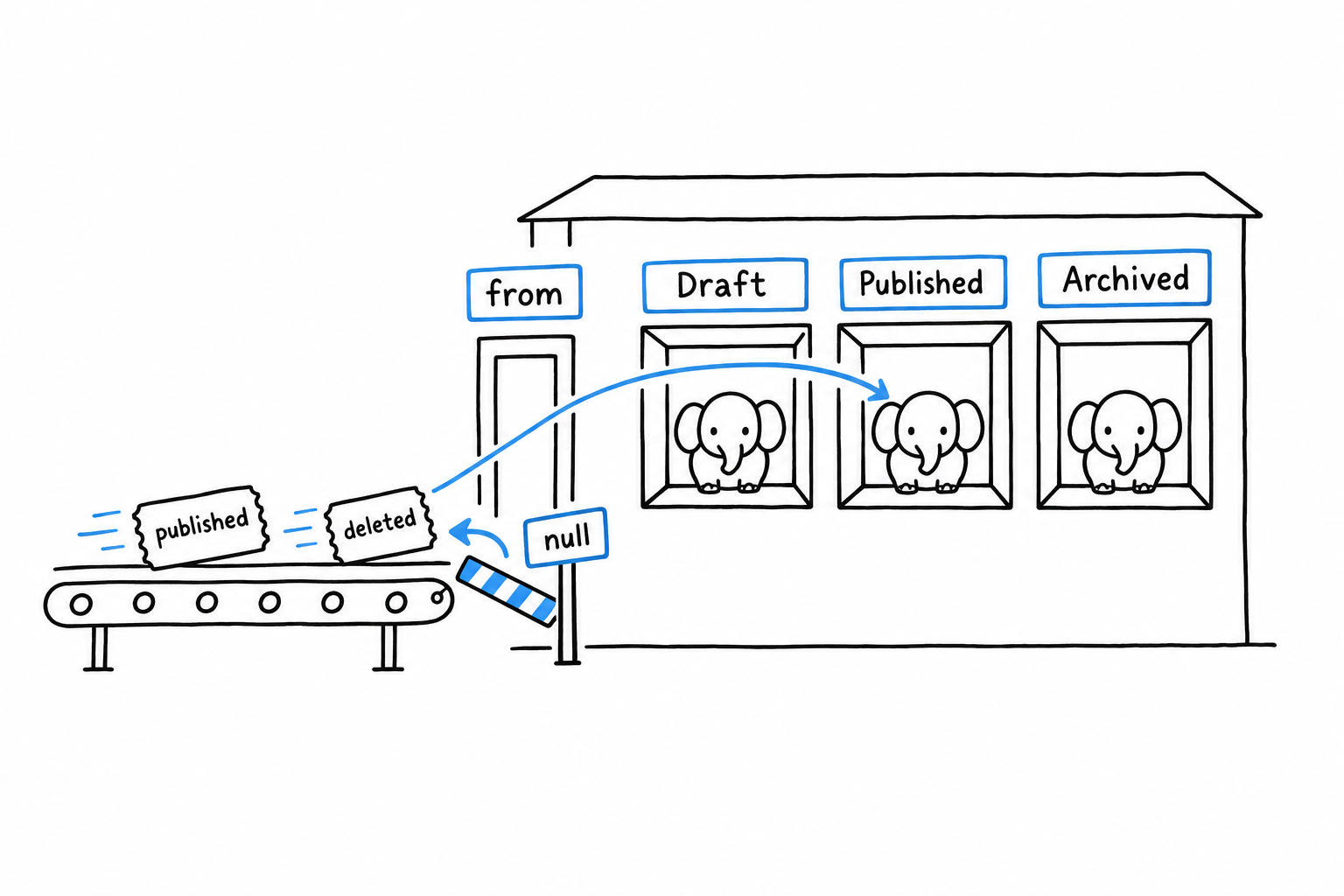
$status = Status::from('published');   // Status::Published
echo $status->label(), PHP_EOL;         // Live
echo $status->value, PHP_EOL;           // published
var_dump($status->canEdit());           // bool(true)
var_dump(Status::tryFrom('deleted'));   // NULL
Cases, values, and methods
An enum (PHP 8.1) declares its cases and nothing else can be one. Status::Draft is an object, the only object of its kind, so two references to the same case are the same object and === is the comparison to use. Enums cannot be instantiated with new, cannot be extended, and cannot hold state: no properties, no per-instance data. What they can have is methods, constants, static methods, and interfaces to implement.
The : string after the name makes this a backed enum: each case carries a scalar (string or int) reachable through ->value. from() turns a scalar back into a case and throws a ValueError when nothing matches; tryFrom() returns null instead. That pair is how an enum crosses a boundary: a database column, a JSON field, a query string. A pure enum, declared without a backing type, has cases and no ->value; use it when the choice never leaves your code.
cases() returns every case in declaration order, which is what a dropdown or a validation rule wants:
$allowed = array_map(fn (Status $s) => $s->value, Status::cases());
// ['draft', 'published', 'archived']
Every case also has ->name ('Draft'), useful for logging.
Because $this inside an enum method is a case, behaviour that depends on the case belongs on the enum, not in if chains scattered across the code. label() and canEdit() above are the pattern: the enum knows what each of its cases means.
Since PHP 8.2 enum cases are allowed in constant expressions, so they can be default parameter values, class constants, and attribute arguments: public function __construct(private Status $status = Status::Draft).
match
match (PHP 8.0) looks like switch and behaves like an expression in Rust or a when in Kotlin. The rules that follow are what set it apart.
It returns a value. $label = match ($status) { ... }; and return match (...) are the normal uses. There is no break, because there is no fallthrough: exactly one arm runs.
It compares with ===. match ('1') { 1 => 'int', '1' => 'string' } picks the second arm. switch would have picked the first.
It must be exhaustive. If no arm matches and there is no default, PHP throws UnhandledMatchError. Add a case to an enum, forget to update a match on it, and the first time that case reaches the match you get an exception naming the exact line, rather than a silent null.
One arm can list several values, separated by commas:
<?php
declare(strict_types=1);

enum Status: string
{
    case Draft = 'draft';
    case Published = 'published';
    case Archived = 'archived';
}

function isVisible(Status $status): bool
{
    return match ($status) {
        Status::Published => true,
        Status::Draft, Status::Archived => false,
    };
}
Static analysers understand this: PHPStan and Psalm both report a match over an enum that leaves a case unhandled, before it ever runs.
The subject of a match does not have to be an enum. Any value works, and the match (true) idiom turns it into a condition ladder that yields a value:
$size = match (true) {
    $bytes < 1024 => 'small',
    $bytes < 1024 * 1024 => 'medium',
    default => 'large',
};
Each arm is compared with === against true, so each arm is a boolean expression. It reads better than a nested ternary and cannot fall through.
switch still exists, with loose comparison, fallthrough, and break. You will meet it in older code. In new code, match is the right default, and switch is for the rare case where you actually want several labels to share a block of statements.
Nulls and throws as expressions
Two operators pair naturally with match and enums.
The nullsafe operator ?-> (PHP 8.0) short-circuits a chain when the left side is null: $order?->customer?->email is null if any link is null, instead of an error. Combined with ?? it gives a default in one line: $email = $order?->customer?->email ?? 'nobody@example.org';.
throw is an expression (PHP 8.0), so it can sit on the right of ??, in a ternary, or in a match arm:
$status = Status::tryFrom($input) ?? throw new \InvalidArgumentException("Unknown status: $input");

$handler = match ($status) {
    Status::Draft => $this->saveDraft(...),
    Status::Published => $this->publish(...),
    Status::Archived => throw new \LogicException('Archived items are read-only'),
};
The second example also shows the pattern for dispatching: a match that returns a callable, then $handler($item).
Persistence and behaviour in one place
Here is the full shape, the way it appears in an application: a backed enum for storage, methods for behaviour, match where the branches live.
<?php
declare(strict_types=1);

interface HasColor
{
    public function color(): string;
}

enum Priority: int implements HasColor
{
    case Low = 1;
    case Normal = 2;
    case High = 3;

    public const DEFAULT = self::Normal;

    public static function fromLabel(string $label): self
    {
        return match (strtolower($label)) {
            'low' => self::Low,
            'normal', 'medium' => self::Normal,
            'high', 'urgent' => self::High,
            default => throw new \ValueError("Unknown priority: $label"),
        };
    }

    public function color(): string
    {
        return match ($this) {
            self::Low => 'grey',
            self::Normal => 'blue',
            self::High => 'red',
        };
    }

    public function escalate(): self
    {
        return match ($this) {
            self::Low => self::Normal,
            self::Normal, self::High => self::High,
        };
    }
}

$p = Priority::fromLabel('medium');
echo $p->color(), PHP_EOL;              // blue
echo $p->escalate()->name, PHP_EOL;     // High
echo Priority::DEFAULT->value, PHP_EOL; // 2
The integer goes in the database. The enum goes everywhere else. There is no PRIORITY_HIGH = 3 constant to keep in sync with a lookup table of colours somewhere, because the case and its behaviour live in one file.
Compared to the older pattern, class constants plus string flags plus a switch, an enum gives you a real type to put in a signature (function assign(Priority $p)), which the engine checks, and a closed set the analyser can reason about.
The trap
Two habits from other languages, and from old PHP, cause the same bug.
Reaching for switch: it compares loosely, so switch (Status::Draft) with case 'draft': never matches (an enum is not equal to its value, under either comparison), and with a plain string subject a case 0: matches more than you expect.
Comparing an enum to its backing value: $status == 'published' is always false. The enum is an object; the string is what it stores. Compare cases to cases ($status === Status::Published), or convert first ($status->value === 'published').
The next question a polyglot asks is what happens when something goes wrong. Errors and Exceptions covers a model that has both.