A Web Request, Without a Framework
PHP can serve a web page with no library, no server code, and no configuration, because handling an HTTP request is what the language was built for. The request is already parsed when your script starts. The response is whatever you print. A framework adds structure on top of that; it does not add the capability.
Seeing the raw layer once makes every framework legible, because they all sit on exactly these primitives.
The front controller
Point PHP’s development server at a single file and every URL goes through it:
php -S localhost:8000 public/index.php
That file is the front controller. In production the web server does the same thing with a rewrite rule (or FrankenPHP and RoadRunner do it for you, as How PHP Runs describes). With the development server, one detail matters: if the script returns false, the server serves the requested file from disk instead, which is how static assets get through.
<?php
declare(strict_types=1);

$path = parse_url($_SERVER['REQUEST_URI'], PHP_URL_PATH);

if ($path !== '/' && is_file(__DIR__ . $path)) {
    return false; // let the built-in server send the CSS or image
}

echo 'Every other URL lands here: ', htmlspecialchars($path, ENT_QUOTES);
Reading the request
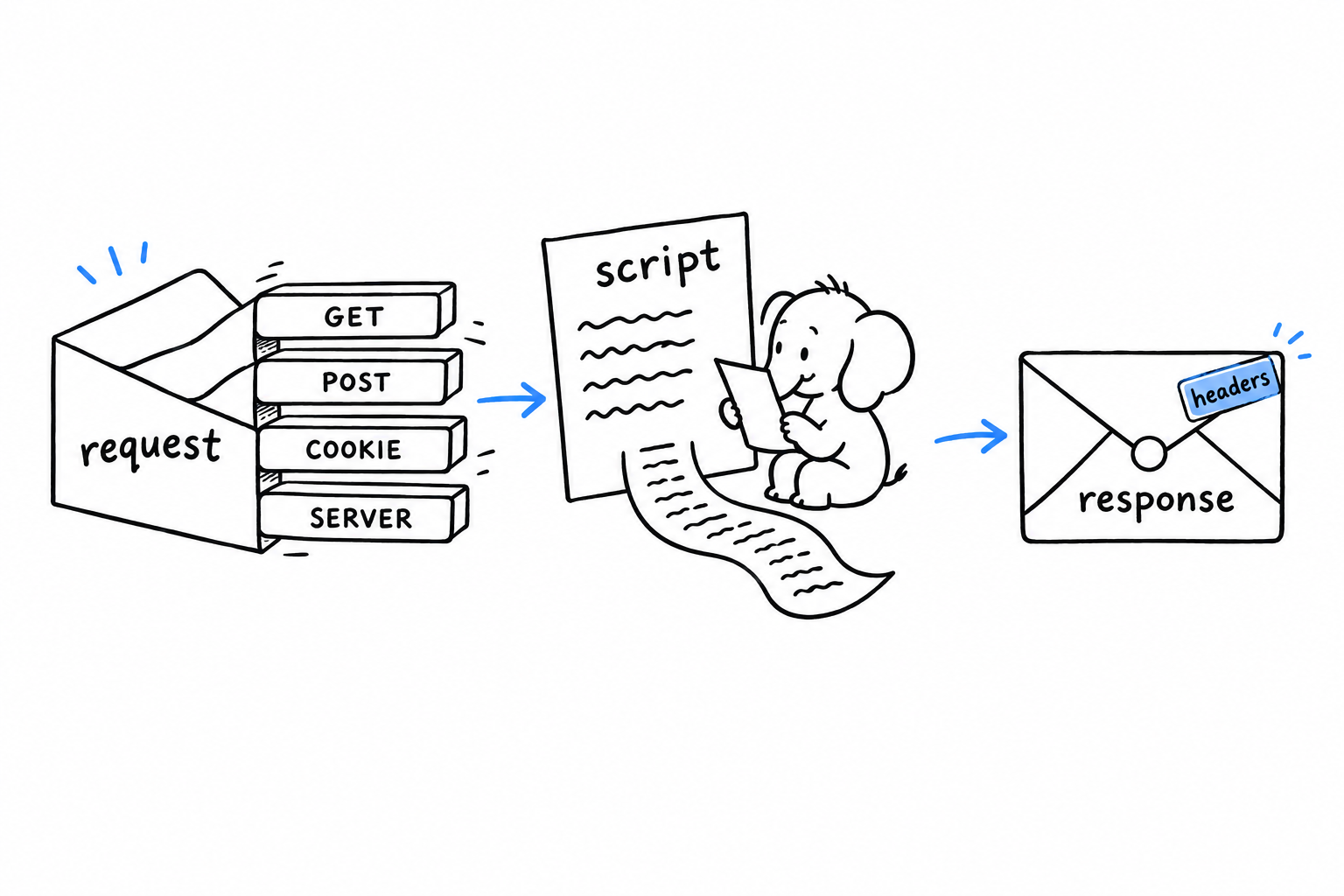
The request lives in superglobals, arrays that PHP fills before the first line of your code runs. $_GET holds the query string, $_POST the fields of a submitted form, $_COOKIE the cookies, $_FILES the uploads, and $_SERVER everything else: REQUEST_METHOD, REQUEST_URI, and each HTTP header as HTTP_ plus its upper-cased name, so Accept-Language becomes $_SERVER['HTTP_ACCEPT_LANGUAGE'].
<?php
declare(strict_types=1);

$method = $_SERVER['REQUEST_METHOD'];
$page = filter_input(INPUT_GET, 'page', FILTER_VALIDATE_INT) ?: 1;
$name = trim($_POST['name'] ?? '');
$lang = $_SERVER['HTTP_ACCEPT_LANGUAGE'] ?? 'en';

$body = json_decode(file_get_contents('php://input'), true, flags: JSON_THROW_ON_ERROR);
$_POST is only filled for application/x-www-form-urlencoded and multipart/form-data bodies on POST. A JSON body, whatever the method, is read raw from php://input. A form sent with PUT or PATCH is not parsed at all unless you ask: request_parse_body() (PHP 8.4) returns the fields and files for those methods too.
Nothing in these arrays is trustworthy. HTTP_HOST is whatever the client sent. REQUEST_URI can contain anything. A field you expected as a string arrives as an array if the client writes name[]=x. Treat every value as untyped user input, validate it with filter_var or your own checks, and only then let it near your logic.
Writing the response
Whatever your script outputs is the response body. echo, print, and any text outside <?php ?> tags go to the client. Status and headers are set with two functions, and they must be called before the first byte of output, because the headers travel first:
<?php
declare(strict_types=1);

http_response_code(201);
header('Content-Type: application/json; charset=utf-8');
header('Cache-Control: no-store');
setcookie('theme', 'dark', [
    'expires' => time() + 86400 * 30,
    'path' => '/',
    'secure' => true,
    'httponly' => true,
    'samesite' => 'Lax',
]);

echo json_encode(['created' => true], JSON_THROW_ON_ERROR);
Print something first, even a stray newline before <?php, and header() fails with “headers already sent”. Output buffering (ob_start() at the top, ob_end_flush() at the end) holds the body in memory until the script finishes and makes the order irrelevant, which is what frameworks do.
Templates are PHP
PHP started as a templating language, and it still is one. An HTML file with <?= $expr ?> in it is a template; include it and it prints. The one rule is on output: escape every value with htmlspecialchars before it lands in HTML, or the first user named <script> owns your page.
<?php
declare(strict_types=1);

function e(string $value): string
{
    return htmlspecialchars($value, ENT_QUOTES | ENT_SUBSTITUTE, 'UTF-8');
}

$todos = ['Write the chapter', 'Escape <everything>'];
?>
<ul>
<?php foreach ($todos as $todo): ?>
    <li><?= e($todo) ?></li>
<?php endforeach; ?>
</ul>
The foreach (...): ... endforeach; form exists for exactly this interleaving. A two-line e() helper is the whole escaping story for HTML; attributes, URLs and JavaScript contexts each need their own encoding, which is the part template engines automate.
A complete application
Here is a working application in one file: a list of notes, stored in SQLite, with a form to add one. It runs with php -S localhost:8000 index.php and nothing else.
<?php
declare(strict_types=1);

$db = new PDO('sqlite:' . __DIR__ . '/notes.db', options: [
    PDO::ATTR_ERRMODE => PDO::ERRMODE_EXCEPTION,
    PDO::ATTR_DEFAULT_FETCH_MODE => PDO::FETCH_ASSOC,
]);
$db->exec('CREATE TABLE IF NOT EXISTS notes (id INTEGER PRIMARY KEY, body TEXT NOT NULL)');

function e(string $value): string
{
    return htmlspecialchars($value, ENT_QUOTES | ENT_SUBSTITUTE, 'UTF-8');
}

$route = $_SERVER['REQUEST_METHOD'] . ' ' . parse_url($_SERVER['REQUEST_URI'], PHP_URL_PATH);

match ($route) {
    'GET /' => (function () use ($db): void {
        $notes = $db->query('SELECT id, body FROM notes ORDER BY id DESC')->fetchAll();
        echo '<h1>Notes</h1><form method="post" action="/notes">',
            '<input name="body" required> <button>Add</button></form><ul>';
        foreach ($notes as $note) {
            echo '<li>', e($note['body']), '</li>';
        }
        echo '</ul>';
    })(),
    'POST /notes' => (function () use ($db): void {
        $body = trim($_POST['body'] ?? '');
        if ($body === '') {
            http_response_code(422);
            echo 'A note needs a body.';
            return;
        }
        $stmt = $db->prepare('INSERT INTO notes (body) VALUES (:body)');
        $stmt->execute(['body' => $body]);
        http_response_code(303);
        header('Location: /');
    })(),
    default => (function (): void {
        http_response_code(404);
        echo 'Not found';
    })(),
};
Three things to take from it. The router is a match on method and path, which scales to about ten routes before you want a real one. PDO is the database API, one interface for SQLite, MySQL, PostgreSQL and others, and ERRMODE_EXCEPTION turns every failure into a thrown PDOException instead of a false you forget to check. The query uses a named placeholder and execute() binds the value; the SQL text and the data never meet as a string, so there is no injection to worry about. PHP 8.4 adds driver-specific subclasses (Pdo\Sqlite, Pdo\Mysql, Pdo\Pgsql) through Pdo::connect(), exposing each driver’s extras with proper types.
Building the SQL with interpolation, "WHERE id = $id", is the one habit from old PHP tutorials that the language still lets you keep. Do not.
Sessions and passwords
A session is server-side storage keyed by a cookie. Call session_start() before any output, and $_SESSION becomes an array that survives across requests for that visitor. By default the data lives in files on the server; frameworks swap in a database or a cache store through session_set_save_handler(). Nothing but the session id travels in the cookie.
<?php
declare(strict_types=1);

session_start();

if ($_SERVER['REQUEST_METHOD'] === 'POST') {
    $ok = password_verify($_POST['password'] ?? '', $storedHash ?? '');
    if ($ok) {
        session_regenerate_id(true);
        $_SESSION['user_id'] = 42;
    }
}

$csrf = $_SESSION['csrf'] ??= bin2hex(random_bytes(32));
password_hash and password_verify from Strings, Numbers, Dates, and JSON are the entire password story. Regenerate the session id on login. Put a random token in the session, print it as a hidden field in every form, and compare on submit with hash_equals(): that is CSRF protection in four lines, and every framework does the same under a nicer name.
The standards layer
Superglobals and header() work, but they are global state, which makes code hard to test and impossible to compose. The PHP-FIG answered with interfaces:
- PSR-7 defines immutable
RequestInterfaceandResponseInterfaceobjects, so a request is a value you pass around and a response is a value you return. - PSR-15 defines middleware: a handler takes a request and returns a response, and middleware wraps handlers. Authentication, CORS, logging, rate limiting are each one class.
- PSR-17 defines the factories that create those objects, so a library never depends on a specific implementation.
- PSR-18 defines an HTTP client, the outgoing side of the same objects.
A library written against PSR-7 and PSR-15 runs in any framework that speaks them, which today is most of them. CakePHP, Laminas, Laravel, Symfony and Yii, and the micro-frameworks Mezzio and Slim, each add routing, dependency injection, templating and a database layer on top of these primitives; the primitives underneath are the ones you have just seen.
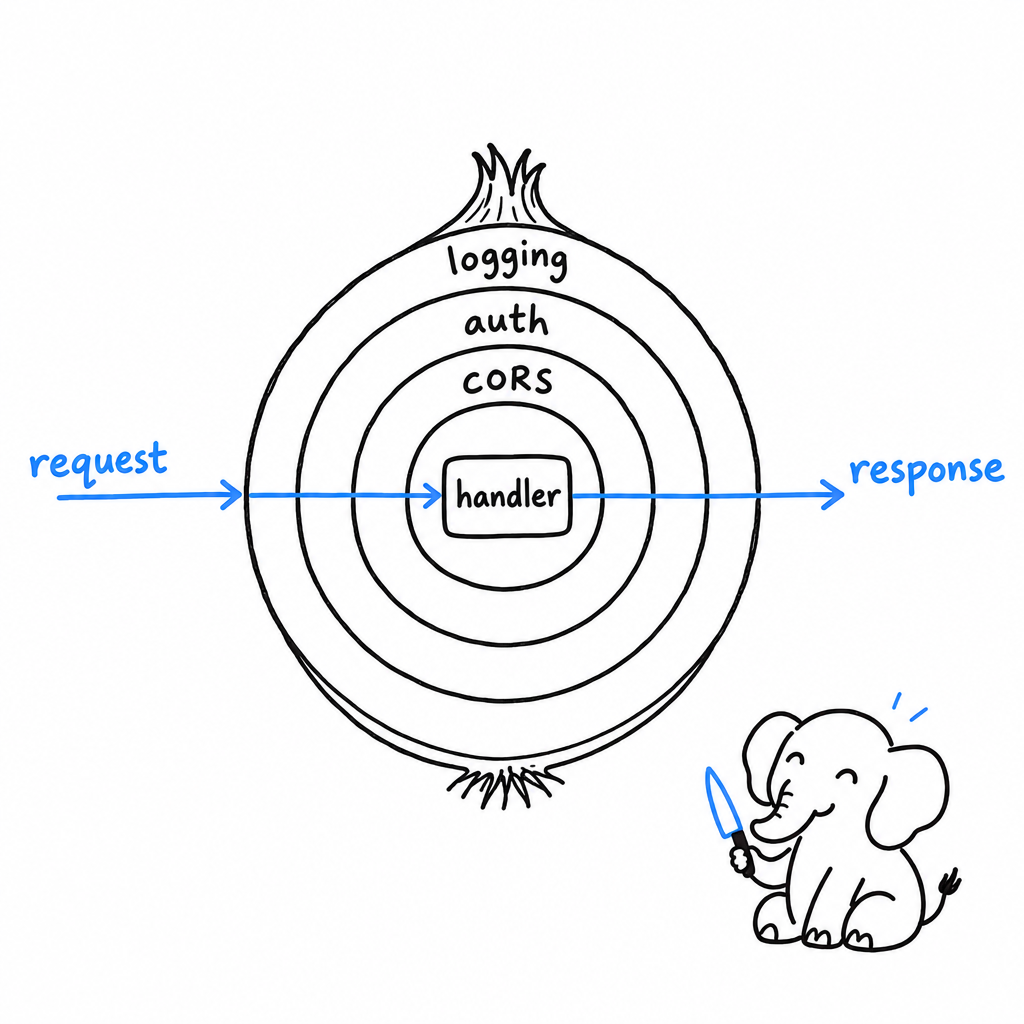
In production, the front controller stays the same. What changes is who calls it: PHP-FPM behind nginx, Apache or Caddy, or a long-running runtime such as FrankenPHP or RoadRunner. Nothing in this chapter needs to change for either.
The application above has no tests and no static analysis. Tests, Static Analysis, and Tooling fixes that.