Errors and Exceptions
PHP has exceptions, and they work the way Python’s or Java’s do. It also has an older mechanism, engine errors, that predates exceptions and still exists. Modern practice is to route everything through the first one. This chapter shows the exception model, then the three lines of configuration that make the old mechanism behave.
Two hierarchies, one root
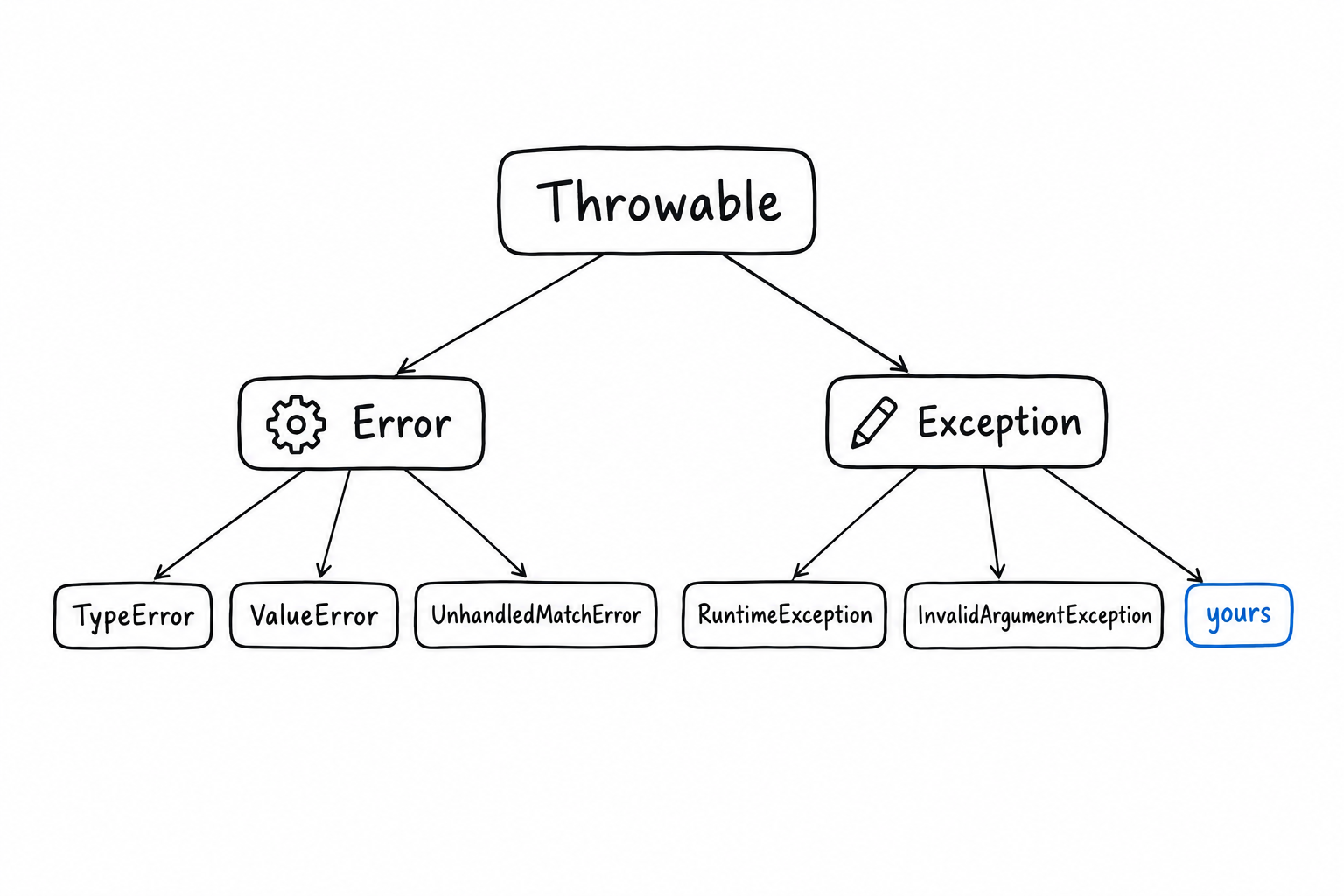
Everything you can throw and catch implements Throwable. Under it sit two families.
Error is what the engine throws when your code is wrong: TypeError for a bad argument, ValueError for a right type with an impossible value, ArgumentCountError, DivisionByZeroError, UnhandledMatchError when a match finds no arm. You do not throw these yourself, and you rarely catch them, because they mean a bug rather than a condition.
Exception is yours. PHP ships a small set in the SPL, and the names are the whole documentation: InvalidArgumentException, RuntimeException, LogicException, DomainException, OutOfRangeException, UnexpectedValueException. Extend one of these rather than Exception directly, and callers get a meaningful family to catch.
The syntax has no surprises:
<?php
declare(strict_types=1);

function parsePort(string $raw): int
{
    if (!ctype_digit($raw)) {
        throw new InvalidArgumentException("Not a port: $raw");
    }

    return (int) $raw;
}

try {
    $port = parsePort('80a');
} catch (InvalidArgumentException|ValueError $e) {
    echo 'Bad input: ', $e->getMessage(), PHP_EOL;
} finally {
    echo 'Done.', PHP_EOL;
}
| catches several types in one block (PHP 7.1). finally runs whether or not something was thrown. Catch Throwable when you truly mean everything, for instance at the top of a worker loop.
No checked exceptions, no error values
A PHP function signals failure by throwing or by returning null. Nothing forces the caller to handle either, and nothing in the signature lists what may be thrown. If you come from Java, there is no throws clause and no compile-time check; a @throws docblock is a courtesy read by your IDE and by PHPStan or Psalm, not by the engine. If you come from Go or Rust, there is no error return value and no Result type in the language. A handful of libraries offer one, but idiomatic PHP does not use them.
The nullable return type plus ?? is the idiom for “maybe”:
<?php
declare(strict_types=1);

function findUser(int $id): ?array
{
    return $id === 1 ? ['name' => 'Ada'] : null;
}

$name = findUser(2)['name'] ?? 'anonymous';
echo $name, PHP_EOL; // anonymous
The rule of thumb: return null when absence is normal, throw when it is not. And since throw is an expression (PHP 8.0), the two combine in one line:
$user = findUser($id) ?? throw new RuntimeException("No user $id");
Custom exceptions carry data
A custom exception is a class, so it can hold typed context and offer a named constructor that builds the message for you:
<?php
declare(strict_types=1);

final class InsufficientFunds extends DomainException
{
    public function __construct(
        public readonly int $requested,
        public readonly int $available,
        ?Throwable $previous = null,
    ) {
        parent::__construct(
            "Requested $requested, only $available available",
            previous: $previous,
        );
    }

    public static function forWithdrawal(int $requested, int $available): self
    {
        return new self($requested, $available);
    }
}

try {
    throw InsufficientFunds::forWithdrawal(100, 40);
} catch (InsufficientFunds $e) {
    echo $e->available, PHP_EOL; // 40
}
The previous argument is how you chain. Catch a low-level exception, wrap it in one that means something to your caller, and pass the original as previous. getPrevious() walks the chain back, and every logger prints it, so nothing is lost.
try {
    $pdo->query($sql);
} catch (PDOException $e) {
    throw new RuntimeException('Order lookup failed', previous: $e);
}
The other mechanism
Before exceptions existed, PHP reported problems by emitting an error of a given level (notice, warning, fatal) and, for anything short of fatal, carrying on. Most of that machinery has been folded into Error exceptions over the years: division by zero throws, a wrong argument type throws, calling a method on null throws. A few conditions still emit a warning and continue: reading an undefined variable, an undefined array key, an undefined property, and every deprecation notice.
<?php
declare(strict_types=1);

$config = [];
echo $config['debug']; // Warning: Undefined array key "debug"
echo 'still running', PHP_EOL;
That “still running” is what a polyglot does not expect. The fix is one handler, installed at bootstrap, that turns every engine error into an exception. Every framework does exactly this:
<?php
declare(strict_types=1);

error_reporting(E_ALL);

set_error_handler(function (int $severity, string $message, string $file, int $line): bool {
    throw new ErrorException($message, 0, $severity, $file, $line);
});

$config = [];
echo $config['debug']; // ErrorException: Undefined array key "debug"
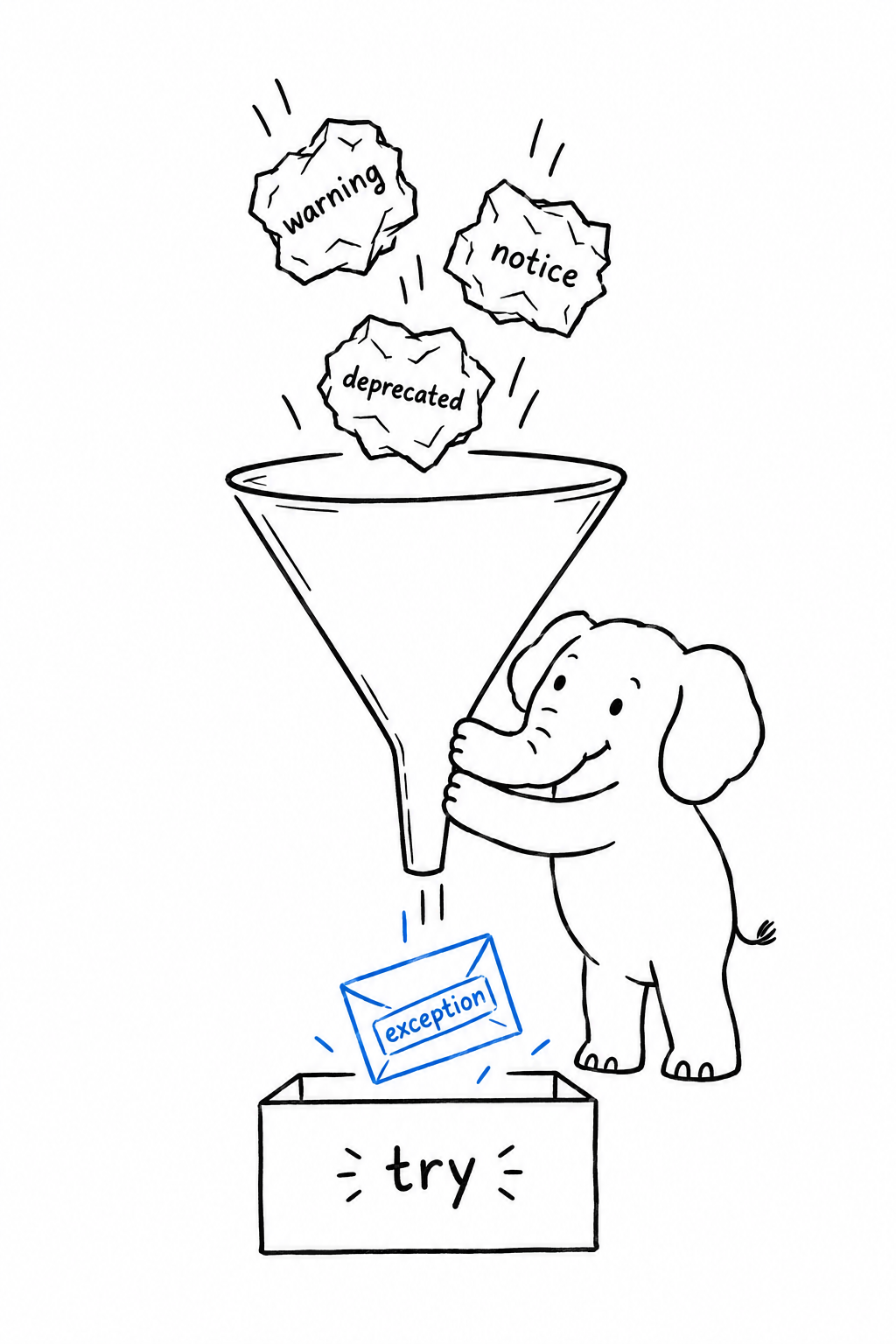
ErrorException is a built-in exception that remembers the severity. From that point on there is only one failure path, and try catches all of it.
Three settings complete the picture. error_reporting(E_ALL) makes sure nothing is filtered out. display_errors is On in development and Off in production, where errors go to the log instead: an uncaught exception on a public page must never print a stack trace. set_exception_handler() receives whatever reaches the top without being caught, which is where you log it and render a generic error page. PHP 8.5 adds get_error_handler() and get_exception_handler() so that libraries can inspect what is installed before wrapping it.
What cannot be caught
Fatal errors end the request: running out of memory, exceeding max_execution_time, declaring the same class twice. No catch sees them. (A parse error in an included file, on the other hand, is a ParseError you can catch since PHP 7.) If you must react, register_shutdown_function() runs after the script stops, and error_get_last() tells you whether the stop was clean. Since PHP 8.5, a fatal error prints a backtrace, so an out-of-memory in production finally points at a line.
Two operators to recognise
You will meet @ in older code: @file_get_contents($url). It silences any warning the expression emits. Your error handler is still called, but error_reporting() returns a reduced mask inside it, which is how a handler can tell that @ was used. Treat the operator as a smell. The one defensible use is around a function that warns and returns false on failure, immediately followed by a check on that return value. Even there, a try around an exception-throwing alternative reads better.
assert() is the other one. It is a development-time check, stripped from production when zend.assertions is set to -1 in php.ini, which is the recommended production value. Use it for invariants that document intent, never for input validation.
The trap
Two mistakes, both silent. The first is catching Exception in a top-level handler and believing you caught everything. A TypeError is an Error, not an Exception, and it walks straight past that block. Catch Throwable at the boundary.
The second is the empty catch:
try {
    $cache->delete($key);
} catch (Throwable) {
}
The variable can be omitted (PHP 8.0), which makes the block honest about ignoring the exception, and there are cases where ignoring is right. But an empty catch around anything that matters is how a bug hides for a year. Log it, at least.
Everything that goes wrong should reach you as one exception, in one place. PHP will do that, once you ask.
That handler, and every class you throw, live in files that PHP has to find. Namespaces, Composer, and Autoloading explains how it finds them.