🐘 And Now, PHP
A two-to-three-hour guide to modern PHP, for developers coming from another language.
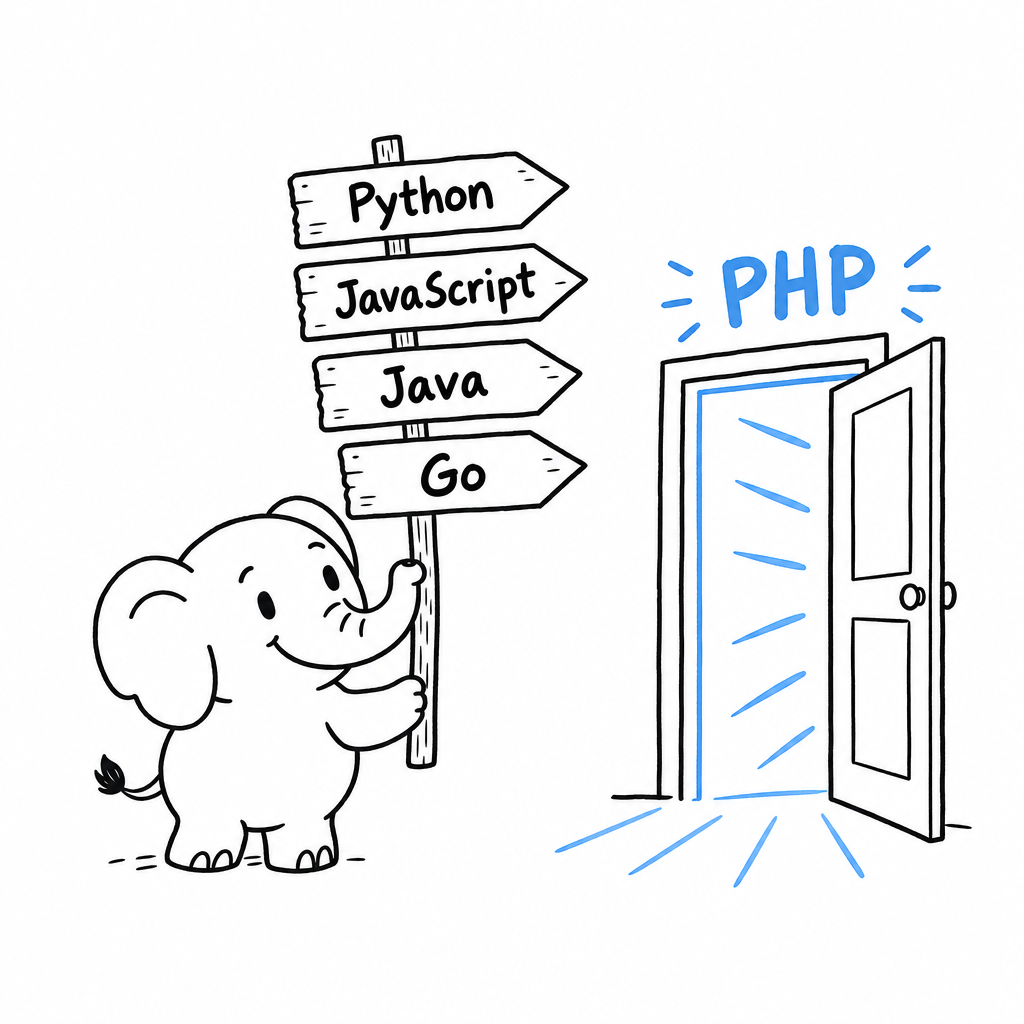
You know how to code. You have just been handed a PHP project, or you are coming back to PHP after years away. You do not need a tutorial. You need the delta: how PHP runs, how it types, how it packages code, where it will surprise you, and what today’s PHP looks like once the old reputation is set aside.
This book takes two to three hours to read. Each chapter answers one question, “how does PHP do this?”, and moves on.
The PHP described here is PHP 8.5. Features younger than PHP 8.2 carry their version number so you know what your project can use.
Introduction
You have been handed a PHP codebase. Maybe you asked for it, more likely you did not. You open the first file, you see $this-> and -> and :: and a function called htmlspecialchars, and a thought forms: is this going to be the language everyone warned me about?
The PHP people warned you about was real, and it is mostly gone. What is left is a typed, object-oriented, garbage-collected language with a package manager, a standard coding style, a serious static analysis ecosystem, a release every November, and a runtime model that is unlike anything you have used, which is the one thing you actually need to learn.
What was true
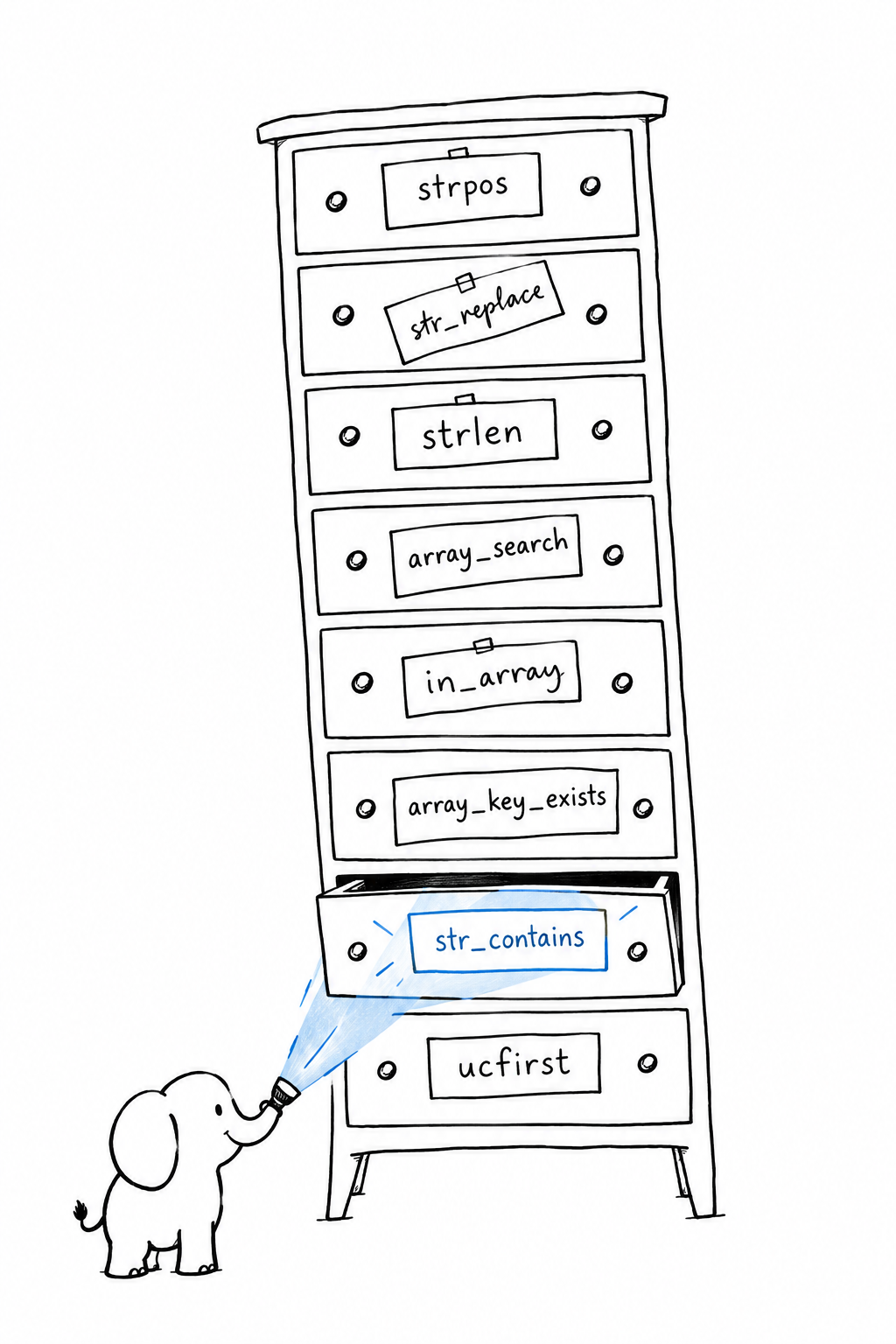
PHP started in 1995 as a set of templates with a bit of logic in them. For its first decade it was permissive to a fault. Variables appeared out of nowhere, "abc" == 0 was true, errors were printed to the page and execution continued, database queries were built by string concatenation, and the standard library was assembled one function at a time by whoever needed it that week, which is why strpos sits next to str_replace and array_key_exists sits next to in_array.
A whole generation learned to program on that PHP, wrote a great deal of it, and much of it still runs. That is the PHP of the jokes.
What changed
PHP 7 (2015) doubled performance and added scalar type declarations. PHP 8 (2020) added a real type system with union types, match, named arguments, attributes, enums, readonly, first-class callables and a JIT compiler. PHP 8.4 added property hooks and asymmetric visibility. PHP 8.5 added a pipe operator. The comparison rules were fixed, dynamic properties were deprecated, the old mysql_* functions were removed, and the interpreter now throws a TypeError where it used to guess.
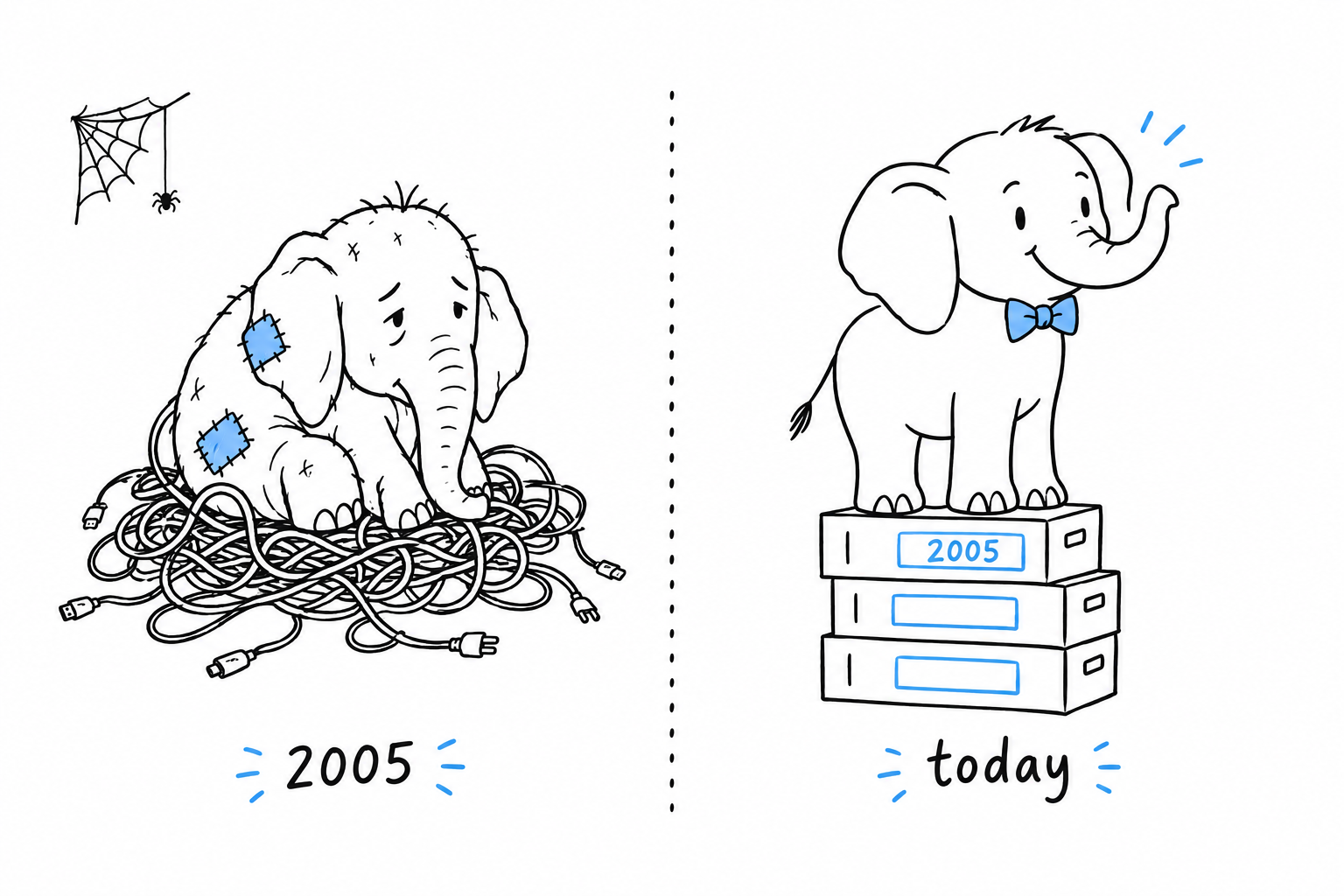
Around the language, the community built Composer, the package manager every project uses; the PHP-FIG standards, so that libraries from different authors fit together; PHPUnit and Pest for testing; PHPStan and Psalm, two static analysers that give you most of what a compiler would; and Rector, which rewrites old code to new syntax. Since 2021 the PHP Foundation has employed core developers so the language has a future that does not depend on volunteers’ evenings.
What still bites
Not everything was fixed, and a book for busy people should say so up front. Strings are byte sequences, so strlen('é') is 2 and you want the mb_ functions for text. The standard library still has its inconsistent names and argument orders. == still coerces, though far less wildly than before. Strict typing is a per-file switch you must turn on. Arrays copy when you assign them. There are no generics in the language itself. Each of these has a modern practice that neutralises it, and each is covered where you will meet it.
The reputation stayed in 2010. The language did not.
The one idea to get first
A PHP web request starts with nothing, runs your code top to bottom, sends its answer, and throws everything away. No shared memory between requests, no application object that stays alive, no event loop, no threads. The web server hands a request to PHP, PHP produces a response, PHP forgets.
If you come from Node, Java, Go or an ASGI Python server, this is the single largest difference, and most PHP idioms follow from it: why there is no connection pool by default, why “global state” is a per-request thing, why a crash affects one visitor, why scaling is a matter of adding processes, why OPcache exists, and why long-running PHP servers like FrankenPHP or RoadRunner are a topic in their own right. How PHP Runs covers it, and it is the one chapter not to skip.
How to read this book
Each chapter answers one question and stands on its own. The bold sentences carry the story: read only those and you get the delta between PHP and what you already know. Read the code blocks and you get the syntax. Read the rest when a detail matters to you.
The comparisons to Python, JavaScript, Java and a few other languages are anchors, not translations. Skip the ones for languages you do not know. Nothing depends on them.
Every example runs on a bare PHP install with php file.php. No framework, no library, so that the lesson is about PHP itself. Install PHP first: your package manager has it, php.net lists official builds, and the official Docker image is php:8.5-cli. Then keep a terminal open and run what you read.
Three chapters serve a particular reader. Returning to PHP After Years Away maps old habits to modern practice, for developers returning to the language. Coming from Python, JavaScript, or Java is a lookup table. PHP 8.0 to 8.5 at a Glance tells you what your project’s PHP version can do.
Two to three hours from now, the codebase you opened will look different. Not simpler, necessarily. Just legible.
How PHP Runs
PHP does not run your application. It runs your script, once, for one request, and then exits. There is no server object you instantiate, no listen() call, no event loop. Something outside PHP (a web server, or you at a terminal) starts the interpreter, the interpreter runs a file from top to bottom, and everything it allocated is freed when the file ends.
Every other chapter in this book is easier once this one has sunk in.
Two ways in
From a terminal, PHP behaves like Python or Ruby:
php hello.php
php -r 'echo PHP_VERSION, PHP_EOL;'
php -a          # interactive shell
php -l file.php # syntax check only
php -S localhost:8000   # development web server, current folder as document root
On the web, PHP is not the server. The web server receives the HTTP request and hands it to PHP, most often through PHP-FPM, a pool of PHP processes waiting behind nginx, Apache or Caddy. One process takes the request, runs the script the URL maps to, writes the response, cleans up, and goes back to waiting for the next one. The pool has as many processes as you configure, which is also how PHP uses all your cores: not with threads, with processes.
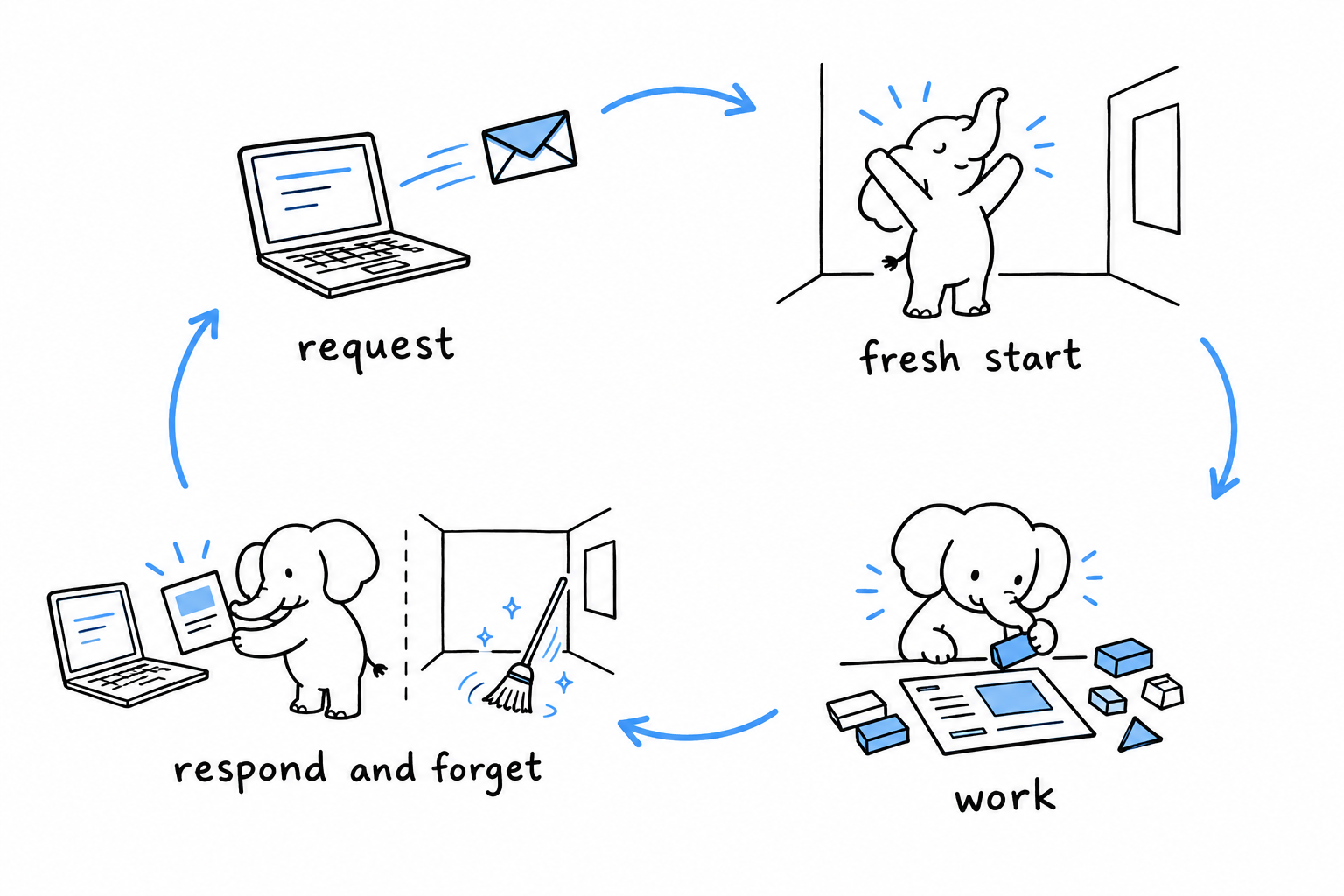
The layer that connects the interpreter to the outside world is called a SAPI (server API). The command line is a SAPI. FPM is a SAPI. Apache’s mod_php is a SAPI. The engine is the same; only the plumbing differs.
Shared nothing
This is the part that changes how you write code. Nothing survives from one request to the next inside PHP. A static property you set, a global you assign, a connection you open, an object you cache in an array: all of it exists for one request and is gone.
<?php
declare(strict_types=1);

final class Counter
{
    public static int $hits = 0;
}

Counter::$hits++;
echo Counter::$hits; // 1, on every single request, forever
Run that under a web server, refresh the page a hundred times, and it prints 1 a hundred times. In Node or Java the same code would count to 100. Neither is a bug. They are different models.
The consequences follow one from another:
- A bug affects one request. A memory leak, an infinite loop, an uncaught exception: the process handling that request dies or is recycled, and the next request gets a fresh one.
- Scaling is horizontal by construction. More traffic, more FPM processes, more machines. Nothing in the application needs to be thread-safe, because nothing is shared.
- State lives outside PHP. Sessions go to files, a database, or a key-value store. Caches go to OPcache and APCu (memory shared between the processes of one machine) or to an external store like Redis or Memcached. The database connection is opened at the start of a request and closed at the end; pooling, if you need it, happens in a pooler in front of the database, not in PHP.
- Startup cost is paid on every request. That is why PHP is fast at starting and why the ecosystem cares about autoloading, OPcache, and preloading.
If you find yourself designing a singleton to “keep the connection open between requests”, stop. There is no between.
The bytecode cache
Reading and compiling every file on every request would be slow, so PHP does not. OPcache keeps the compiled form of each file in shared memory, and the next request reuses it. It ships with PHP and is on by default in every serious setup.
In development, OPcache checks file timestamps and recompiles what changed, so the edit-refresh loop just works, with no build step and no watcher. In production, timestamp checks are usually disabled for speed, which means a deployment must reset the cache: restart FPM, or call opcache_reset(). Forgetting this is the classic “I deployed and nothing changed” moment.
OPcache also hosts the JIT compiler (PHP 8.0). It helps CPU-bound scripts, mostly, and is not what makes a typical web application fast. Treat it as a flag to try, not as a foundation.
Long-running PHP
The shared-nothing model is the default, not a law. Several runtimes keep your application in memory across requests, the way a Node or Java server does: FrankenPHP in worker mode, RoadRunner, and Swoole or OpenSwoole. Your bootstrap runs once, then a loop hands you requests.
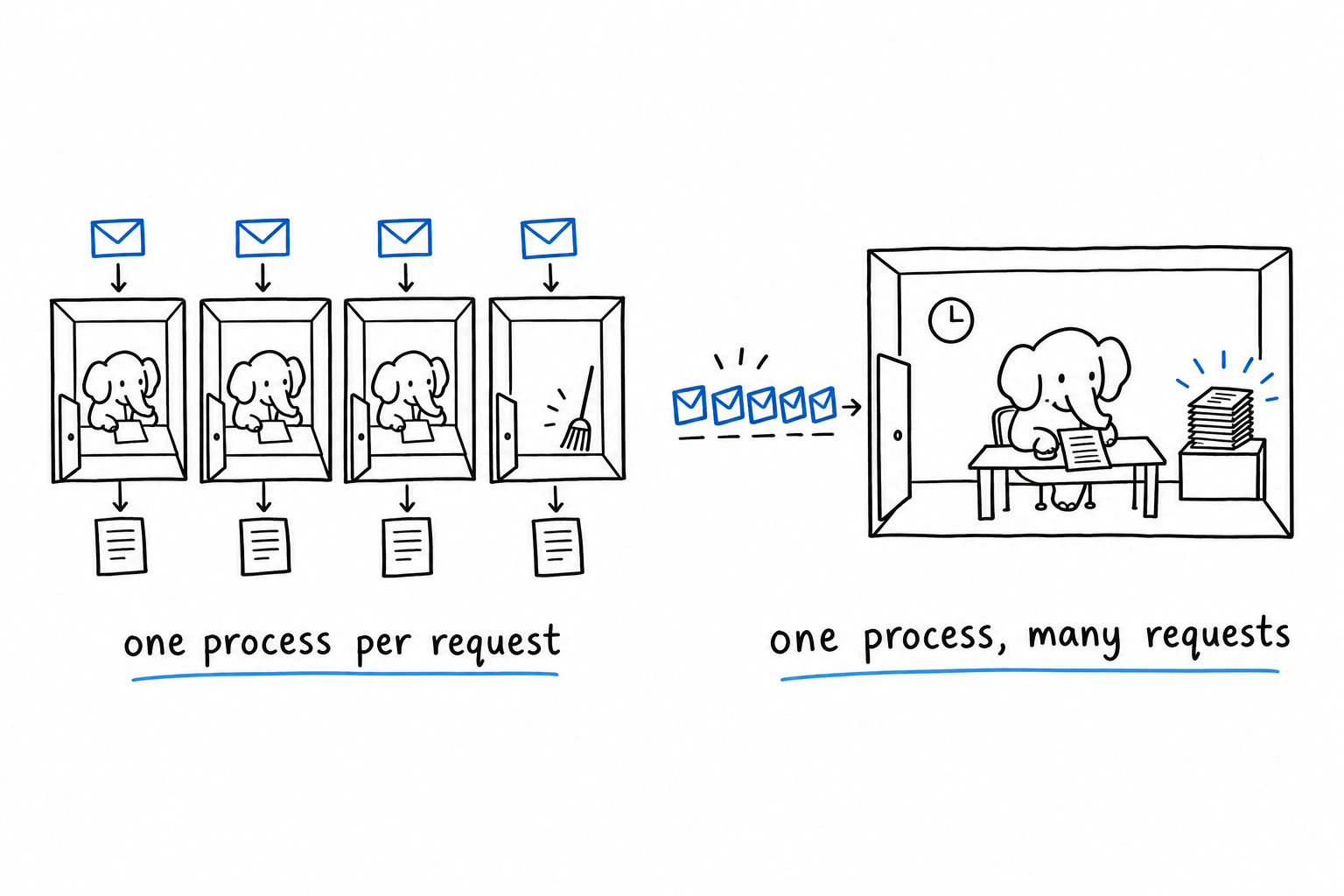
The gain is real: no bootstrap cost per request, and connections can actually be kept open. The cost is the one you already know from other languages: state now leaks unless you clean it, a memory leak grows, and a static counter really does count. Frameworks that support these runtimes reset their containers between requests for exactly this reason. Start with FPM. Move to a worker runtime when you have measured a reason to.
What is in the box
The interpreter is a C core plus extensions, some bundled and always on, some compiled in at build time, some installed separately. php -m lists what your build has. The ones you will notice missing on a fresh install are usually pdo_mysql or pdo_pgsql (database drivers), intl (Unicode collation, formatting), mbstring (multibyte strings), curl, gd or imagick (images), and xdebug (debugger, development only).
Your package manager provides them as separate packages (php-intl, php-mbstring, and so on). The official Docker image provides docker-php-ext-install. Extensions not shipped with PHP come from PECL, or from PIE, the newer Composer-style installer for extensions.
Configuration lives in php.ini. The command line and FPM read different ini files, which is why a script behaves one way in a terminal and another under the web server. php --ini shows which files the CLI loads; phpinfo() in a page shows what FPM loads. Two settings matter from day one: memory_limit (128 MB by default under FPM, unlimited in the CLI) and max_execution_time (30 seconds under FPM, unlimited in the CLI).
The trap
Coming from a long-running runtime, the first mistake is to expect memory to persist: a cache in a static array, a “connection pool” class, a counter for rate limiting. Under FPM these silently do nothing useful. The second mistake is the mirror image: after moving to a worker runtime, a request-scoped value stored in a static ends up shared between users.
Ask one question about any piece of state: does it need to outlive this request? If yes, it does not belong in PHP memory. Put it in the database, a cache store, or the session.
With the model in place, the syntax is the easy part. Syntax is exactly that.
Syntax
PHP looks like C with a $ in front of every variable, -> for members, and . for string concatenation. If you read Java, JavaScript or C#, you already read PHP. The rest of this chapter is the list of places where your fingers will type the wrong thing.
One file, top to bottom
<?php
declare(strict_types=1);

$name = 'world';
$count = 3;

echo "Hello, {$name}!", PHP_EOL;
echo 'Hello, ' . $name . '! Count: ' . $count . PHP_EOL;
The file opens with <?php. Everything before that tag, even a blank line, is sent to the output as-is, because PHP began life as a template language. A file that contains only code opens with <?php and never closes the tag: a ?> at the end followed by a stray newline would leak that newline into your HTTP response.
declare(strict_types=1); comes next, on its own line. It turns off automatic conversion of scalar arguments in calls made from this file. Types explains exactly what it does and does not cover. For now: put it in every file, and think of a file without it as a file with a warning sign on it.
Variables start with $ and are never declared. Assign, and the variable exists. There is no let, no var, no type in front. Variable names are case-sensitive; function and class names are not, though nobody relies on that.
Statements end with a semicolon. echo takes a comma-separated list and prints it; print does the same with one argument and is rarely seen. PHP_EOL is the platform’s newline.
Strings
The concatenation operator is ., not +. Writing $a + $b with two strings makes PHP try to add them as numbers, which is a TypeError for non-numeric strings under PHP 8.
Single quotes give you the bytes you typed. Double quotes interpolate variables and translate escapes like \n. Wrap anything beyond a plain variable in braces:
<?php
declare(strict_types=1);

$user = ['name' => 'Ada'];
$items = 3;

echo "Hi {$user['name']}, you have {$items} items\n";
echo 'Hi {$user[name]}\n'; // printed literally, backslash included
For multi-line text, a heredoc interpolates and a nowdoc does not. The closing marker may be indented (since PHP 7.3), and that indentation is removed from every line:
<?php
declare(strict_types=1);

$title = 'Report';

$html = <<<HTML
    <h1>{$title}</h1>
    <p>Generated by PHP</p>
    HTML;

$raw = <<<'TXT'
    No {$interpolation} in here.
    TXT;

echo $html, PHP_EOL, $raw, PHP_EOL;
Three arrows
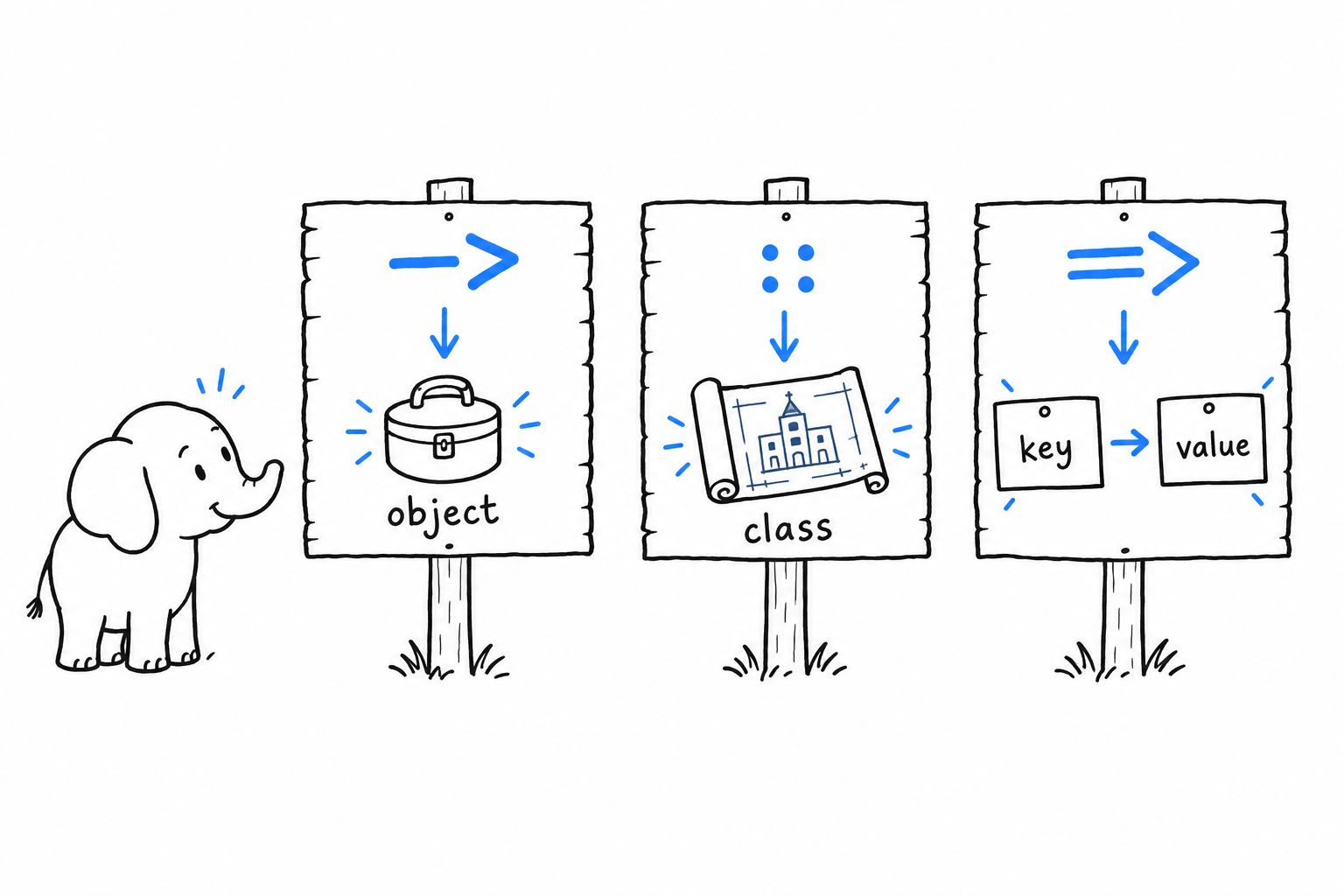
PHP has three arrow-shaped tokens, and they never overlap.
-> reaches into an instance: $user->name, $user->save(). :: reaches into a class: User::create(), User::MAX_AGE, self::$count. => pairs a key with a value inside an array literal or a match arm: ['id' => 1].
<?php
declare(strict_types=1);

final class Money
{
    public const string CURRENCY = 'EUR'; // typed constant, PHP 8.3

    public function __construct(public readonly int $cents)
    {
    }

    public static function zero(): self
    {
        return new self(0);
    }
}

$price = new Money(1999);
echo $price->cents, ' ', Money::CURRENCY, ' ', Money::zero()->cents, PHP_EOL;
// 1999 EUR 0
Inside a method, the current instance is $this. Classes and objects get their own chapter, Classes; this example only shows which arrow goes where.
Equality
Use ===. Treat == as a legacy operator. The double equals converts both sides to a common type before comparing, which produced the famous absurdities of old PHP. Since PHP 8 a number compared to a non-numeric string is compared as strings, so 0 == 'foo' is false and '1' == '01' is still true. Saner, but still a guessing game. Triple equals compares value and type, with no guessing.
The same rule applies to !== versus !=, and to in_array() and array_search(), which take a third true argument to compare strictly.
<=> is the spaceship: it returns -1, 0 or 1, and exists for sort callbacks.
Null, in three operators
<?php
declare(strict_types=1);

$config = ['debug' => null, 'owner' => null];

$debug = $config['debug'] ?? false;      // false: ?? treats null like missing
$config['level'] ??= 'info';             // assign only if null or missing
$length = $config['owner']?->name;       // null, no error: nullsafe chain
$mode = $config['debug'] ? 'on' : 'off'; // plain ternary, same as everywhere

var_dump($debug, $config['level'], $length, $mode);
?? is null coalescing and also swallows “undefined key” and “undefined variable”, which makes it the idiomatic way to read an optional array entry. ??= assigns only when the left side is null or missing. ?-> (PHP 8.0) stops a chain at the first null and yields null. The shorthand ternary ?: exists too ($a ?: $b returns $a if truthy), and is fine with booleans, misleading with anything else.
Control flow, all at once
<?php
declare(strict_types=1);

$scores = ['ada' => 92, 'linus' => 71, 'grace' => 85];

foreach ($scores as $who => $score) {
    if ($score >= 90) {
        $grade = 'A';
    } elseif ($score >= 80) {
        $grade = 'B';
    } else {
        $grade = 'C';
    }
    echo "{$who}: {$grade}", PHP_EOL;
}

for ($i = 0; $i < 3; $i++) {
    echo $i;
}
echo PHP_EOL;

$attempts = 0;
while ($attempts < 3) {
    $attempts++;
}

$label = match (true) {
    $attempts === 0 => 'never tried',
    $attempts < 3 => 'a few tries',
    default => 'gave it everything',
};
echo $label, PHP_EOL;
Nothing here needs explaining except two details. foreach is the loop for arrays and any iterable, and it gives you the key and the value together with as $key => $value. match is an expression, compares with ===, has no fall-through, and throws if nothing matches; switch still exists, compares with ==, falls through, and is what you find in older code. Enums and match shows what match is for.
Everything else on one screen
<?php
declare(strict_types=1);

namespace App\Billing;         // one per file, mirrors the folder

use App\Money;                 // import a class from another namespace
use function App\format_cents; // functions and constants can be imported too

const TAX_RATE = 0.2;          // compile-time constant, namespaced
define('LEGACY', true);        // runtime constant, global, older style

// one-line comment
# also a one-line comment, rarer
/* block
   comment */

/**
 * Docblock: read by editors, PHPStan and Psalm, not by PHP itself.
 */
function total(int ...$cents): int
{
    return array_sum($cents);
}

$parts = [100, 250];
echo total(...$parts), PHP_EOL; // 350: ... unpacks on both sides
... unpacks an array into arguments and, in a parameter list, collects the rest into an array. Named arguments (total(cents: 5)) have existed since 8.0. null is a value, lowercase by convention, with true and false. Namespaces and use do exactly what you expect from Java packages or ES imports; Namespaces, Composer, and Autoloading covers how files get found.
Side by side
| Python | JavaScript | Java | PHP | |
|---|---|---|---|---|
| Concatenate | a + b | a + b | a + b | $a . $b |
| Strict equality | a == b | a === b | a.equals(b) | $a === $b |
| Null coalescing | a or b | a ?? b | (none) | $a ?? $b |
| Null-safe member | (none) | a?.b | (none) | $a?->b |
| Lambda | lambda x: x * 2 | x => x * 2 | x -> x * 2 | fn($x) => $x * 2 |
| Map literal | {'k': 1} | {k: 1} | Map.of("k", 1) | ['k' => 1] |
| Interpolation | f"{x}" | `${x}` | (none) | "{$x}" |
| Instance member | obj.name | obj.name | obj.name | $obj->name |
| Static member | Cls.name | Cls.name | Cls.name | Cls::$name |
| Ternary | a if c else b | c ? a : b | c ? a : b | $c ? $a : $b |
The trap
Two things trip every newcomer in the first hour. The first is ==: a comparison that looks right, passes the obvious tests, and then decides that '1e1' == '10' and null == false. Type === until it is a reflex, and let strict_types catch the rest.
The second is the standard library. strpos($haystack, $needle) but array_search($needle, $haystack). str_replace with underscores, strlen without. array_key_exists next to in_array. The naming was never designed; it accumulated. Newer functions are consistent (str_contains, array_is_list, array_find), the old ones will not change, and the fix is not memory but an editor with completion and a static analyser that flags the wrong argument order.
With the syntax out of the way, the interesting questions start. What does int actually enforce? Types answers that with more nuance than you might like.
Types
PHP is dynamically typed, and every type you write down is checked at runtime. Not at compile time like Java, not erased like TypeScript. A parameter declared int receives an int or the call throws a TypeError, every time, in production. That is the whole model; the nuance is in what “receives an int” means, and that nuance is a switch.
The types you can write
<?php
declare(strict_types=1);

function describe(int|float $n, ?string $label, bool $verbose = false): string
{
    return ($label ?? 'value') . ': ' . $n . ($verbose ? ' (verbose)' : '');
}

echo describe(3, null), PHP_EOL;          // value: 3
echo describe(2.5, 'pi-ish', true), PHP_EOL; // pi-ish: 2.5 (verbose)
Scalars are int, float, string, bool. Compound types are array, object, callable, iterable, and any class or interface name. On top of those, PHP has a handful of types that only make sense in one position: void and never as return types (never means the function throws or exits), static as the return type of a fluent method, self for the current class, mixed when you really accept anything, and null, true, false as standalone types since PHP 8.2.
They combine. ?string is string|null. int|string is a union (PHP 8.0). Countable&Traversable is an intersection (PHP 8.1): the object must implement both. (Countable&Traversable)|null mixes the two (PHP 8.2), and that is as far as the grammar goes. No generics, no tuples, no structural types.
Types go on parameters, return values, properties, and since PHP 8.3 on class constants:
<?php
declare(strict_types=1);

final class Temperature
{
    public const string UNIT = 'C';

    public function __construct(
        public readonly float $degrees,
    ) {
    }
}

$t = new Temperature(21.5);
var_dump($t->degrees); // float(21.5)
Untyped parameters and properties still exist and mean mixed. Modern code does not leave them out.
What int really accepts
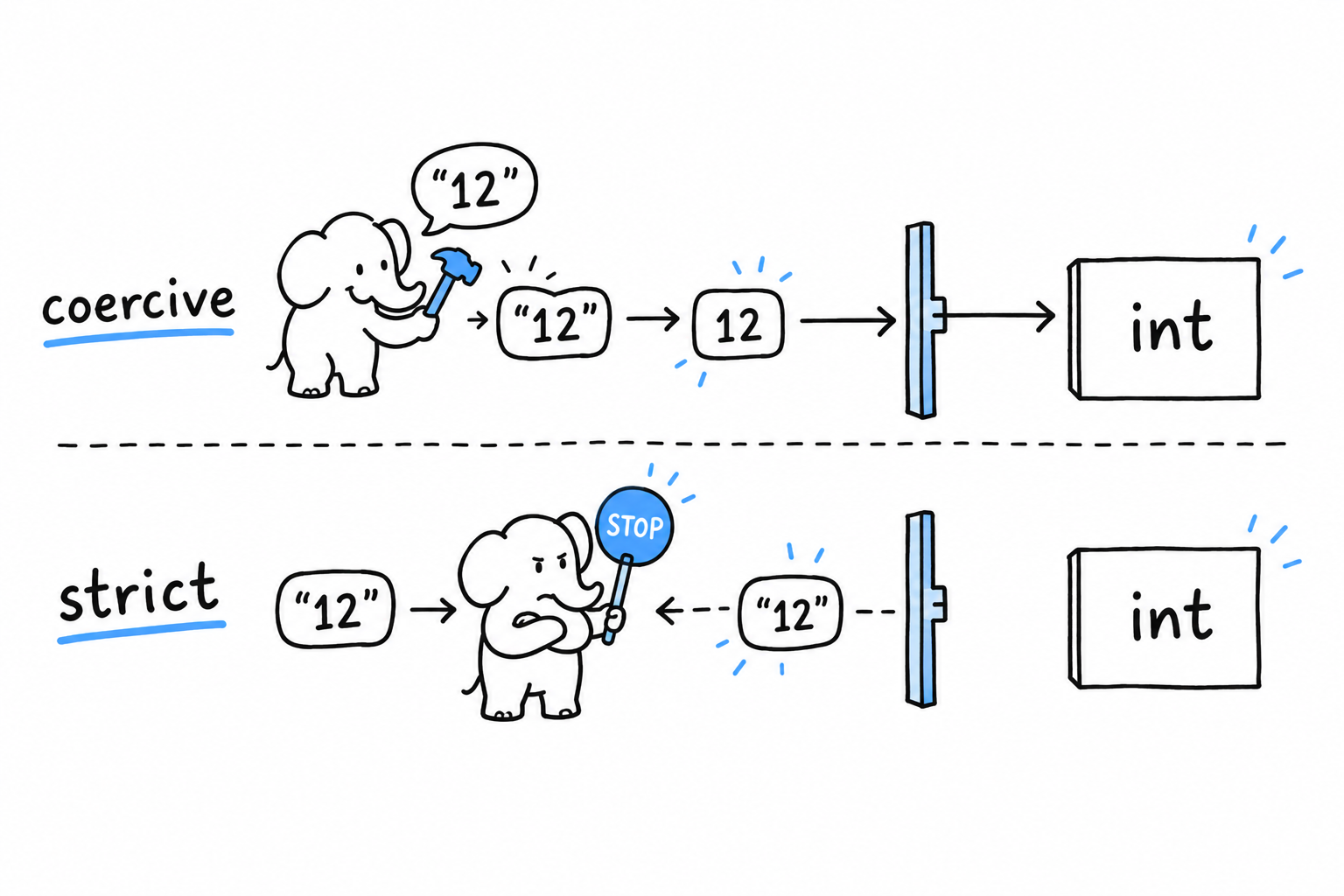
Here is where PHP differs from everything else. Without strict_types, PHP coerces scalar arguments to the declared type when it can. Pass the string "12" to an int parameter and the function receives the integer 12. Pass "12abc" and you get a TypeError. Pass 1.5 and you get 1 with a deprecation notice.
| You pass | int parameter, coercive mode | int parameter, strict mode |
|---|---|---|
12 | 12 | 12 |
"12" | 12 | TypeError |
"12abc" | TypeError | TypeError |
12.0 | 12 | TypeError |
1.5 | 1, deprecated since 8.1 | TypeError |
true | 1 | TypeError |
null | TypeError (?int accepts it) | TypeError (?int accepts it) |
Coercion only concerns scalars. An array is never turned into a string, an object never into an int. And one conversion is always allowed, even in strict mode: an int where a float is expected, because that never loses information.
The switch is per file, and per caller
<?php
declare(strict_types=1);

function double(int $n): int
{
    return $n * 2;
}

echo double(21), PHP_EOL;    // 42
echo double('21'), PHP_EOL;  // TypeError: must be of type int, string given
Delete the declare line and the second call prints 42. The way the switch works surprises almost everyone on at least one point:
It is per file. There is no global setting, no php.ini flag, no project-wide option. Each file states its own mode, and a file without the line is in coercive mode.
It applies to calls made from the file, not to functions defined in it. If double() lives in a strict file and is called from a coercive file, double('21') coerces. The caller decides. This is deliberate: a library author cannot force strictness on code that calls it, and legacy code keeps working when it calls a modern library.
It covers return values too. A strict-mode function that declares : int and returns "42" throws.
The practical rule is short. Put declare(strict_types=1); at the top of every file you write, let your code-style tool enforce it, and stop thinking about it.
strict_typesis not “PHP with types on”. PHP always checks types. The switch decides whether a string that looks like a number counts as a number.
Converting on purpose
When you want a conversion, say so:
<?php
declare(strict_types=1);

var_dump((int) '42');        // int(42)
var_dump((int) '42 apples'); // int(42): a cast takes the leading digits
var_dump((int) 'apples');    // int(0)
var_dump((string) 3.0);      // string(1) "3"
var_dump((bool) '0');        // bool(false): "0" is falsy, "0.0" is not
var_dump(intval('0x1A', 16)); // int(26)
Casts never throw and never warn; they do their best with what they get. That makes them the right tool for user input you have already validated, and the wrong tool for anything you have not. To check before converting, is_int(), is_string(), is_numeric() and their siblings return booleans, and filter_var($x, FILTER_VALIDATE_INT) returns the integer or false.
To see what you are holding, var_dump() prints the type and value. get_debug_type() (PHP 8.0) returns the name you would write in a declaration (int, string, App\User), where the older gettype() returns integer and object.
Null and the standard library
Your own functions reject null for a non-nullable parameter in both modes. Built-in functions are more forgiving, and that forgiveness is on its way out. strlen(null) returns 0 today with a deprecation notice (since PHP 8.1), and the next major version is expected to throw. Code that reads strlen($_GET['q']) on a missing parameter is living on borrowed time; strlen($_GET['q'] ?? '') is not.
The same tolerance shows up in the other direction. Where a function used to return false on failure, newer ones throw a ValueError (PHP 8.0), and the ones that still return false are documented that way. When the documentation says string|false, check for false with ===, never with if (!$result), because "0" and "" are falsy too.
Numbers, briefly
An int is 64 bits on every platform you will meet. Overflow does not wrap; an integer that overflows becomes a float, silently:
<?php
declare(strict_types=1);

var_dump(PHP_INT_MAX + 1); // float(9.223372036854776E+18)
var_dump(0.1 + 0.2 === 0.3); // bool(false), as in every IEEE 754 language
var_dump(intdiv(7, 2), 7 / 2); // int(3), float(3.5)
Division always produces a float unless both operands are integers and the result is exact. intdiv() gives integer division; % is the integer modulo; fmod() the float one. For money or anything decimal, the bcmath extension and its BcMath\Number class (PHP 8.4) do arbitrary-precision arithmetic.
Where the generics went
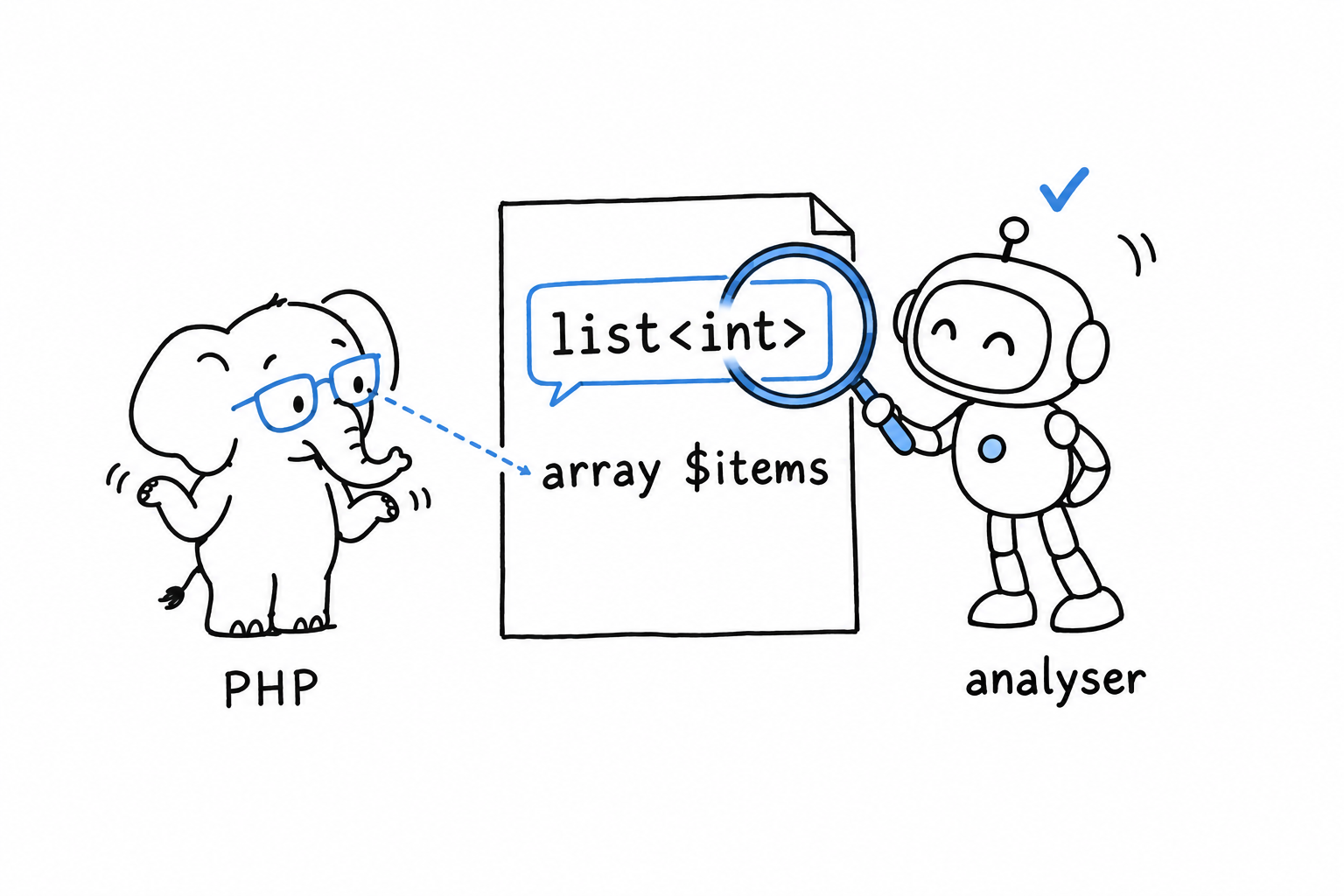
There are none in the language. array is the type of every array, whatever it contains, and a Collection class cannot say what it collects. The ecosystem answered with docblocks read by static analysers, and on a maintained project that answer is as binding as a compiler:
<?php
declare(strict_types=1);

/**
 * @template T
 * @param list<T> $items
 * @param callable(T): bool $keep
 * @return list<T>
 */
function keep(array $items, callable $keep): array
{
    return array_values(array_filter($items, $keep));
}

/** @var list<int> $evens */
$evens = keep([1, 2, 3, 4], fn (int $n) => $n % 2 === 0);
PHP reads array and callable. PHPStan and Psalm read list<T> and callable(T): bool, infer that $evens holds integers, and fail the build if you pass strings. list<int>, array<string, User>, non-empty-string, int<1, max>: the vocabulary is richer than the language, and the two tools agree on most of it. Tests, Static Analysis, and Tooling shows how to set one up.
The trap
The first mistake is to write function f(int $n) in a file without strict_types, pass "12" in a test, watch it work, and conclude that PHP checks nothing. It checked; it also converted. The second is the reverse: adding declare(strict_types=1) to one file and expecting the whole application to become strict. Only the calls in that file changed.
Both have the same cure. The line goes in every file, a code-style rule enforces it, and a static analyser catches at build time the cases the runtime would catch in production.
Arrays were mentioned three times in this chapter without a word about what they are. That is because they are not what your language calls an array. Arrays sets that straight.
Arrays
A PHP array is an ordered hash map, and it is the only built-in collection. It plays the role of Python’s list and dict at once, of a JavaScript array and object at once, of Java’s ArrayList and LinkedHashMap at once. Keys are integers or strings, values are anything, and insertion order is always preserved.
<?php
declare(strict_types=1);

$list = ['apple', 'pear'];                  // keys 0, 1
$map  = ['name' => 'Ada', 'born' => 1815];  // string keys
$mixed = [5 => 'five', 'six', 'x' => 'ex']; // keys 5, 6, 'x'

$list[] = 'plum';          // append, key 2
$map['died'] = 1852;       // insert, at the end

var_dump(array_is_list($list)); // true
var_dump(array_is_list($map));  // false
There is no separate list type. A “list” is an array whose keys happen to be 0, 1, 2 and so on, in that order, and array_is_list() (PHP 8.1) tells you whether that holds. The distinction matters when the array leaves PHP: json_encode() emits [...] for a list and {...} for anything else.
Keys are normalised
A key is either an int or a string, and PHP converts everything else on the way in. A numeric string becomes the integer it names, a float loses its decimals, a boolean becomes 0 or 1, and null becomes the empty string:
<?php
declare(strict_types=1);

$a = [];
$a['1'] = 'a';   // key 1, not '1'
$a[1.7] = 'b';   // key 1, overwrites (and a deprecation notice since 8.1)
$a[true] = 'c';  // key 1, overwrites again
$a[null] = 'd';  // key ''

var_dump($a); // [1 => 'c', '' => 'd']
Three writes, one key. The rule is convenient when a database returns ids as strings, and a trap when you expected '1' and 1 to be two entries. They never are.
Reading a key that is not there
Reading a missing key emits a warning and yields null. Two functions tell you whether a key exists, and they disagree about null:
<?php
declare(strict_types=1);

$user = ['name' => 'Ada', 'email' => null];

var_dump(isset($user['email']));            // false: the value is null
var_dump(array_key_exists('email', $user)); // true: the key is there
var_dump(isset($user['phone']));            // false, no warning

$phone = $user['phone'] ?? 'unknown';       // no warning, default applied
isset() answers “is there a non-null value here?”, array_key_exists() answers “is the key present?”. For almost everything, ?? is what you want: it reads the key if it exists and is not null, and falls back otherwise, silently.
Arrays are values
This is the one to remember. Assigning an array copies it. Passing an array to a function copies it. Returning one copies it. The original never sees what happens to the copy.
<?php
declare(strict_types=1);

function addItem(array $cart, string $item): array
{
    $cart[] = $item;
    return $cart;
}

$cart = ['book'];
$bigger = addItem($cart, 'pen');

var_dump(count($cart));   // 1
var_dump(count($bigger)); // 2
In JavaScript, Python or Java, cart would now hold two items, because those languages hand around a reference to one shared structure. In PHP the function got its own array, and to give you the result it must return it.
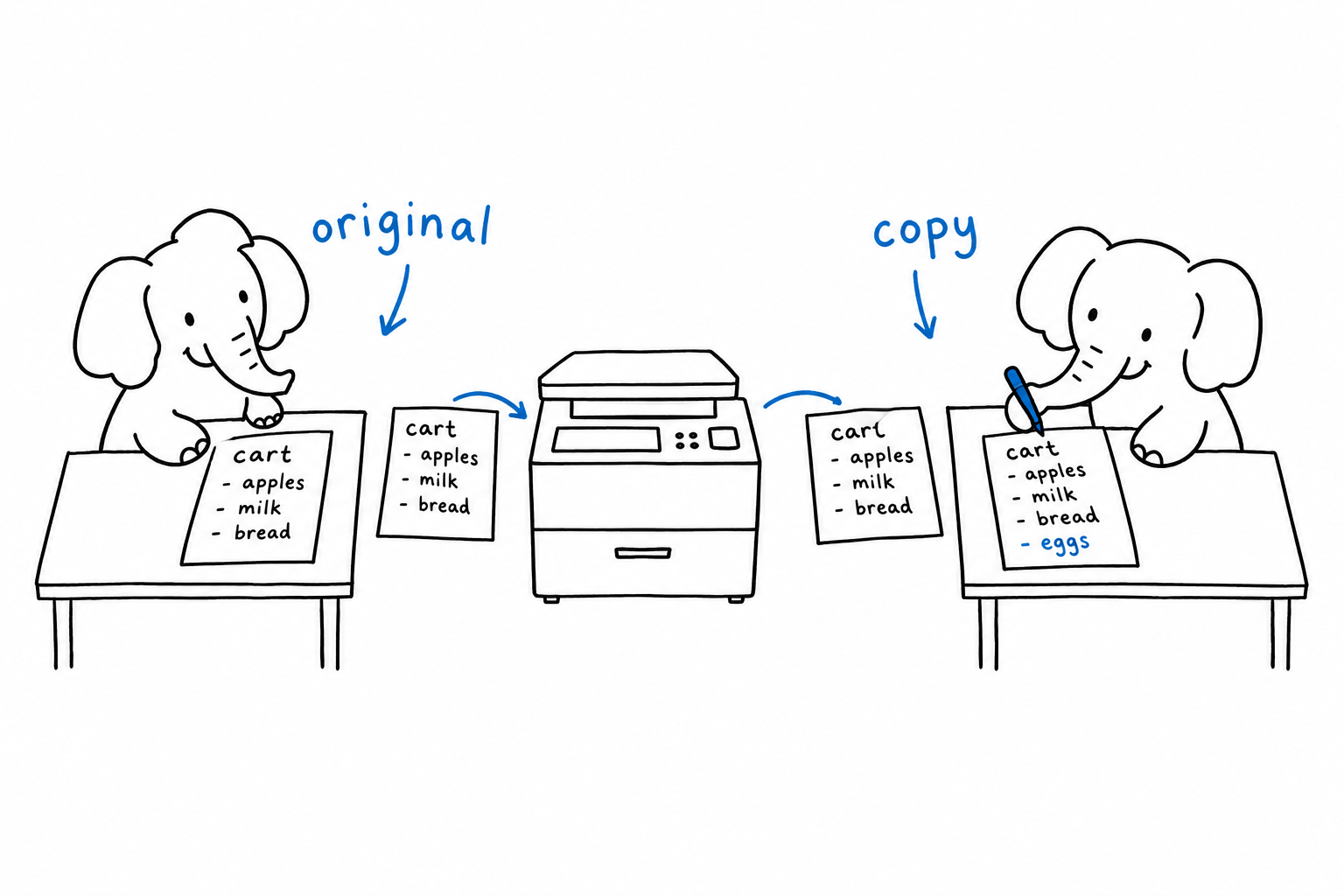
The cost is smaller than it sounds. Under the hood PHP shares the memory and only duplicates the data at the first write, a scheme called copy-on-write. Passing a ten-thousand-element array to a function that only reads it costs nothing.
You can opt out with a reference, &, on the parameter:
function addItemInPlace(array &$cart, string $item): void
{
    $cart[] = $item;
}
Reserve it for the rare hot loop where the copy is measurable. A function that returns a new array is easier to read, to test and to type, and the sort() family, which mutates in place through references, is the legacy exception, not the model.
Objects behave the other way round: an object variable is a handle, and copies of the handle point at the same object, as in every language you know. When you need reference semantics for a collection, wrap it in a class. Classes covers that.
foreach, by value and by reference
foreach iterates over a copy, so mutating $item inside the loop changes nothing:
<?php
declare(strict_types=1);

$prices = [10, 20, 30];

foreach ($prices as $price) {
    $price *= 2; // local copy, the array is untouched
}

foreach ($prices as &$price) {
    $price *= 2; // writes through
}
unset($price); // break the reference

var_dump($prices); // [20, 40, 60]
The unset() after a by-reference loop is not decoration. Without it, $price still points at the last element, and the next innocent $price = 0; overwrites $prices[2]. Most PHP developers have been bitten by this once. A foreach with $key => $value and a write to $prices[$key] avoids the whole question, and so does array_map().
Taking arrays apart and putting them together
Destructuring works on lists and on maps:
<?php
declare(strict_types=1);

[$x, $y] = [3, 4];
['id' => $id, 'name' => $name] = ['id' => 7, 'name' => 'Ada'];
[, $second] = ['skip', 'keep']; // holes are allowed

$defaults = ['color' => 'blue', 'size' => 'M'];
$order = [...$defaults, 'size' => 'L']; // string keys spread since 8.1

var_dump($order); // ['color' => 'blue', 'size' => 'L']
The spread with string keys behaves like JavaScript’s {...defaults, size: 'L'}: later entries win. With integer keys, spreading renumbers, so [...[1, 2], ...[3]] is [1, 2, 3], not a map with duplicate keys.
The functional trio and its cousins
array_map(), array_filter() and array_reduce() do what their names say, with a wrinkle each:
<?php
declare(strict_types=1);

$orders = [
    ['id' => 1, 'total' => 40, 'paid' => true],
    ['id' => 2, 'total' => 15, 'paid' => false],
    ['id' => 3, 'total' => 90, 'paid' => true],
];

$totals = array_map(fn(array $o) => $o['total'], $orders);       // [40, 15, 90]
$paid   = array_filter($orders, fn(array $o) => $o['paid']);      // keys 0 and 2
$sum    = array_reduce($totals, fn(int $carry, int $t) => $carry + $t, 0); // 145

echo json_encode($paid);                // {"0":{...},"2":{...}}  an object!
echo json_encode(array_values($paid));  // [{...},{...}]          a list
array_filter() keeps the original keys. After filtering a list, the keys have holes, array_is_list() says false, and json_encode() produces an object. array_values() renumbers. Watch the argument order too: the array comes first for array_filter() and array_reduce(), the callback first for array_map(). That inconsistency is thirty years old, and your editor’s autocomplete is the cure.
PHP 8.4 added the searches you kept writing by hand: array_find() returns the first matching element, array_find_key() its key, array_any() and array_all() return booleans. PHP 8.5 added array_first() and array_last(), which return the first and last values regardless of keys, next to the older array_key_first() and array_key_last().
// PHP 8.4
$firstBig = array_find($orders, fn(array $o) => $o['total'] > 50);
$allPaid  = array_all($orders, fn(array $o) => $o['paid']);   // false
Sorting mutates in place and, since PHP 8.0, is stable. usort() with the spaceship operator is the idiom:
usort($orders, fn(array $a, array $b) => $b['total'] <=> $a['total']);
sort() and usort() renumber the keys; asort() and uasort() keep them; ksort() sorts by key. array_column($orders, 'total', 'id') pulls one field out of a list of rows and, given the third argument, indexes the result by another. array_combine(), array_flip(), array_unique(), array_slice() and array_splice() are there too, with count() for the length.
You will also meet compact() and extract(), which turn local variables into an array and back. Recognise them, do not write them: they defeat static analysis and your editor.
Iterating anything
foreach is not limited to arrays. Anything iterable works: arrays, generators, and objects implementing Iterator or IteratorAggregate. A function that accepts iterable can be fed a million-row generator without loading the million rows, which Functions and Closures picks up.
<?php
declare(strict_types=1);

function total(iterable $amounts): int
{
    $sum = 0;
    foreach ($amounts as $amount) {
        $sum += $amount;
    }
    return $sum;
}

echo total([1, 2, 3]); // 6
When an array is not enough
An array cannot say what it contains. array $orders tells the reader nothing, and the language has no array<Order>. Two answers coexist. The lightweight one is a docblock, @param list<Order> $orders, which PHPStan and Psalm enforce as if it were a real type and your editor uses for completion. The heavier one is a small class, a final class Orders holding a private array, exposing exactly the operations you need, and implementing the interfaces that let it behave like an array where useful: Countable for count(), ArrayAccess for $orders[0], IteratorAggregate for foreach.
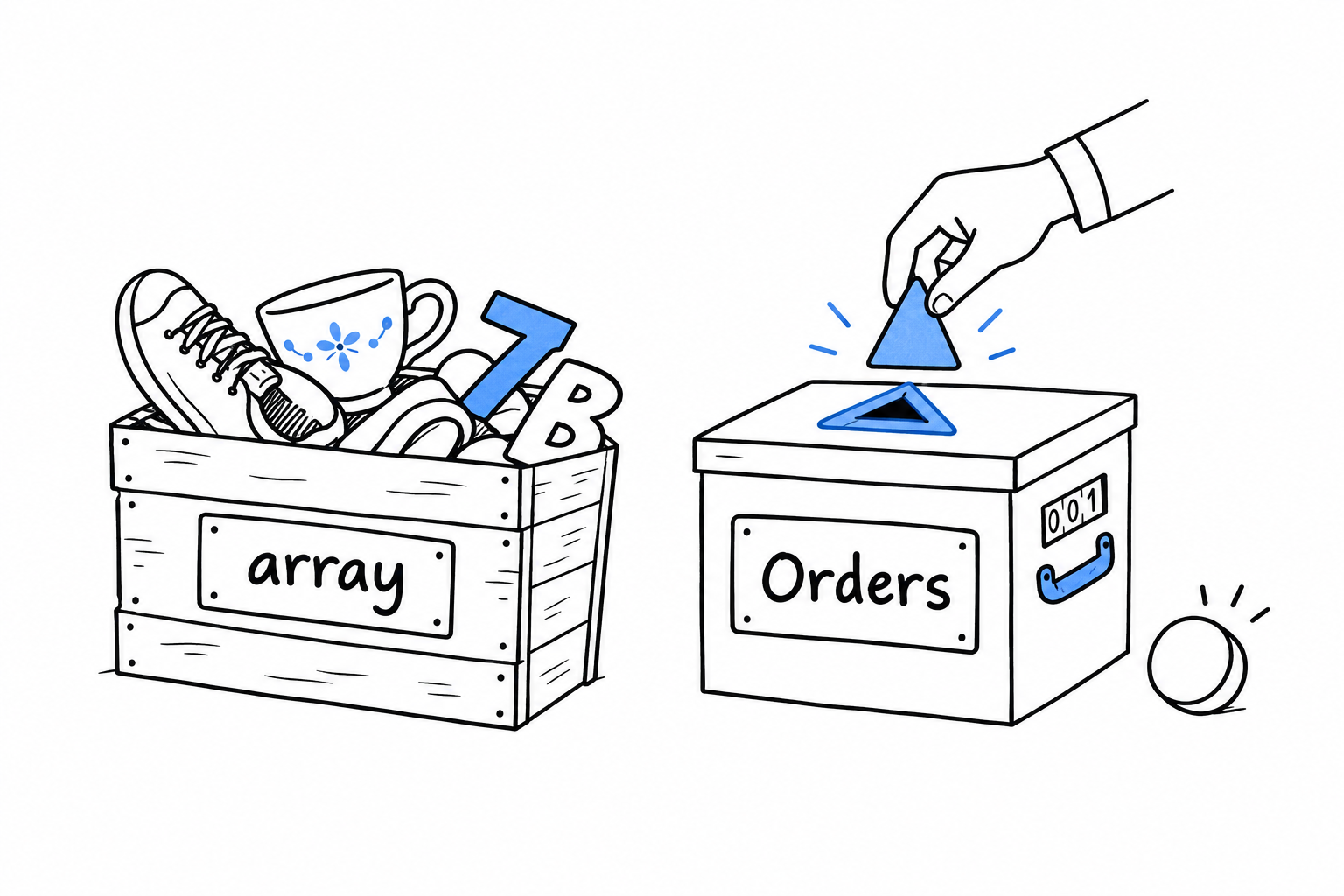
Two built-in classes cover cases arrays cannot. SplObjectStorage maps objects to data using the object itself as key. WeakMap (PHP 8.0) does the same without keeping the object alive, which is how caches keyed by entity avoid leaking.
Two habits to break: expecting a function to mutate the array you pass it, and forgetting that
array_filter()leaves holes. Return the new array, and wrap inarray_values()before encoding.
Arrays are what most PHP code passes around. Functions are what it passes them to, and PHP’s closures capture differently from the ones you know. That is Functions and Closures.
Functions and Closures
PHP functions look like TypeScript’s with a $ on every parameter, and closures capture by value, not by variable. That second half is where the surprises live. The first half you can read at speed.
<?php
declare(strict_types=1);

function greet(string $name, string $greeting = 'Hello', bool $shout = false): string
{
    $text = "$greeting, $name!";
    return $shout ? strtoupper($text) : $text;
}

echo greet('Ada');                       // Hello, Ada!
echo greet('Ada', shout: true);          // HELLO, ADA!
echo greet(greeting: 'Hi', name: 'Ada'); // Hi, Ada!
Parameters and return values carry types, checked at runtime as Types explained. Defaults work as everywhere. Named arguments (PHP 8.0) let you skip the defaults you do not care about and make a call with four booleans readable. Positional and named can mix, positional first.
Variadics, references, and the odd return types
... on the last parameter collects the rest into an array; ... in a call unpacks an array into arguments, string keys included, which turns an array into named arguments:
<?php
declare(strict_types=1);

function sum(int ...$numbers): int
{
    return array_sum($numbers);
}

echo sum(1, 2, 3);        // 6
echo sum(...[4, 5]);      // 9

$options = ['greeting' => 'Hey', 'name' => 'Ada'];
// greet(...$options) would call greet(name: 'Ada', greeting: 'Hey')
A parameter declared &$x receives a reference: the function writes into the caller’s variable. The standard library uses it for sort(), preg_match()’s $matches and a few others. In your own code, prefer returning the value. A function that changes its arguments is one your reader has to open to understand.
Parameter types take everything the type system offers: ?string $label = null for an optional value, int|string $id for a union, Countable&Traversable $items for an intersection. Write the ? explicitly; a plain string $x = null still works but has been deprecated since PHP 8.4. For a function that accepts a function, two declarations exist: callable accepts closures and also the string and array forms below; Closure accepts only real closure objects. New code tends to declare Closure and let callers convert with (...), because a Closure can be type-checked and a string cannot.
Two return types describe functions that do not return normally. void means nothing comes back. never (PHP 8.1) means the function always throws or exits, so static analysers know that code after a fail() call is unreachable.
Functions are not values, but you can grab a handle
A function name is not an expression. $f = strlen; is a syntax error, and the historical workaround was a string: $f = 'strlen'; works because the callable type accepts a function name, a [$object, 'method'] pair, or a 'Class::method' string. That works, and nothing checks it until it runs.
The modern way is the first-class callable syntax (PHP 8.1): the name followed by (...).
<?php
declare(strict_types=1);

final class Mailer
{
    public function send(string $to): string
    {
        return "sent to $to";
    }
}

$length = strlen(...);                   // Closure wrapping strlen()
$send = (new Mailer())->send(...);       // Closure bound to that instance

echo $length('hello'); // 5
echo $send('ada@example.org');

var_dump(array_map(strtoupper(...), ['a', 'b'])); // ['A', 'B']
The result is a Closure object, PHP’s only function value. It is type-safe, refactor-safe (rename the method and your editor follows), and it is what to pass to array_map() and friends. Closure::fromCallable('strlen') does the same from a string when you have one.
A polyglot’s reflex is
$this->sendwithout parentheses. In PHP that reads the propertysend, which does not exist. The method as a value is$this->send(...).
Closures capture by value
Anonymous functions exist, and you have to say what they capture:
<?php
declare(strict_types=1);

$rate = 0.2;

$withTax = function (float $price) use ($rate): float {
    return $price * (1 + $rate);
};

$rate = 0.5; // too late, the closure already copied 0.2

echo $withTax(100.0); // 120
The use clause copies the variables at the moment the closure is created. Nothing in the enclosing scope is visible unless listed, and later changes to the outer variable do not reach the closure. JavaScript and Python close over the variable itself and would print 150 here. PHP hands the closure a snapshot.

To capture the variable rather than its value, add &: use (&$rate). Now the closure and the outer scope share it, in both directions. The usual need for it is an accumulator, or a recursive closure that must see itself:
$fact = function (int $n) use (&$fact): int {
    return $n <= 1 ? 1 : $n * $fact($n - 1);
};
Arrow functions (PHP 7.4) drop the ceremony. fn captures the whole enclosing scope automatically, by value, and holds a single expression:
$withTax = fn(float $price): float => $price * (1 + $rate);
No use, no return, no braces, and the same snapshot semantics. Most callbacks you write will be arrow functions. Reach for function () use () when you need statements, or a by-reference capture.
Inside a class, a closure keeps $this automatically, which is what you expect. Mark it static fn or static function when it does not need the instance; that avoids keeping the object alive from inside a long-lived callback. Closure::bind() and $closure->call($object) rebind $this to another object, and are how frameworks reach private state from outside. You will rarely write them yourself.
Generators
A function containing yield returns a Generator without running its body. Each foreach step runs it to the next yield. This is Python’s generator, nearly line for line:
<?php
declare(strict_types=1);

/** @return Generator<int, string> */
function lines(string $path): Generator
{
    $handle = fopen($path, 'r');
    try {
        while (($line = fgets($handle)) !== false) {
            yield rtrim($line, "\n");
        }
    } finally {
        fclose($handle);
    }
}

foreach (lines('/etc/hosts') as $number => $line) {
    echo "$number: $line", PHP_EOL;
}
The file is read one line at a time, however large it is, and closed when the loop ends or breaks. A generator is iterable, so any function accepting iterable takes it without knowing. yield $key => $value sets explicit keys, yield from delegates to another generator or array, and a return inside a generator sets a value readable through getReturn() once iteration is over. Generators run once; to iterate again, call the function again.
Pipelines
PHP 8.5 adds the pipe operator. $x |> f(...) calls f($x), and chains read top to bottom instead of inside out:
// PHP 8.5
$slug = ' Hello World '
    |> trim(...)
    |> strtolower(...)
    |> (fn(string $s) => str_replace(' ', '-', $s));

echo $slug; // hello-world
Each stage is any callable taking one argument, which is exactly what the first-class callable syntax and arrow functions produce. Before 8.5 the same code is three nested calls or three temporary variables; both still work, and both are still common.
PHP 8.5 also brings #[\NoDiscard], an attribute for functions whose return value must not be dropped. Call such a function as a bare statement and PHP emits a warning; cast the call to (void) to say you meant it. Libraries use it on methods returning a new immutable object, to catch the classic $date->modify() bug where the result is thrown away.
Legacy shapes you will recognise
func_get_args() and func_num_args() read the arguments of a function declared without parameters. They predate ...$args and survive in old code. call_user_func() and call_user_func_array() invoke a callable; $callable(...$args) does the same today. create_function() built closures from strings and was removed in 8.0. When you meet these, the modern replacement is one line away, and Rector can make the edit for you.
Closures snapshot their
usevariables, arrow functions snapshot everything, and a method becomes a value with(...). Keep those three straight and PHP callbacks hold no further surprises.
Functions carry behaviour. The data they act on is mostly objects, and PHP’s object model has changed more in the last five years than in the fifteen before. Classes shows what it looks like now.
Classes
A modern PHP class is short, typed, and mostly immutable. The constructor declares the properties, the types are checked at runtime, and most of the boilerplate you remember from Java, or from PHP 5, is gone. Here is one, whole:
<?php
declare(strict_types=1);

namespace App\Billing;

final class Invoice
{
    private array $lines = [];

    public function __construct(
        public readonly string $number,
        public readonly \DateTimeImmutable $issuedAt,
    ) {
    }

    public function addLine(string $label, int $cents): static
    {
        $this->lines[] = ['label' => $label, 'cents' => $cents];

        return $this;
    }

    public function total(): int
    {
        return array_sum(array_column($this->lines, 'cents'));
    }
}

$invoice = new Invoice('2026-0042', new \DateTimeImmutable('2026-09-14'));
$invoice->addLine('Hosting', 1200)->addLine('Support', 800);

echo $invoice->number, ': ', $invoice->total(), PHP_EOL; // 2026-0042: 2000
Read it top to bottom. namespace puts the class in App\Billing, so its full name is App\Billing\Invoice (the Composer chapter explains how that maps to a file). final forbids subclassing; modern PHP code makes classes final by default and opens them on purpose. The constructor has no body: writing public readonly string $number in the parameter list declares the property, types it, and assigns it, all in one line. This is constructor promotion (PHP 8.0), and it removed most of the ceremony from PHP classes. readonly (PHP 8.1) makes the property assignable once, in the constructor, and never again. static as a return type means “the class of the object this was called on”, which is what a fluent method wants.
Two symbols do all the member access. -> reaches an instance member, :: reaches a static one or a constant. $this is the current object, and you always write it: there is no implicit this.
Objects travel by handle
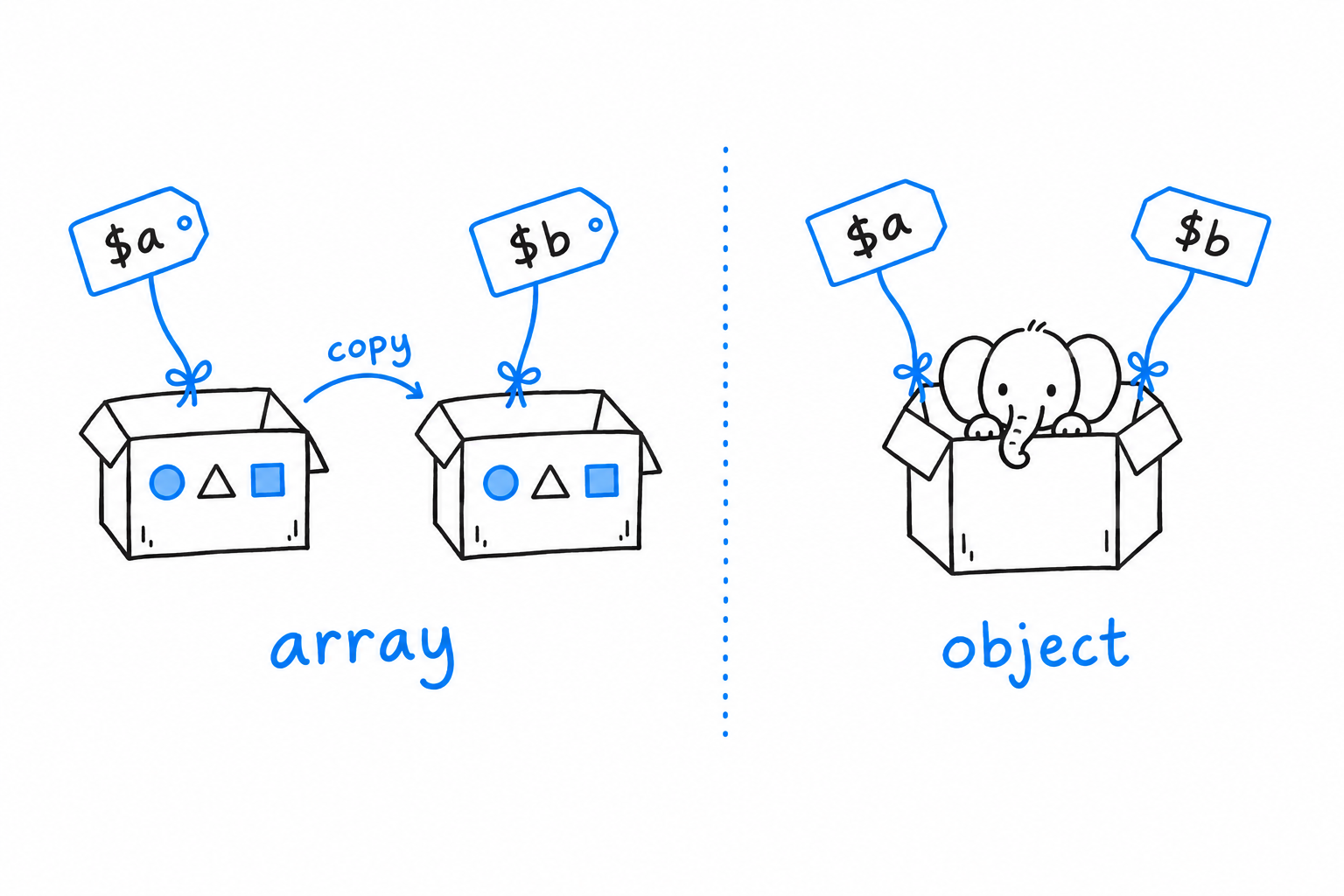
Arrays copy when you assign them (the Arrays chapter has the details). Objects do not. Assigning or passing an object copies a handle to the same object, the way Java, Python and JavaScript do it:
<?php
declare(strict_types=1);

final class Cart
{
    public array $items = [];
}

function addApple(Cart $cart): void
{
    $cart->items[] = 'apple';
}

$cart = new Cart();
addApple($cart);
echo count($cart->items), PHP_EOL; // 1, the caller sees the change
No & is involved: reference parameters (&$x) are a different mechanism, for variables, and you almost never need them with objects.
clone $cart makes a shallow copy: a new object whose properties hold the same values, so an object stored inside is shared between the two copies. Define __clone() if the copy needs its own inner objects.
Two comparisons exist. == compares state, property by property; === asks whether both sides are the same object. $a === clone $a is false.
Immutability without getters
The classic PHP 5 class had a private property, a getter, and sometimes a setter. Three modern features replace that pattern, and you will see all three in codebases written after 2024.
readonly you have met. When every property is readonly, mark the class instead (PHP 8.2):
<?php
declare(strict_types=1);

final readonly class Money
{
    public function __construct(
        public int $amount,
        public string $currency,
    ) {
    }

    public function add(Money $other): self
    {
        return new self($this->amount + $other->amount, $this->currency);
    }
}
Every property is public and nobody can change it. You get a value object with no getters at all.
Asymmetric visibility (PHP 8.4) lets the outside read a property that only the class can write:
// PHP 8.4
final class Counter
{
    public private(set) int $count = 0;

    public function increment(): void
    {
        $this->count++;
    }
}

$c = new Counter();
$c->increment();
echo $c->count; // 1
$c->count = 5;  // Error: Cannot modify private(set) property Counter::$count
That is the getter, gone. Where you need logic on read or write, property hooks (PHP 8.4) attach it to the property itself, like a C# property or Python’s @property:
// PHP 8.4
final class User
{
    public string $email {
        set(string $value) {
            if (!filter_var($value, FILTER_VALIDATE_EMAIL)) {
                throw new \InvalidArgumentException("Invalid email: $value");
            }
            $this->email = strtolower($value);
        }
    }

    public string $domain {
        get => substr($this->email, strpos($this->email, '@') + 1);
    }
}

$u = new User();
$u->email = 'Ada@Example.org';
echo $u->domain; // example.org
To the caller these are plain properties. Inside, set validates and normalises, and get computes. A property with only a get hook and no backing store is a computed property.
Interfaces, abstract classes, traits
Interfaces and abstract classes work as they do in Java and C#: an interface lists method signatures and constants, an abstract class may carry implementation, a class implements many interfaces and extends one parent. #[\Override] (PHP 8.3) on a method makes PHP check that the parent really has it, which catches typos in overrides.
Traits are the part with no exact equivalent in most languages. A trait is a block of methods and properties that the compiler copies into every class that uses it. Ruby’s mixins are the closest anchor; Rust’s traits are not, despite the name.
<?php
declare(strict_types=1);

trait HasTimestamps
{
    private ?\DateTimeImmutable $createdAt = null;

    public function touch(): void
    {
        $this->createdAt ??= new \DateTimeImmutable();
    }
}

final class Article
{
    use HasTimestamps;
}

$a = new Article();
$a->touch();
Traits are handy for cross-cutting helpers and easy to overuse. A class that uses five traits is five files you have to read to know what it does. Prefer composition where you can.
static versus self is a one-paragraph subject. self names the class where the code is written; static names the class of the object at runtime. In a static factory method inside a parent class, new static() builds the subclass that was actually called; new self() always builds the parent.
Construction
PHP has one constructor per class and no method overloading. Two idioms fill the gap: named arguments (PHP 8.0) for optional parameters, and static factory methods for alternative ways to build:
<?php
declare(strict_types=1);

final readonly class Period
{
    private function __construct(
        public \DateTimeImmutable $start,
        public \DateTimeImmutable $end,
    ) {
    }

    public static function fromStrings(string $start, string $end): self
    {
        return new self(new \DateTimeImmutable($start), new \DateTimeImmutable($end));
    }

    public static function year(int $year): self
    {
        return self::fromStrings("$year-01-01", "$year-12-31");
    }
}

$fy = Period::year(2026);
echo $fy->end->format('Y-m-d'), PHP_EOL; // 2026-12-31
A private constructor plus public factories reads as well as a set of overloaded constructors, and it names each variant.
Since PHP 8.4 you can chain a call on a fresh object without wrapping it in parentheses: new Period(...)->start used to need (new Period(...))->start.
For immutable objects, “change” means “make a modified copy”. PHP 8.5 gives that its own syntax: clone($money, ['amount' => 500]) returns a copy with the listed properties replaced. The usual visibility rules apply, and a readonly property can only be written from inside its class, so the call lives in a withAmount() method rather than at the call site. Before 8.5, that same method cloned and assigned inside __clone(), which PHP 8.3 permitted for readonly properties.
Strings, magic, and metadata
Any object can print itself by implementing __toString(). Declaring it makes the class implement Stringable (PHP 8.0) automatically, so you can type a parameter as string|Stringable and accept both.
The other double-underscore methods are hooks the engine calls: __get and __set run when code touches a property that does not exist, __call when it calls a method that does not exist. Frameworks and ORMs use them to build fluent APIs and lazy models. Recognise them; do not reach for them in application code. Related: creating a property that was never declared ($obj->foo = 1 with no $foo in the class) has been deprecated since PHP 8.2 and is planned to become an error in the next major version. Declare your properties.
Attributes (PHP 8.0) are structured metadata on a class, method, property or parameter, read through reflection. Java annotations and C# attributes are the direct anchor:
<?php
declare(strict_types=1);

#[\Attribute(\Attribute::TARGET_METHOD)]
final readonly class Route
{
    public function __construct(public string $path) {}
}

final class HomeController
{
    #[Route('/')]
    public function index(): string
    {
        return 'Hello';
    }
}

$method = new \ReflectionMethod(HomeController::class, 'index');
foreach ($method->getAttributes(Route::class) as $attribute) {
    echo $attribute->newInstance()->path, PHP_EOL; // /
}
An attribute is itself a class marked #[\Attribute]. Nothing happens at runtime until something calls getAttributes(); the metadata is inert until read. Routing, validation, serialisation and test frameworks all build on this.
Invoice::class yields the fully qualified name as a string, which is what you pass around instead of hardcoding 'App\Billing\Invoice'. $x instanceof Invoice checks type at runtime and is false rather than an error when $x is not an object. Lazy objects (PHP 8.4) let a class be instantiated without running its constructor until a property is first touched, a tool for dependency injection containers and ORMs rather than everyday code.
There are no generics. A Collection class holds mixed as far as the engine is concerned; the @template docblocks described in Types give PHPStan and Psalm what the engine lacks.
The trap
A function that receives an object and “just tweaks it a bit” tweaks the caller’s object too. If you meant a local modification, clone first, or design the class as readonly and return a new instance.
And readonly is shallow. It freezes the property slot, not what the slot points to. A readonly array $items cannot be reassigned, but a readonly Cart $cart still lets anyone holding $cart push items into it. Immutability of the whole graph is a design decision, not a keyword.
With classes in hand, the question is how PHP represents a fixed set of choices. Enums and match answers it.
Enums and match
A PHP enum is a class with a fixed set of instances, and match is the expression that picks one branch per instance. Together they replace the class-constants-and-switch pattern that older PHP code is full of. If you know Java enums, you know most of this already; if you come from Python’s Enum or from TypeScript’s string literal unions, the shape will look familiar and the checks will be stricter.
<?php
declare(strict_types=1);

enum Status: string
{
    case Draft = 'draft';
    case Published = 'published';
    case Archived = 'archived';

    public function label(): string
    {
        return match ($this) {
            self::Draft => 'Draft',
            self::Published => 'Live',
            self::Archived => 'Archived',
        };
    }

    public function canEdit(): bool
    {
        return $this !== self::Archived;
    }
}

$status = Status::from('published');   // Status::Published
echo $status->label(), PHP_EOL;         // Live
echo $status->value, PHP_EOL;           // published
var_dump($status->canEdit());           // bool(true)
var_dump(Status::tryFrom('deleted'));   // NULL
Cases, values, and methods
An enum (PHP 8.1) declares its cases and nothing else can be one. Status::Draft is an object, the only object of its kind, so two references to the same case are the same object and === is the comparison to use. Enums cannot be instantiated with new, cannot be extended, and cannot hold state: no properties, no per-instance data. What they can have is methods, constants, static methods, and interfaces to implement.
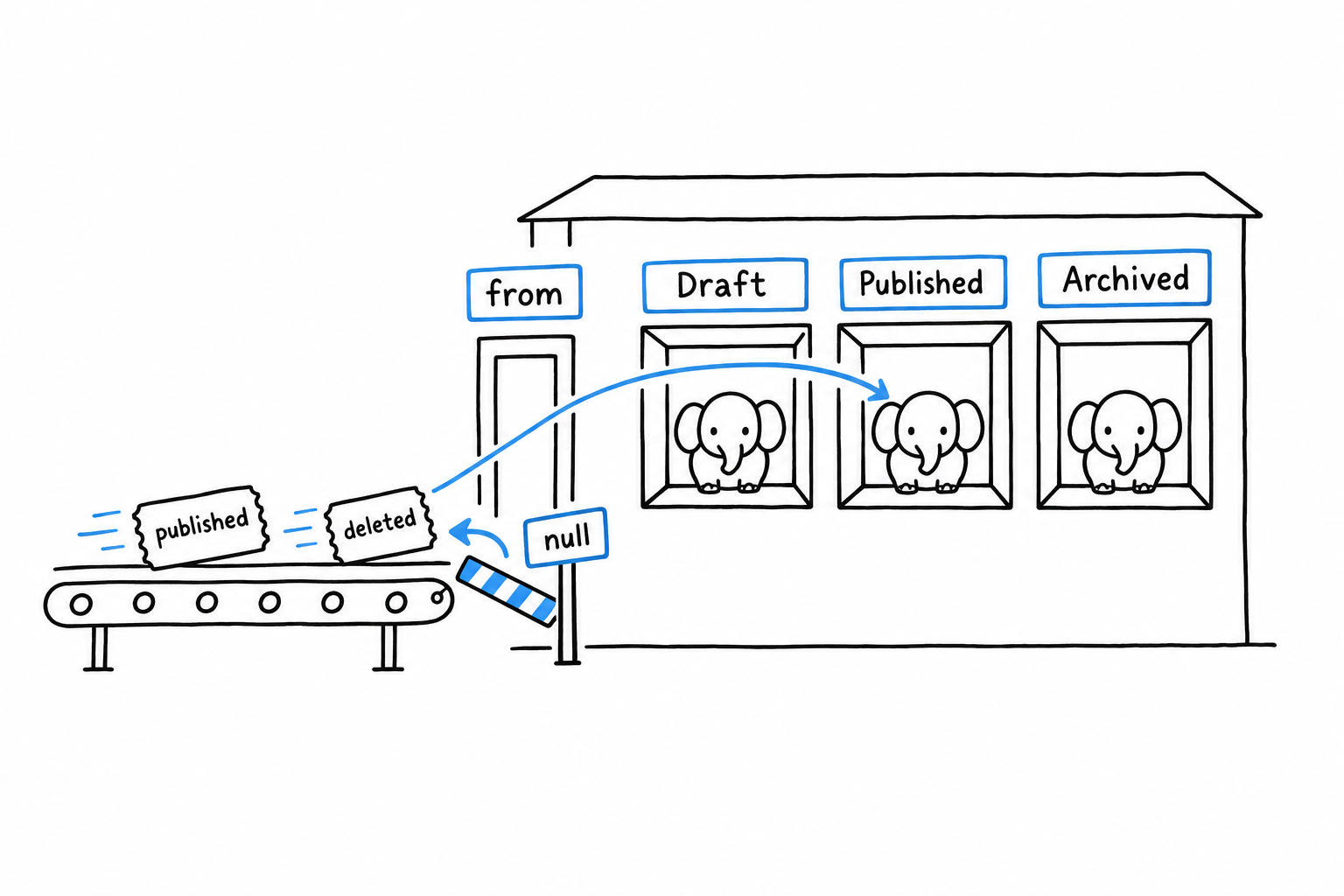
The : string after the name makes this a backed enum: each case carries a scalar (string or int) reachable through ->value. from() turns a scalar back into a case and throws a ValueError when nothing matches; tryFrom() returns null instead. That pair is how an enum crosses a boundary: a database column, a JSON field, a query string. A pure enum, declared without a backing type, has cases and no ->value; use it when the choice never leaves your code.
cases() returns every case in declaration order, which is what a dropdown or a validation rule wants:
$allowed = array_map(fn (Status $s) => $s->value, Status::cases());
// ['draft', 'published', 'archived']
Every case also has ->name ('Draft'), useful for logging.
Because $this inside an enum method is a case, behaviour that depends on the case belongs on the enum, not in if chains scattered across the code. label() and canEdit() above are the pattern: the enum knows what each of its cases means.
Since PHP 8.2 enum cases are allowed in constant expressions, so they can be default parameter values, class constants, and attribute arguments: public function __construct(private Status $status = Status::Draft).
match
match (PHP 8.0) looks like switch and behaves like an expression in Rust or a when in Kotlin. The rules that follow are what set it apart.
It returns a value. $label = match ($status) { ... }; and return match (...) are the normal uses. There is no break, because there is no fallthrough: exactly one arm runs.
It compares with ===. match ('1') { 1 => 'int', '1' => 'string' } picks the second arm. switch would have picked the first.
It must be exhaustive. If no arm matches and there is no default, PHP throws UnhandledMatchError. Add a case to an enum, forget to update a match on it, and the first time that case reaches the match you get an exception naming the exact line, rather than a silent null.
One arm can list several values, separated by commas:
<?php
declare(strict_types=1);

enum Status: string
{
    case Draft = 'draft';
    case Published = 'published';
    case Archived = 'archived';
}

function isVisible(Status $status): bool
{
    return match ($status) {
        Status::Published => true,
        Status::Draft, Status::Archived => false,
    };
}
Static analysers understand this: PHPStan and Psalm both report a match over an enum that leaves a case unhandled, before it ever runs.
The subject of a match does not have to be an enum. Any value works, and the match (true) idiom turns it into a condition ladder that yields a value:
$size = match (true) {
    $bytes < 1024 => 'small',
    $bytes < 1024 * 1024 => 'medium',
    default => 'large',
};
Each arm is compared with === against true, so each arm is a boolean expression. It reads better than a nested ternary and cannot fall through.
switch still exists, with loose comparison, fallthrough, and break. You will meet it in older code. In new code, match is the right default, and switch is for the rare case where you actually want several labels to share a block of statements.
Nulls and throws as expressions
Two operators pair naturally with match and enums.
The nullsafe operator ?-> (PHP 8.0) short-circuits a chain when the left side is null: $order?->customer?->email is null if any link is null, instead of an error. Combined with ?? it gives a default in one line: $email = $order?->customer?->email ?? 'nobody@example.org';.
throw is an expression (PHP 8.0), so it can sit on the right of ??, in a ternary, or in a match arm:
$status = Status::tryFrom($input) ?? throw new \InvalidArgumentException("Unknown status: $input");

$handler = match ($status) {
    Status::Draft => $this->saveDraft(...),
    Status::Published => $this->publish(...),
    Status::Archived => throw new \LogicException('Archived items are read-only'),
};
The second example also shows the pattern for dispatching: a match that returns a callable, then $handler($item).
Persistence and behaviour in one place
Here is the full shape, the way it appears in an application: a backed enum for storage, methods for behaviour, match where the branches live.
<?php
declare(strict_types=1);

interface HasColor
{
    public function color(): string;
}

enum Priority: int implements HasColor
{
    case Low = 1;
    case Normal = 2;
    case High = 3;

    public const DEFAULT = self::Normal;

    public static function fromLabel(string $label): self
    {
        return match (strtolower($label)) {
            'low' => self::Low,
            'normal', 'medium' => self::Normal,
            'high', 'urgent' => self::High,
            default => throw new \ValueError("Unknown priority: $label"),
        };
    }

    public function color(): string
    {
        return match ($this) {
            self::Low => 'grey',
            self::Normal => 'blue',
            self::High => 'red',
        };
    }

    public function escalate(): self
    {
        return match ($this) {
            self::Low => self::Normal,
            self::Normal, self::High => self::High,
        };
    }
}

$p = Priority::fromLabel('medium');
echo $p->color(), PHP_EOL;              // blue
echo $p->escalate()->name, PHP_EOL;     // High
echo Priority::DEFAULT->value, PHP_EOL; // 2
The integer goes in the database. The enum goes everywhere else. There is no PRIORITY_HIGH = 3 constant to keep in sync with a lookup table of colours somewhere, because the case and its behaviour live in one file.
Compared to the older pattern, class constants plus string flags plus a switch, an enum gives you a real type to put in a signature (function assign(Priority $p)), which the engine checks, and a closed set the analyser can reason about.
The trap
Two habits from other languages, and from old PHP, cause the same bug.
Reaching for switch: it compares loosely, so switch (Status::Draft) with case 'draft': never matches (an enum is not equal to its value, under either comparison), and with a plain string subject a case 0: matches more than you expect.
Comparing an enum to its backing value: $status == 'published' is always false. The enum is an object; the string is what it stores. Compare cases to cases ($status === Status::Published), or convert first ($status->value === 'published').
The next question a polyglot asks is what happens when something goes wrong. Errors and Exceptions covers a model that has both.
Errors and Exceptions
PHP has exceptions, and they work the way Python’s or Java’s do. It also has an older mechanism, engine errors, that predates exceptions and still exists. Modern practice is to route everything through the first one. This chapter shows the exception model, then the three lines of configuration that make the old mechanism behave.
Two hierarchies, one root
Everything you can throw and catch implements Throwable. Under it sit two families.
Error is what the engine throws when your code is wrong: TypeError for a bad argument, ValueError for a right type with an impossible value, ArgumentCountError, DivisionByZeroError, UnhandledMatchError when a match finds no arm. You do not throw these yourself, and you rarely catch them, because they mean a bug rather than a condition.
Exception is yours. PHP ships a small set in the SPL, and the names are the whole documentation: InvalidArgumentException, RuntimeException, LogicException, DomainException, OutOfRangeException, UnexpectedValueException. Extend one of these rather than Exception directly, and callers get a meaningful family to catch.
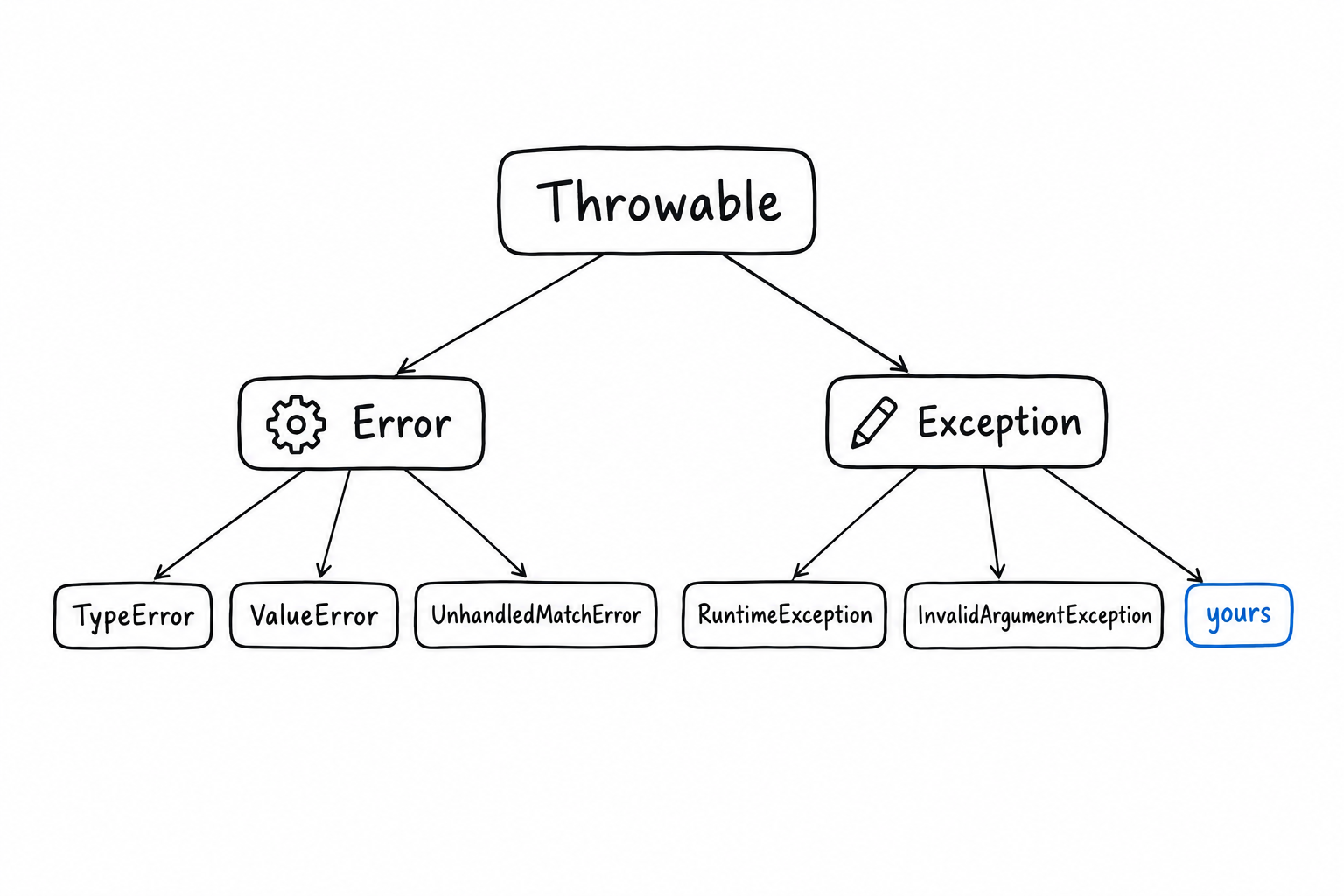
The syntax has no surprises:
<?php
declare(strict_types=1);

function parsePort(string $raw): int
{
    if (!ctype_digit($raw)) {
        throw new InvalidArgumentException("Not a port: $raw");
    }

    return (int) $raw;
}

try {
    $port = parsePort('80a');
} catch (InvalidArgumentException|ValueError $e) {
    echo 'Bad input: ', $e->getMessage(), PHP_EOL;
} finally {
    echo 'Done.', PHP_EOL;
}
| catches several types in one block (PHP 7.1). finally runs whether or not something was thrown. Catch Throwable when you truly mean everything, for instance at the top of a worker loop.
No checked exceptions, no error values
A PHP function signals failure by throwing or by returning null. Nothing forces the caller to handle either, and nothing in the signature lists what may be thrown. If you come from Java, there is no throws clause and no compile-time check; a @throws docblock is a courtesy read by your IDE and by PHPStan or Psalm, not by the engine. If you come from Go or Rust, there is no error return value and no Result type in the language. A handful of libraries offer one, but idiomatic PHP does not use them.
The nullable return type plus ?? is the idiom for “maybe”:
<?php
declare(strict_types=1);

function findUser(int $id): ?array
{
    return $id === 1 ? ['name' => 'Ada'] : null;
}

$name = findUser(2)['name'] ?? 'anonymous';
echo $name, PHP_EOL; // anonymous
The rule of thumb: return null when absence is normal, throw when it is not. And since throw is an expression (PHP 8.0), the two combine in one line:
$user = findUser($id) ?? throw new RuntimeException("No user $id");
Custom exceptions carry data
A custom exception is a class, so it can hold typed context and offer a named constructor that builds the message for you:
<?php
declare(strict_types=1);

final class InsufficientFunds extends DomainException
{
    public function __construct(
        public readonly int $requested,
        public readonly int $available,
        ?Throwable $previous = null,
    ) {
        parent::__construct(
            "Requested $requested, only $available available",
            previous: $previous,
        );
    }

    public static function forWithdrawal(int $requested, int $available): self
    {
        return new self($requested, $available);
    }
}

try {
    throw InsufficientFunds::forWithdrawal(100, 40);
} catch (InsufficientFunds $e) {
    echo $e->available, PHP_EOL; // 40
}
The previous argument is how you chain. Catch a low-level exception, wrap it in one that means something to your caller, and pass the original as previous. getPrevious() walks the chain back, and every logger prints it, so nothing is lost.
try {
    $pdo->query($sql);
} catch (PDOException $e) {
    throw new RuntimeException('Order lookup failed', previous: $e);
}
The other mechanism
Before exceptions existed, PHP reported problems by emitting an error of a given level (notice, warning, fatal) and, for anything short of fatal, carrying on. Most of that machinery has been folded into Error exceptions over the years: division by zero throws, a wrong argument type throws, calling a method on null throws. A few conditions still emit a warning and continue: reading an undefined variable, an undefined array key, an undefined property, and every deprecation notice.
<?php
declare(strict_types=1);

$config = [];
echo $config['debug']; // Warning: Undefined array key "debug"
echo 'still running', PHP_EOL;
That “still running” is what a polyglot does not expect. The fix is one handler, installed at bootstrap, that turns every engine error into an exception. Every framework does exactly this:
<?php
declare(strict_types=1);

error_reporting(E_ALL);

set_error_handler(function (int $severity, string $message, string $file, int $line): bool {
    throw new ErrorException($message, 0, $severity, $file, $line);
});

$config = [];
echo $config['debug']; // ErrorException: Undefined array key "debug"
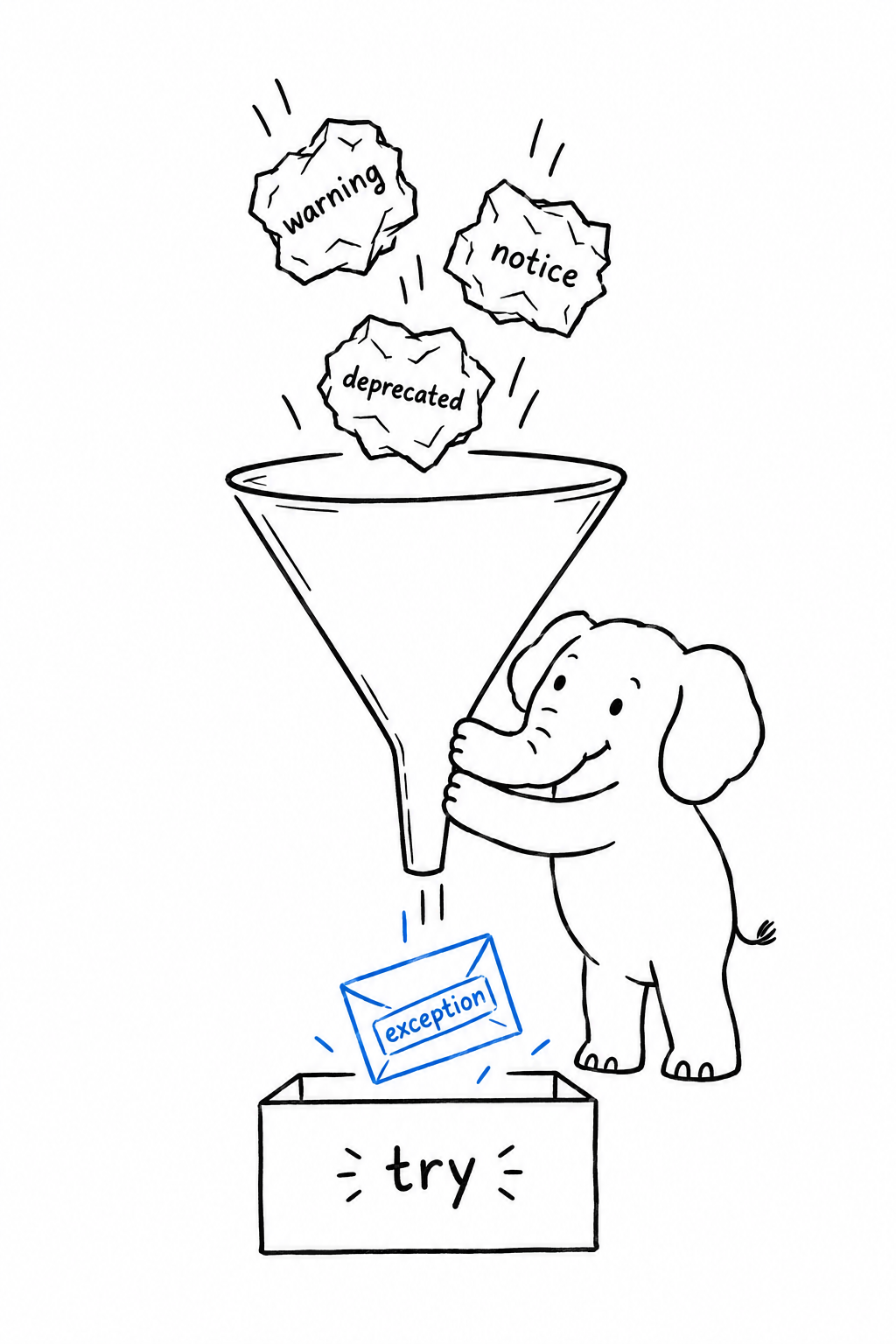
ErrorException is a built-in exception that remembers the severity. From that point on there is only one failure path, and try catches all of it.
Three settings complete the picture. error_reporting(E_ALL) makes sure nothing is filtered out. display_errors is On in development and Off in production, where errors go to the log instead: an uncaught exception on a public page must never print a stack trace. set_exception_handler() receives whatever reaches the top without being caught, which is where you log it and render a generic error page. PHP 8.5 adds get_error_handler() and get_exception_handler() so that libraries can inspect what is installed before wrapping it.
What cannot be caught
Fatal errors end the request: running out of memory, exceeding max_execution_time, declaring the same class twice. No catch sees them. (A parse error in an included file, on the other hand, is a ParseError you can catch since PHP 7.) If you must react, register_shutdown_function() runs after the script stops, and error_get_last() tells you whether the stop was clean. Since PHP 8.5, a fatal error prints a backtrace, so an out-of-memory in production finally points at a line.
Two operators to recognise
You will meet @ in older code: @file_get_contents($url). It silences any warning the expression emits. Your error handler is still called, but error_reporting() returns a reduced mask inside it, which is how a handler can tell that @ was used. Treat the operator as a smell. The one defensible use is around a function that warns and returns false on failure, immediately followed by a check on that return value. Even there, a try around an exception-throwing alternative reads better.
assert() is the other one. It is a development-time check, stripped from production when zend.assertions is set to -1 in php.ini, which is the recommended production value. Use it for invariants that document intent, never for input validation.
The trap
Two mistakes, both silent. The first is catching Exception in a top-level handler and believing you caught everything. A TypeError is an Error, not an Exception, and it walks straight past that block. Catch Throwable at the boundary.
The second is the empty catch:
try {
    $cache->delete($key);
} catch (Throwable) {
}
The variable can be omitted (PHP 8.0), which makes the block honest about ignoring the exception, and there are cases where ignoring is right. But an empty catch around anything that matters is how a bug hides for a year. Log it, at least.
Everything that goes wrong should reach you as one exception, in one place. PHP will do that, once you ask.
That handler, and every class you throw, live in files that PHP has to find. Namespaces, Composer, and Autoloading explains how it finds them.
Namespaces, Composer, and Autoloading
PHP has no module system. It has three smaller things, require, namespaces, and an autoload hook, and Composer assembles them into a package manager that behaves like npm, pip, Maven or Cargo. You will never write a require for one of your own classes again, but it helps to know what Composer does on your behalf.
The three primitives
require 'file.php'; reads and runs a file, once per call. That was how code was shared in 2005, and it is still how the whole thing bootstraps: a single require of vendor/autoload.php at the top of your entry point.
A namespace is a prefix on a class name. namespace App\Billing; at the top of a file makes every class declared in it App\Billing\Something. Nothing else: no hierarchy, no visibility, no folder. App\Billing is not “inside” App; they are two strings that happen to share a prefix.
The autoload hook is the piece that makes the first two useful. When PHP meets a class it has not seen, it calls a function you registered, passing the class name, and that function is expected to require the right file. After that PHP retries.
<?php
declare(strict_types=1);

spl_autoload_register(function (string $class): void {
    $file = __DIR__ . '/src/' . str_replace('\\', '/', $class) . '.php';
    if (is_file($file)) {
        require $file;
    }
});

$invoice = new App\Billing\Invoice(); // loads src/App/Billing/Invoice.php
That is the entire mechanism. Composer writes a better version of that closure, with a cache, and hands it to you.
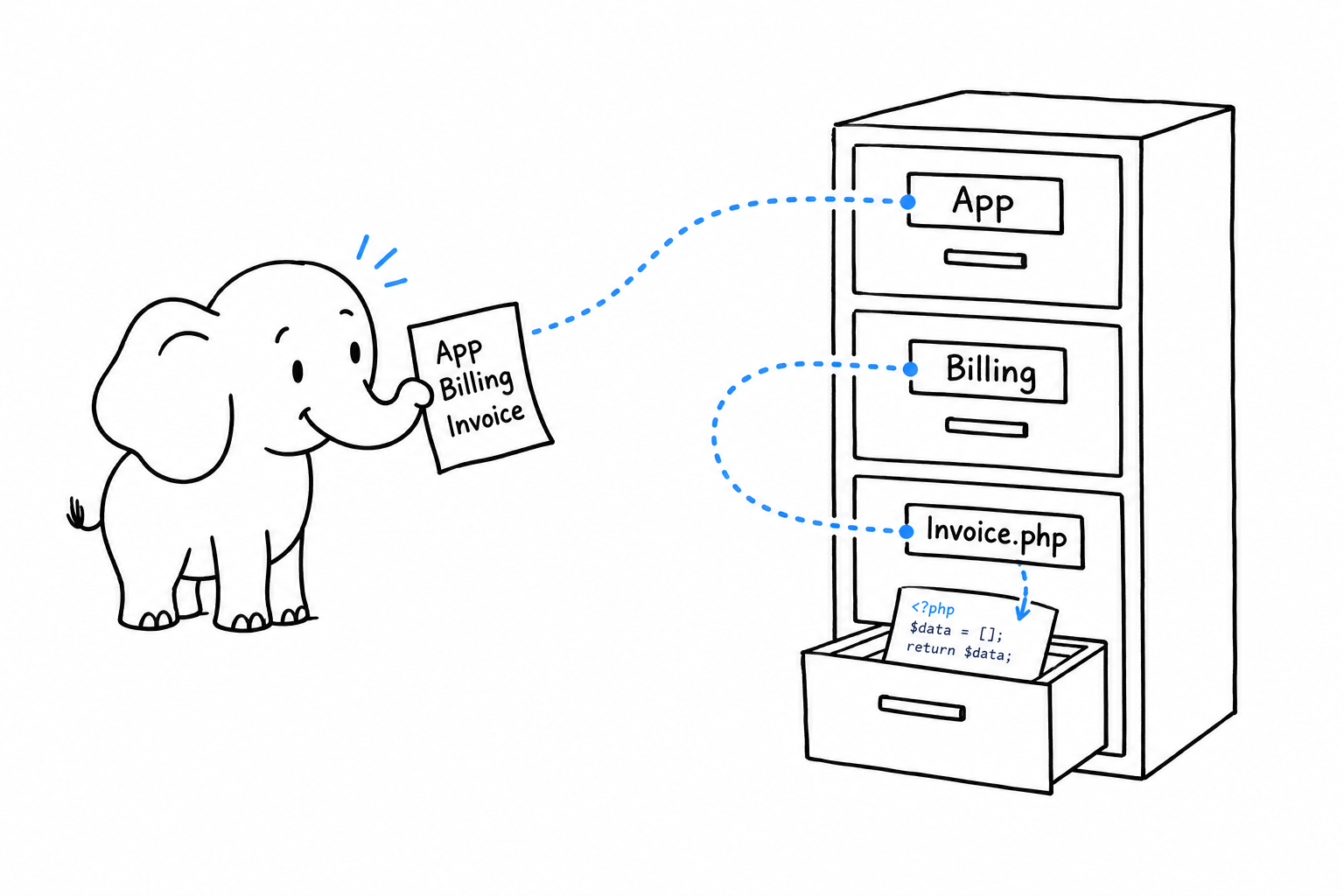
PSR-4: name to path
The rule the closure above follows has a name, PSR-4, and Composer implements it from a block in composer.json:
{
    "name": "acme/shop",
    "type": "project",
    "require": {
        "php": "^8.4",
        "ext-intl": "*"
    },
    "require-dev": {
        "phpunit/phpunit": "^12.0"
    },
    "autoload": {
        "psr-4": { "App\\": "src/" }
    },
    "autoload-dev": {
        "psr-4": { "App\\Tests\\": "tests/" }
    }
}
App\Billing\Invoice lives in src/Billing/Invoice.php. One class per file, file name equal to class name, folders equal to namespace segments after the prefix. The layout that results is the same on every modern PHP project you will open:
shop/
├── composer.json
├── composer.lock
├── public/
│   └── index.php        # require __DIR__ . '/../vendor/autoload.php';
├── src/
│   └── Billing/
│       └── Invoice.php  # namespace App\Billing;
├── tests/
│   └── Billing/
│       └── InvoiceTest.php
└── vendor/              # generated, not committed
Add a class under src/, and it is found on the next request with no command to run. PSR-4 resolves by path at call time. The older classmap strategy scans folders into a generated array and needs composer dump-autoload after every new file; you will meet it in legacy projects.
Composer, in the vocabulary you know
composer.json is your package.json. composer.lock is the lockfile. vendor/ is node_modules, generated and ignored by Git. Packagist is the registry.
composer init                          # interactive composer.json
composer require monolog/monolog       # add and install, updates the lock
composer require --dev phpstan/phpstan # development-only dependency
composer install                       # reproduce exactly what the lock says
composer update                        # resolve anew, rewrite the lock
composer update monolog/monolog        # ... for one package only
composer show                          # what is installed, with versions
composer outdated                      # what has a newer release
composer audit                         # known vulnerabilities in the lock
composer dump-autoload -o              # regenerate the autoloader, optimised
install obeys the lock; update rewrites it. In CI and in production you run install, and you get the exact versions your colleague tested. Commit the lock for an application. For a library, most authors do not, so that the library is tested against whatever its users resolve; the debate is the same one you have had in every other ecosystem.
Version constraints follow semver, and ^8.4 means “8.4 or any later 8.x”. The php entry in require is a constraint too; with config.platform.php you can pin the version Composer resolves against, so a developer on PHP 8.5 does not pull a package your production 8.4 cannot run.
Scripts live under a scripts key and run with composer run name or as lifecycle hooks (post-install-cmd), the way npm scripts do. Extensions are not packages: ext-intl in require only checks that the extension is present, and installing it is the job of your package manager, PECL, or PIE. Tools you would install globally elsewhere (linters, analysers) go in require-dev instead, so every developer and CI runs the same version; composer global require exists and is best left alone. A monorepo declares its inner packages as path repositories, and Composer symlinks them.
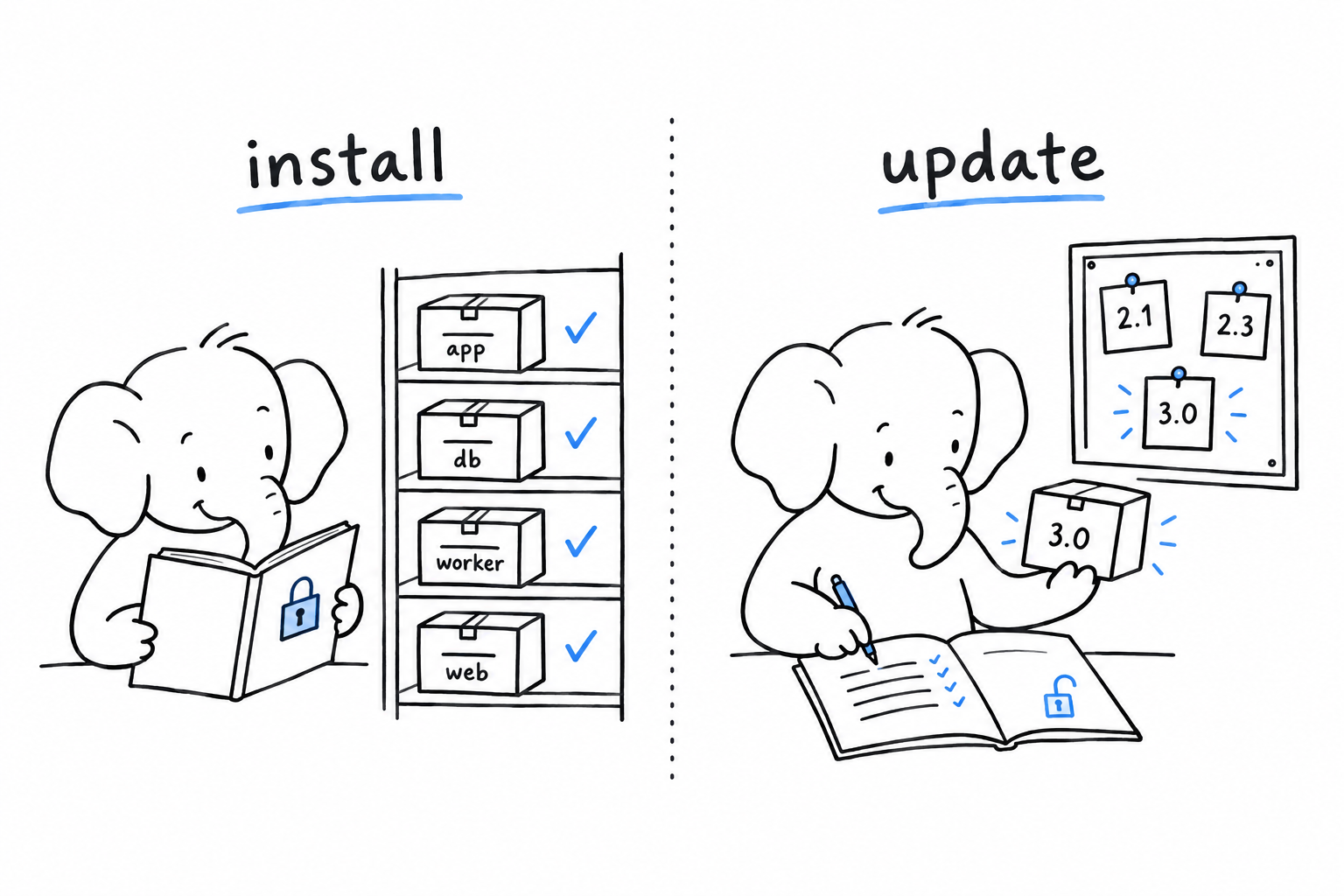
Living with namespaces
Inside a file, a use statement imports a name so you can write it short. Aliases resolve collisions, and functions and constants can be imported too:
<?php
declare(strict_types=1);

namespace App\Billing;

use App\Customer\Customer;
use DateTimeImmutable as Date;
use function App\Support\money;
use const App\Support\CURRENCY;

final class Invoice
{
    public function __construct(
        public readonly Customer $customer,
        public readonly Date $issuedOn,
    ) {
    }

    public function total(): string
    {
        return money(1999, CURRENCY);
    }
}

echo Invoice::class, PHP_EOL; // App\Billing\Invoice
Invoice::class gives the fully qualified name as a string, which is what you pass to a container, a mock, or instanceof checks that take a string. A leading backslash, \DateTimeImmutable, names a class from the global namespace without a use.
Functions fall back to the global namespace; classes do not. Calling strlen() inside App\Billing looks for App\Billing\strlen first, then strlen. Calling new DateTimeImmutable() without a use or a leading backslash fails. You will see \strlen() in some libraries: the backslash skips the lookup and lets OPcache inline a few built-ins. It is a micro-optimisation, not a convention you need to adopt.
The standards worth knowing
The PHP-FIG is the group where framework and library authors agree on interfaces, published as PSRs. A PSR is a contract, not a library: implementations come from many vendors, and you can swap one for another because your code only sees the interface. The ones you will meet in the first week:
- PSR-4 autoloading, above.
- PER Coding Style, the successor of PSR-12: brace placement, indentation, naming. PHP-CS-Fixer or PHP_CodeSniffer enforces it.
- PSR-3
LoggerInterface. Every library logs through it; you plug in the logger you like. - PSR-7, PSR-15 and PSR-17: HTTP request and response objects, middleware, and their factories. The language’s own
$_GETandheader()are covered in A Web Request, Without a Framework; PSR-7 is the object model libraries share on top. - PSR-11
ContainerInterface, so a library can ask any container for a service. - PSR-14 event dispatching, PSR-6 and PSR-16 caching.
A library that types its constructor against Psr\Log\LoggerInterface works in every framework listed in this book. That interoperability is why the ecosystem has fewer forks and rewrites than its size would suggest.
The trap
Never edit a file in vendor/. The next composer install on any machine erases the change, and nobody will know why production differs from your laptop. Fork the package, or override the class through your own autoload entry, or send the patch upstream.
The second trap is quieter. You add a class, PHP says it does not exist, and you spend twenty minutes on a typo that is not there. Check the namespace against the folder: App\Billing\Invoice must be src/Billing/Invoice.php, letter for letter, case included on Linux. If the project uses classmap rather than psr-4, run composer dump-autoload and move on.
Composer is not a build step. There is nothing to compile, bundle or transpile.
composer install, then run the code.
With classes found and packages installed, what remains is the standard library you will lean on every day. Strings, Numbers, Dates, and JSON is the tour.
Strings, Numbers, Dates, and JSON
PHP ships with a large standard library, and most of it is functions, not methods. You do not call $s.upper(). You call strtoupper($s). There is no string class, no number class, no receiver: values go in as arguments, results come out as return values. Once you accept that, the library is wide, fast, and documented function by function on php.net, where each page has the signature, the changelog by version, and examples worth reading.
The names are inconsistent. strlen sits next to str_replace, array_key_exists takes the key first and in_array takes the needle first, strpos returns false on failure, and so does array_search, but preg_match returns 0. This is the residue of thirty years of growth, and it is not going away. Your editor’s autocomplete and the php.net page are the fix, not memorisation. After a week you stop noticing.
Strings are bytes
A PHP string is a sequence of bytes. Not code points, not grapheme clusters, bytes. strlen('é') is 2. strrev('héllo') scrambles the accent. substr can cut a multibyte character in half.
<?php
declare(strict_types=1);

$word = 'café';

echo strlen($word), PHP_EOL;      // 5
echo mb_strlen($word), PHP_EOL;   // 4
echo strtoupper($word), PHP_EOL;  // CAFé
echo mb_strtoupper($word), PHP_EOL; // CAFÉ
For any text a human will read, use the mb_ family: mb_strlen, mb_substr, mb_strtoupper, mb_str_pad, and since PHP 8.4 mb_trim, mb_ucfirst and mb_lcfirst. They assume UTF-8 by default. The plain functions stay useful for what they were made for: binary data, ASCII protocols, hashes, and anything where a byte really is the unit.
For anything locale-aware, the intl extension wraps ICU: Normalizer to canonicalise composed and decomposed forms, Collator to sort “é” next to “e” in the user’s language, NumberFormatter for currencies and plurals, IntlDateFormatter for dates spelled out the way a French or Japanese reader expects.
The everyday helpers are what you expect from any language, with PHP names:
<?php
declare(strict_types=1);

$path = '/var/log/app.log';

var_dump(str_contains($path, 'log'));      // true (PHP 8.0)
var_dump(str_starts_with($path, '/var'));  // true
var_dump(str_ends_with($path, '.log'));    // true

echo implode(', ', ['a', 'b', 'c']), PHP_EOL;    // a, b, c
print_r(explode('/', trim($path, '/')));         // ['var', 'log', 'app.log']
echo str_pad('7', 3, '0', STR_PAD_LEFT), PHP_EOL; // 007
echo ucfirst('php'), PHP_EOL;                    // Php
echo sprintf('%05.2f|%-6s|%03d', 3.14159, 'ok', 7), PHP_EOL; // 03.14|ok    |007
echo number_format(1234567.891, 2), PHP_EOL;     // 1,234,567.89
sprintf is C’s, printf prints instead of returning, and number_format is what you reach for before you discover NumberFormatter.
Two syntaxes handle multi-line text. Heredoc interpolates, nowdoc does not, and both strip the indentation of the closing marker:
<?php
declare(strict_types=1);

$name = 'Ada';

$greeting = <<<TXT
    Hello, {$name}.
    Welcome back.
    TXT;

$raw = <<<'TXT'
    Hello, {$name}. This stays literal.
    TXT;

echo $greeting, PHP_EOL, $raw, PHP_EOL;
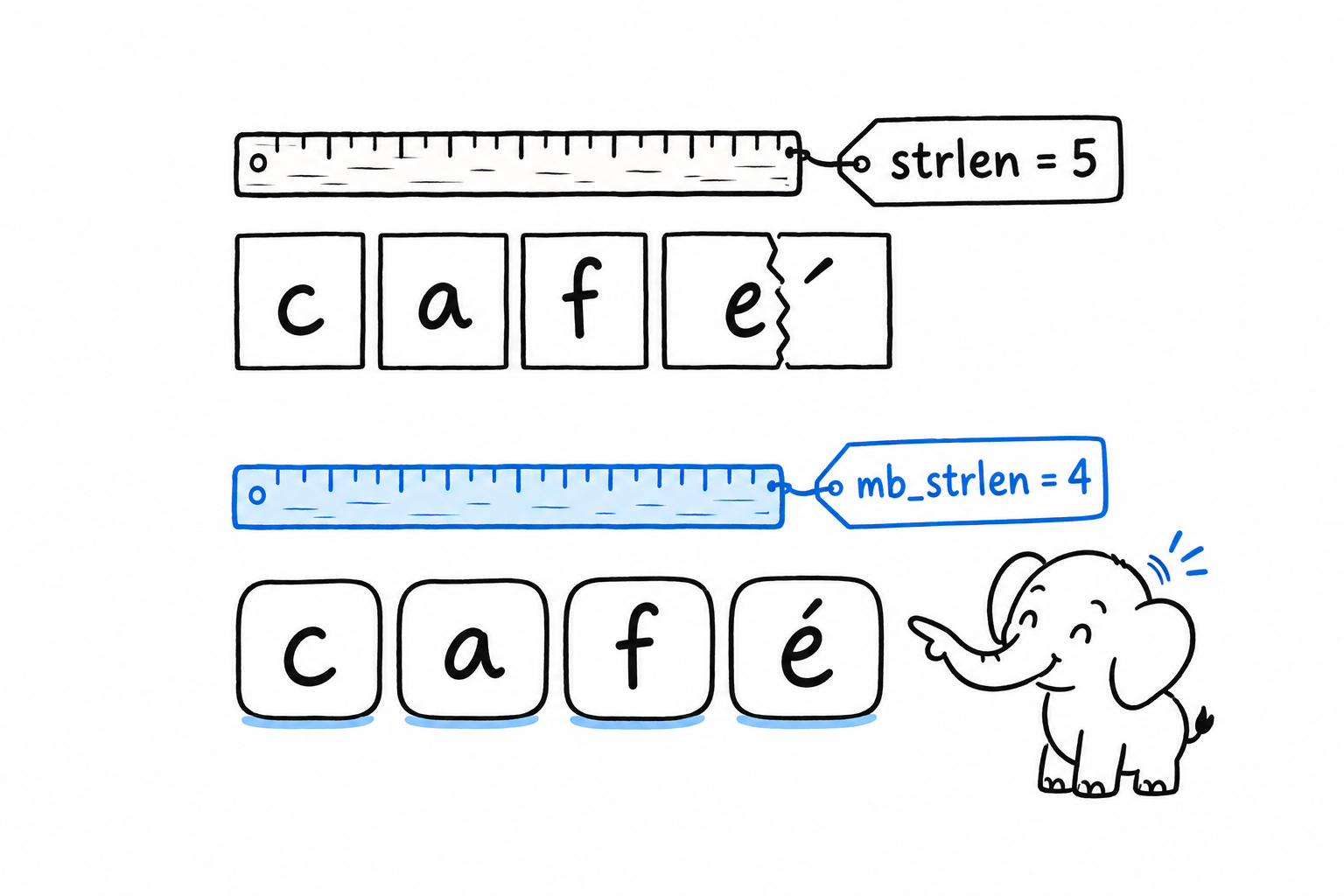
Regular expressions
PHP uses PCRE, the same dialect as Perl and close to what Python’s re and JavaScript accept. The pattern is a string with delimiters, usually / or ~, followed by modifiers. Add the u modifier whenever the text is UTF-8, or . matches single bytes and \w ignores accented letters.
<?php
declare(strict_types=1);

$line = 'Order #4521 shipped to Zoé on 2026-03-14';

if (preg_match('/#(?<id>\d+).*on (?<date>\d{4}-\d{2}-\d{2})/u', $line, $m)) {
    echo $m['id'], ' ', $m['date'], PHP_EOL; // 4521 2026-03-14
}

echo preg_replace('/\s+/u', ' ', "too   many\n\nspaces"), PHP_EOL;

echo preg_replace_callback(
    '/\d+/',
    fn (array $m): string => (string) ($m[0] * 2),
    'a1 b22 c333',
), PHP_EOL; // a2 b44 c666
preg_match returns 1, 0, or false on a malformed pattern. Named groups land in the match array under their name. preg_split, preg_quote and preg_match_all round out the family.
Numbers
int is a signed 64-bit integer, and when it overflows PHP silently switches to float. No exception, no wrap-around, a float. That is fine for a counter and wrong for an ID or a money amount.
<?php
declare(strict_types=1);

var_dump(PHP_INT_MAX + 1);    // float(9.223372036854776E+18)
var_dump(intdiv(7, 2));       // int(3)
var_dump(7 / 2);              // float(3.5), division always yields float unless exact
var_dump(7 % 2);              // int(1)
var_dump(2 ** 10);            // int(1024)
var_dump(fdiv(1, 0));         // float(INF), where 1 / 0 throws DivisionByZeroError

var_dump(0.1 + 0.2 === 0.3);                             // false
var_dump(abs(0.1 + 0.2 - 0.3) < PHP_FLOAT_EPSILON);      // true
var_dump(round(2.5), round(3.5), round(-2.5));           // 3, 4, -3: half away from zero
Floats are IEEE 754 doubles with the usual caveats. round defaults to rounding half away from zero and takes a mode constant for bankers’ rounding. Money is either integers in the smallest unit (cents) or arbitrary precision: bcadd, bcmul and friends work on strings, and PHP 8.4 wraps them in BcMath\Number, an immutable object with operator support.
// PHP 8.4
$price = new BcMath\Number('19.99');
$total = $price * 3;
echo $total, PHP_EOL; // 59.97
For randomness, rand() and mt_rand() are fast and predictable. Anything security-related uses random_int, random_bytes, or the Random\Randomizer class (PHP 8.2), which are backed by the operating system’s CSPRNG.
<?php
declare(strict_types=1);

echo random_int(1, 6), PHP_EOL;                 // a fair die
echo bin2hex(random_bytes(16)), PHP_EOL;        // 32 hex chars, a fine token

$r = new Random\Randomizer();
echo $r->getInt(1, 100), PHP_EOL;
print_r($r->shuffleArray([1, 2, 3, 4]));
echo $r->getBytesFromString('abcdef0123456789', 8), PHP_EOL; // PHP 8.3
Dates
Use DateTimeImmutable and never DateTime. Both exist, they share an interface, and the mutable one is a trap: $date->modify('+1 day') changes $date in place and returns it, so every reference to that object shifts with it. The immutable version returns a new object and leaves the original alone, the way you would expect from Java’s java.time or Python’s datetime.
<?php
declare(strict_types=1);

date_default_timezone_set('UTC');

$start = new DateTimeImmutable('2026-03-14 09:30', new DateTimeZone('Europe/Paris'));
$end = $start->modify('+2 weeks')->setTime(18, 0);

echo $start->format(DateTimeInterface::ATOM), PHP_EOL; // 2026-03-14T09:30:00+01:00
echo $end->format('D, d M Y H:i'), PHP_EOL;            // Sat, 28 Mar 2026 18:00

$diff = $start->diff($end);
echo $diff->days, ' days, ', $diff->h, ' hours', PHP_EOL; // 14 days, 8 hours

$parsed = DateTimeImmutable::createFromFormat('d/m/Y', '01/07/2026');
echo $parsed->getTimestamp(), PHP_EOL;

$inTokyo = $start->setTimezone(new DateTimeZone('Asia/Tokyo'));
echo $inTokyo->format('H:i T'), PHP_EOL; // 17:30 JST

foreach (new DatePeriod($start, new DateInterval('P1D'), 3) as $day) {
    echo $day->format('l'), PHP_EOL; // Saturday, Sunday, Monday, Tuesday
}
The parser behind new DateTimeImmutable('...') and modify() accepts English phrases ('next monday', 'first day of last month') and every common ISO layout. DateInterval uses ISO 8601 durations (P1Y2M3DT4H). The default timezone comes from php.ini; setting it to UTC at the top of your entry point and converting at the edges is the usual practice. Format codes are PHP’s own (Y-m-d H:i:s), not strftime’s, which was deprecated in 8.1.
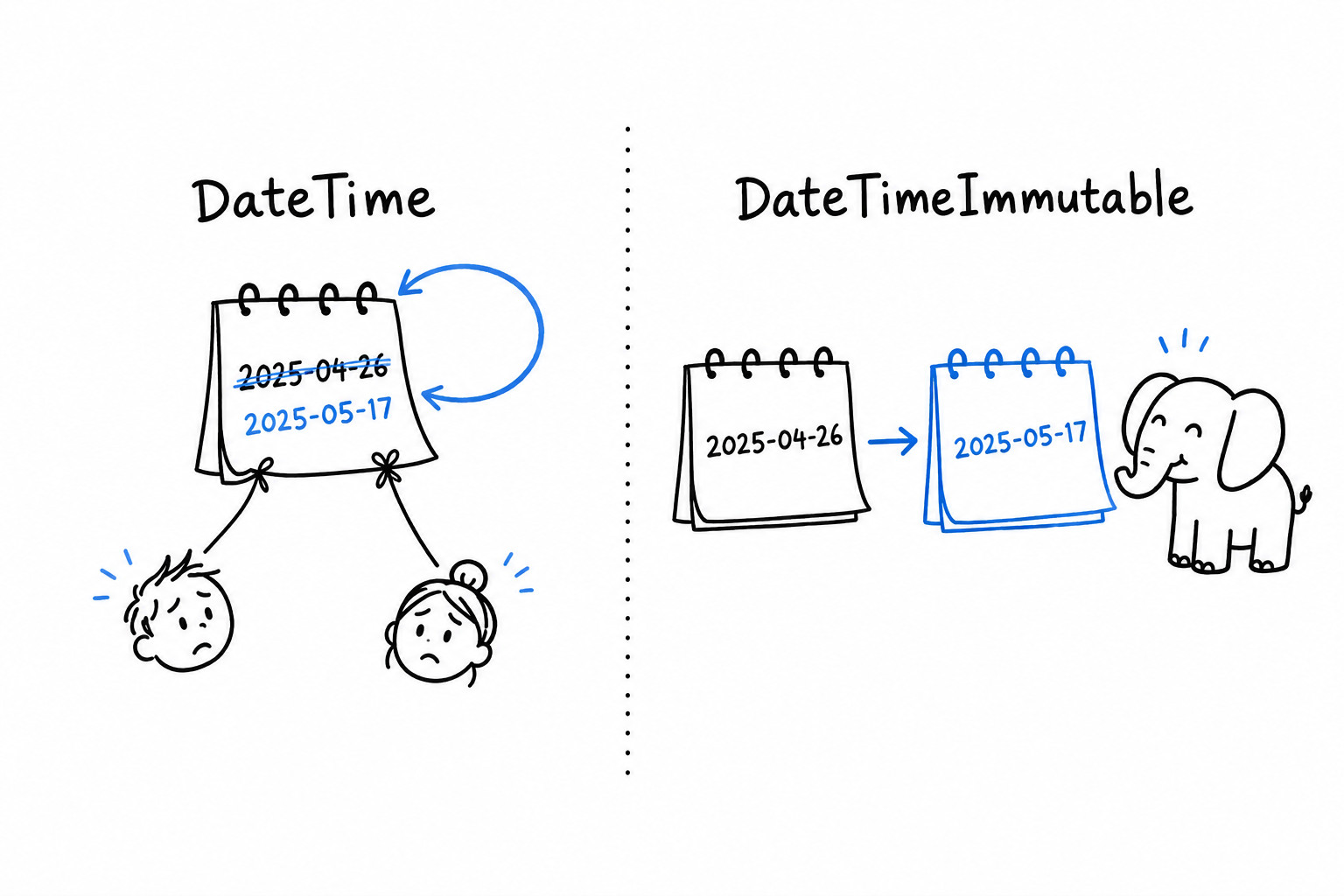
JSON
json_encode and json_decode are built in and fast. Pass JSON_THROW_ON_ERROR every time, otherwise a failure returns false or null and you find out three functions later.
<?php
declare(strict_types=1);

$payload = ['id' => 4521, 'tags' => ['php', 'json'], 'total' => 59.97, 'note' => null];

$json = json_encode($payload, JSON_THROW_ON_ERROR | JSON_PRETTY_PRINT | JSON_UNESCAPED_UNICODE);
echo $json, PHP_EOL;

$asArray = json_decode($json, true, flags: JSON_THROW_ON_ERROR);   // nested arrays
$asObject = json_decode($json, flags: JSON_THROW_ON_ERROR);        // stdClass objects
echo $asArray['tags'][0], ' ', $asObject->tags[1], PHP_EOL;         // php json

var_dump(json_validate('{"ok": true}')); // true (PHP 8.3), without building the tree
The second argument of json_decode decides between associative arrays and stdClass. Arrays are what most code wants. Objects of your own classes serialise through the JsonSerializable interface: implement jsonSerialize(): mixed and return the array shape you want. The reverse direction, JSON to typed object, is not in the language; libraries and frameworks provide it.
One pitfall deserves its own sentence, and Arrays explains why: an array whose keys are not 0, 1, 2... encodes as a JSON object, not a list. array_filter leaves holes, json_encode sees holes, your API returns {"0": ..., "2": ...}. Wrap it in array_values() first.
Large integers survive a round trip only while they fit in 64 bits; beyond that, decode with JSON_BIGINT_AS_STRING. Floats print with up to 17 significant digits by default (serialize_precision), so 0.1 stays 0.1.
Files and streams
file_get_contents and file_put_contents read or write a whole file in one call, and they accept URLs and stream wrappers as well as paths. For line-by-line work there is the C-style fopen/fgets/fclose trio, or SplFileObject, which is iterable:
<?php
declare(strict_types=1);

$path = __DIR__ . '/notes.txt';
file_put_contents($path, "one\ntwo\nthree\n");

foreach (new SplFileObject($path) as $n => $line) {
    if ($line !== '') {
        echo $n, ': ', rtrim($line), PHP_EOL;
    }
}

$stdin = fopen('php://stdin', 'r');
$buffer = fopen('php://memory', 'r+');
fwrite($buffer, 'scratch');
rewind($buffer);
echo fread($buffer, 100), PHP_EOL;
__DIR__ is the folder of the current file, and relative paths otherwise resolve against the working directory, which under a web server is rarely what you think. The php:// wrappers expose standard streams, memory buffers and temp files through the same functions as real files, and file_get_contents('https://...') works when allow_url_fopen is on, though for real HTTP work you want curl or a PSR-18 client.
Validation, hashing, URIs
filter_var validates and sanitises scalars against a set of built-in filters, with no dependency:
<?php
declare(strict_types=1);

var_dump(filter_var('ada@example.org', FILTER_VALIDATE_EMAIL)); // the string, or false
var_dump(filter_var('42', FILTER_VALIDATE_INT));                // int(42)
var_dump(filter_var('yes', FILTER_VALIDATE_BOOL, FILTER_NULL_ON_FAILURE)); // true

$hash = password_hash('correct horse battery staple', PASSWORD_DEFAULT);
var_dump(password_verify('correct horse battery staple', $hash)); // true
echo hash('sha256', 'payload'), PHP_EOL;
password_hash picks the algorithm, generates the salt, and encodes everything into one string; password_verify reads it back. That is the whole password story, and PASSWORD_DEFAULT moves to stronger algorithms across versions without you changing code. hash covers everything else, from sha256 to xxh3, and hash_hmac signs.
Since PHP 8.5, URLs are parsed by a real parser rather than the loose parse_url:
// PHP 8.5
$uri = new Uri\Rfc3986\Uri('https://example.org:8443/docs/intro?lang=fr#top');
echo $uri->getHost(), ' ', $uri->getPort(), ' ', $uri->getPath(), PHP_EOL;
// example.org 8443 /docs/intro
Uri\WhatWg\Url in the same extension applies the browser rules instead of the RFC ones, for when you need to agree with what an <a href> will do.
That is the standard library you will touch in a normal week. The next question is what PHP gives you when the input is not a string in a variable but an HTTP request. A Web Request, Without a Framework answers it with no library at all.
A Web Request, Without a Framework
PHP can serve a web page with no library, no server code, and no configuration, because handling an HTTP request is what the language was built for. The request is already parsed when your script starts. The response is whatever you print. A framework adds structure on top of that; it does not add the capability.
Seeing the raw layer once makes every framework legible, because they all sit on exactly these primitives.
The front controller
Point PHP’s development server at a single file and every URL goes through it:
php -S localhost:8000 public/index.php
That file is the front controller. In production the web server does the same thing with a rewrite rule (or FrankenPHP and RoadRunner do it for you, as How PHP Runs describes). With the development server, one detail matters: if the script returns false, the server serves the requested file from disk instead, which is how static assets get through.
<?php
declare(strict_types=1);

$path = parse_url($_SERVER['REQUEST_URI'], PHP_URL_PATH);

if ($path !== '/' && is_file(__DIR__ . $path)) {
    return false; // let the built-in server send the CSS or image
}

echo 'Every other URL lands here: ', htmlspecialchars($path, ENT_QUOTES);
Reading the request
The request lives in superglobals, arrays that PHP fills before the first line of your code runs. $_GET holds the query string, $_POST the fields of a submitted form, $_COOKIE the cookies, $_FILES the uploads, and $_SERVER everything else: REQUEST_METHOD, REQUEST_URI, and each HTTP header as HTTP_ plus its upper-cased name, so Accept-Language becomes $_SERVER['HTTP_ACCEPT_LANGUAGE'].
<?php
declare(strict_types=1);

$method = $_SERVER['REQUEST_METHOD'];
$page = filter_input(INPUT_GET, 'page', FILTER_VALIDATE_INT) ?: 1;
$name = trim($_POST['name'] ?? '');
$lang = $_SERVER['HTTP_ACCEPT_LANGUAGE'] ?? 'en';

$body = json_decode(file_get_contents('php://input'), true, flags: JSON_THROW_ON_ERROR);
$_POST is only filled for application/x-www-form-urlencoded and multipart/form-data bodies on POST. A JSON body, whatever the method, is read raw from php://input. A form sent with PUT or PATCH is not parsed at all unless you ask: request_parse_body() (PHP 8.4) returns the fields and files for those methods too.
Nothing in these arrays is trustworthy. HTTP_HOST is whatever the client sent. REQUEST_URI can contain anything. A field you expected as a string arrives as an array if the client writes name[]=x. Treat every value as untyped user input, validate it with filter_var or your own checks, and only then let it near your logic.
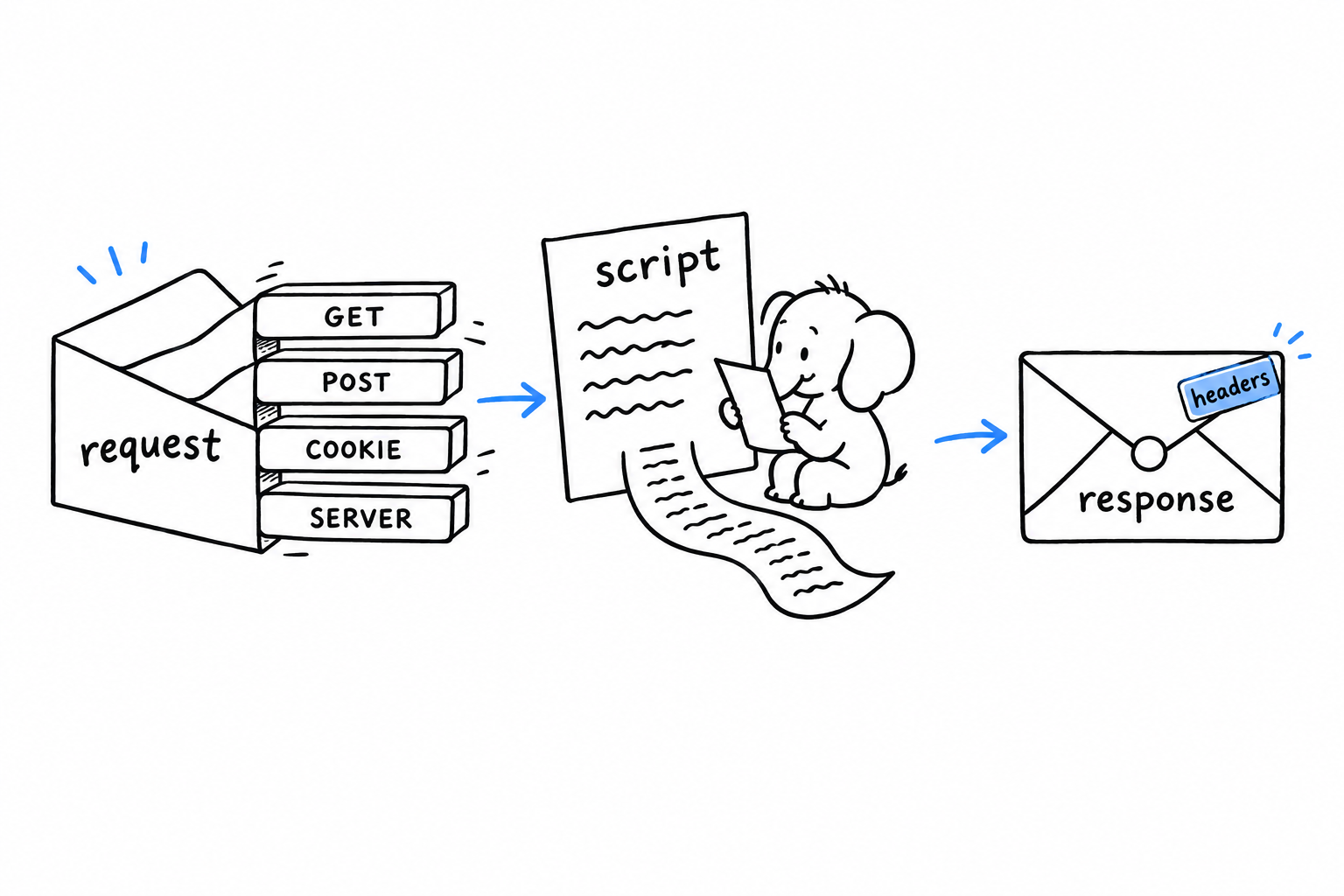
Writing the response
Whatever your script outputs is the response body. echo, print, and any text outside <?php ?> tags go to the client. Status and headers are set with two functions, and they must be called before the first byte of output, because the headers travel first:
<?php
declare(strict_types=1);

http_response_code(201);
header('Content-Type: application/json; charset=utf-8');
header('Cache-Control: no-store');
setcookie('theme', 'dark', [
    'expires' => time() + 86400 * 30,
    'path' => '/',
    'secure' => true,
    'httponly' => true,
    'samesite' => 'Lax',
]);

echo json_encode(['created' => true], JSON_THROW_ON_ERROR);
Print something first, even a stray newline before <?php, and header() fails with “headers already sent”. Output buffering (ob_start() at the top, ob_end_flush() at the end) holds the body in memory until the script finishes and makes the order irrelevant, which is what frameworks do.
Templates are PHP
PHP started as a templating language, and it still is one. An HTML file with <?= $expr ?> in it is a template; include it and it prints. The one rule is on output: escape every value with htmlspecialchars before it lands in HTML, or the first user named <script> owns your page.
<?php
declare(strict_types=1);

function e(string $value): string
{
    return htmlspecialchars($value, ENT_QUOTES | ENT_SUBSTITUTE, 'UTF-8');
}

$todos = ['Write the chapter', 'Escape <everything>'];
?>
<ul>
<?php foreach ($todos as $todo): ?>
    <li><?= e($todo) ?></li>
<?php endforeach; ?>
</ul>
The foreach (...): ... endforeach; form exists for exactly this interleaving. A two-line e() helper is the whole escaping story for HTML; attributes, URLs and JavaScript contexts each need their own encoding, which is the part template engines automate.
A complete application
Here is a working application in one file: a list of notes, stored in SQLite, with a form to add one. It runs with php -S localhost:8000 index.php and nothing else.
<?php
declare(strict_types=1);

$db = new PDO('sqlite:' . __DIR__ . '/notes.db', options: [
    PDO::ATTR_ERRMODE => PDO::ERRMODE_EXCEPTION,
    PDO::ATTR_DEFAULT_FETCH_MODE => PDO::FETCH_ASSOC,
]);
$db->exec('CREATE TABLE IF NOT EXISTS notes (id INTEGER PRIMARY KEY, body TEXT NOT NULL)');

function e(string $value): string
{
    return htmlspecialchars($value, ENT_QUOTES | ENT_SUBSTITUTE, 'UTF-8');
}

$route = $_SERVER['REQUEST_METHOD'] . ' ' . parse_url($_SERVER['REQUEST_URI'], PHP_URL_PATH);

match ($route) {
    'GET /' => (function () use ($db): void {
        $notes = $db->query('SELECT id, body FROM notes ORDER BY id DESC')->fetchAll();
        echo '<h1>Notes</h1><form method="post" action="/notes">',
            '<input name="body" required> <button>Add</button></form><ul>';
        foreach ($notes as $note) {
            echo '<li>', e($note['body']), '</li>';
        }
        echo '</ul>';
    })(),
    'POST /notes' => (function () use ($db): void {
        $body = trim($_POST['body'] ?? '');
        if ($body === '') {
            http_response_code(422);
            echo 'A note needs a body.';
            return;
        }
        $stmt = $db->prepare('INSERT INTO notes (body) VALUES (:body)');
        $stmt->execute(['body' => $body]);
        http_response_code(303);
        header('Location: /');
    })(),
    default => (function (): void {
        http_response_code(404);
        echo 'Not found';
    })(),
};
Three things to take from it. The router is a match on method and path, which scales to about ten routes before you want a real one. PDO is the database API, one interface for SQLite, MySQL, PostgreSQL and others, and ERRMODE_EXCEPTION turns every failure into a thrown PDOException instead of a false you forget to check. The query uses a named placeholder and execute() binds the value; the SQL text and the data never meet as a string, so there is no injection to worry about. PHP 8.4 adds driver-specific subclasses (Pdo\Sqlite, Pdo\Mysql, Pdo\Pgsql) through Pdo::connect(), exposing each driver’s extras with proper types.
Building the SQL with interpolation, "WHERE id = $id", is the one habit from old PHP tutorials that the language still lets you keep. Do not.
Sessions and passwords
A session is server-side storage keyed by a cookie. Call session_start() before any output, and $_SESSION becomes an array that survives across requests for that visitor. By default the data lives in files on the server; frameworks swap in a database or a cache store through session_set_save_handler(). Nothing but the session id travels in the cookie.
<?php
declare(strict_types=1);

session_start();

if ($_SERVER['REQUEST_METHOD'] === 'POST') {
    $ok = password_verify($_POST['password'] ?? '', $storedHash ?? '');
    if ($ok) {
        session_regenerate_id(true);
        $_SESSION['user_id'] = 42;
    }
}

$csrf = $_SESSION['csrf'] ??= bin2hex(random_bytes(32));
password_hash and password_verify from Strings, Numbers, Dates, and JSON are the entire password story. Regenerate the session id on login. Put a random token in the session, print it as a hidden field in every form, and compare on submit with hash_equals(): that is CSRF protection in four lines, and every framework does the same under a nicer name.
The standards layer
Superglobals and header() work, but they are global state, which makes code hard to test and impossible to compose. The PHP-FIG answered with interfaces:
- PSR-7 defines immutable
RequestInterfaceandResponseInterfaceobjects, so a request is a value you pass around and a response is a value you return. - PSR-15 defines middleware: a handler takes a request and returns a response, and middleware wraps handlers. Authentication, CORS, logging, rate limiting are each one class.
- PSR-17 defines the factories that create those objects, so a library never depends on a specific implementation.
- PSR-18 defines an HTTP client, the outgoing side of the same objects.
A library written against PSR-7 and PSR-15 runs in any framework that speaks them, which today is most of them. CakePHP, Laminas, Laravel, Symfony and Yii, and the micro-frameworks Mezzio and Slim, each add routing, dependency injection, templating and a database layer on top of these primitives; the primitives underneath are the ones you have just seen.
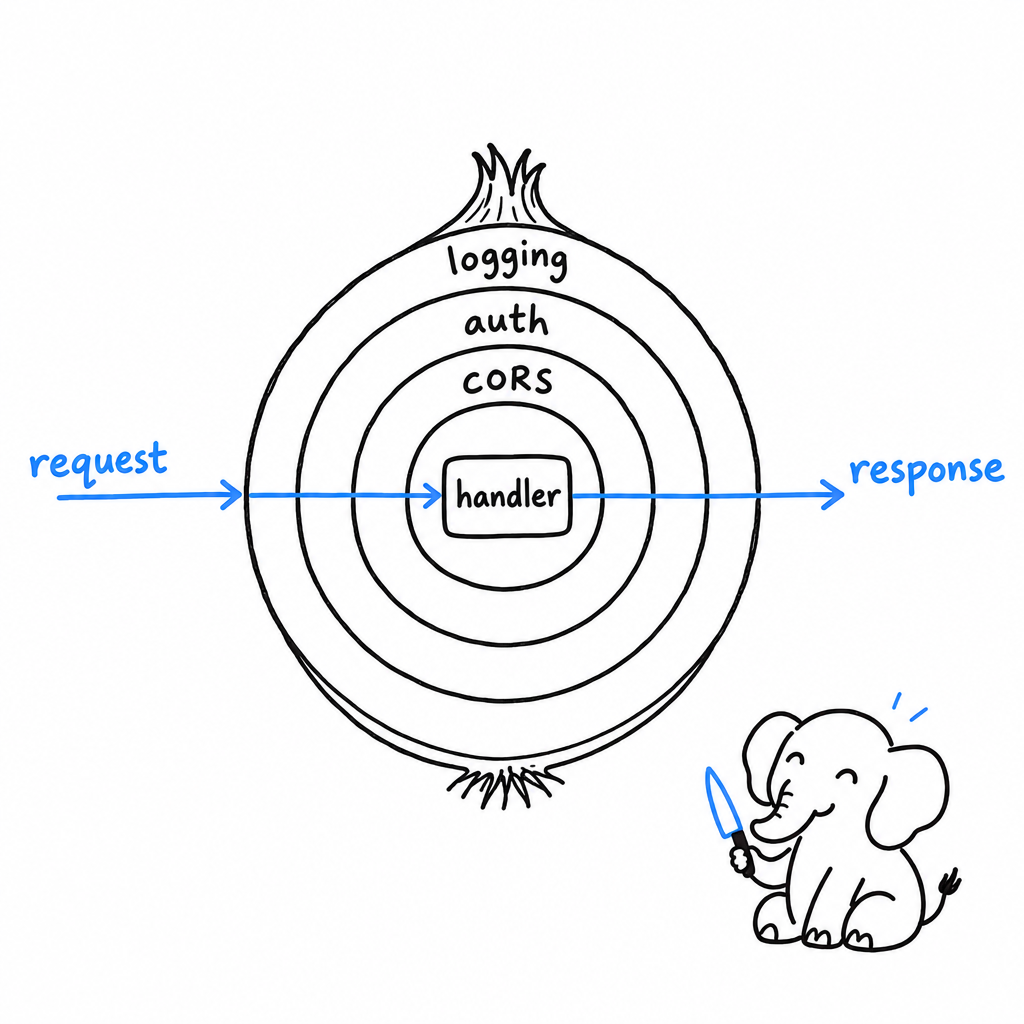
In production, the front controller stays the same. What changes is who calls it: PHP-FPM behind nginx, Apache or Caddy, or a long-running runtime such as FrankenPHP or RoadRunner. Nothing in this chapter needs to change for either.
The application above has no tests and no static analysis. Tests, Static Analysis, and Tooling fixes that.
Tests, Static Analysis, and Tooling
A maintained PHP project runs four tools on every commit: a test runner, a static analyser, a code style fixer, and Composer’s own audit. None of them ship with the language. All of them install with one composer require --dev and run from vendor/bin/. If you have used pytest with mypy, or Jest with tsc and Prettier, you already know the shape. Only the names change.
This chapter names two tools for each job. That is not indecision. Both are widely used, both are good, and the project you just joined has already picked one.
Tests
Two test runners dominate. PHPUnit is the xUnit-style runner every other PHP test tool builds on. Pest is a describe-and-it layer on top of PHPUnit’s engine. They share assertions, mocks, configuration and the coverage machinery; they differ in how a test reads.
The function under test:
<?php
declare(strict_types=1);

namespace App;

function slugify(string $title): string
{
    $slug = strtolower(trim($title));
    $slug = preg_replace('/[^a-z0-9]+/', '-', $slug);

    return trim($slug, '-');
}
A namespaced function is not a class, so PSR-4 cannot find it: the file goes in a files entry of the autoload block in composer.json, and Composer requires it on every run.
The same test, PHPUnit first:
<?php
declare(strict_types=1);

namespace App\Tests;

use PHPUnit\Framework\Attributes\DataProvider;
use PHPUnit\Framework\Attributes\Test;
use PHPUnit\Framework\TestCase;
use function App\slugify;

final class SlugifyTest extends TestCase
{
    #[Test]
    public function itLowercasesAndJoinsWithDashes(): void
    {
        self::assertSame('hello-world', slugify('Hello World'));
    }

    #[Test]
    #[DataProvider('edgeCases')]
    public function itHandlesEdgeCases(string $input, string $expected): void
    {
        self::assertSame($expected, slugify($input));
    }

    public static function edgeCases(): iterable
    {
        yield 'leading punctuation' => ['!!Hi', 'hi'];
        yield 'empty' => ['', ''];
        yield 'unicode is stripped' => ['café', 'caf'];
    }
}
Then Pest:
<?php
declare(strict_types=1);

use function App\slugify;

it('lowercases and joins with dashes', function () {
    expect(slugify('Hello World'))->toBe('hello-world');
});

it('handles edge cases', function (string $input, string $expected) {
    expect(slugify($input))->toBe($expected);
})->with([
    'leading punctuation' => ['!!Hi', 'hi'],
    'empty' => ['', ''],
    'unicode is stripped' => ['café', 'caf'],
]);
Run them with vendor/bin/phpunit or vendor/bin/pest. Configuration lives in phpunit.xml at the project root: which folders hold tests, whether to fail on warnings, which environment variables to set. Pest reads the same file.
The PHPUnit conventions worth knowing on day one: a test class ends in Test and extends TestCase, a test method carries the #[Test] attribute or starts with test, setUp() runs before each test, self::assertSame() is the strict assertion (there is an assertEquals(), and it juggles types the way == does, so prefer assertSame()), and $this->createMock(SomeInterface::class) returns a test double you configure with ->method('name')->willReturn($value).
Coverage is not built in. It needs an extension that watches which lines execute: Xdebug (with xdebug.mode=coverage) or PCOV, which does only coverage and does it faster. Either way, vendor/bin/phpunit --coverage-text prints the report.
The unicode test above documents a bug:
slugify('café')drops theéinstead of transliterating it. A test that pins down current behaviour is still a test. Fix the function later withintl’sTransliterator.
Static analysis
PHP checks types at runtime, one call at a time. It will not tell you that a function three files away can return null and you never handle it. PHPStan and Psalm are the compiler PHP does not have. They read the whole codebase, follow every type through every call, and report what would fail before anything runs. Think mypy for Python, or the type checker inside TypeScript’s tsc.
<?php
declare(strict_types=1);

function findUser(int $id): ?User
{
    return $id === 1 ? new User('Ada') : null;
}

echo findUser(2)->name;
PHP runs this and crashes on the second line with “Attempt to read property on null”. Both analysers refuse it before that:
Cannot access property $name on User|null.
Both tools have levels. PHPStan goes from 0 (obvious mistakes only) to 10 (every mixed must be narrowed). Psalm goes the other way, from 8 (lenient) to 1 (strict). New projects start at the strictest level they can bear and never go down. Legacy projects generate a baseline, a file listing every current error so that only new errors fail the build, and then shrink the baseline over time.
A minimal phpstan.neon:
parameters:
    level: 8
    paths:
        - src
        - tests
Both tools read docblocks for what the language cannot express: @param list<int> $ids, @return array<string, User>, and the @template generics that Types introduced. This is where generics live in PHP. The runtime ignores the docblock; the analyser enforces it.
Code style
PER Coding Style, published by the PHP-FIG, is the style guide. It succeeded PSR-12, which succeeded PSR-2, and every framework and most libraries follow it: four spaces, braces on their own line for classes and functions, on the same line for control structures, one class per file. You do not have to learn it. You run a tool.
PHP-CS-Fixer rewrites files to match a rule set. PHP_CodeSniffer reports violations with phpcs and fixes what it can with phpcbf. Both accept PER as a one-line configuration. For PHP-CS-Fixer, .php-cs-fixer.dist.php:
<?php
declare(strict_types=1);

$finder = PhpCsFixer\Finder::create()->in([__DIR__ . '/src', __DIR__ . '/tests']);

return (new PhpCsFixer\Config())
    ->setRules(['@PER-CS' => true])
    ->setFinder($finder);
For PHP_CodeSniffer, phpcs.xml:
<?xml version="1.0"?>
<ruleset name="project">
    <rule ref="PSR12"/>
    <file>src</file>
    <file>tests</file>
</ruleset>
Pick one, run it in CI, and stop discussing brace placement in code review.
Upgrades
Rector rewrites your code to a newer PHP version, or to a newer version of a framework, automatically. It knows that Foo $x = null must become ?Foo $x = null, that a switch returning a value is a match, that a constructor assigning promoted-looking properties can be promoted. Point it at a target version and it does the mechanical part of a migration:
<?php
declare(strict_types=1);

use Rector\Config\RectorConfig;
use Rector\ValueObject\PhpVersion;

return RectorConfig::configure()
    ->withPaths([__DIR__ . '/src', __DIR__ . '/tests'])
    ->withPhpVersion(PhpVersion::PHP_84)
    ->withPreparedSets(deadCode: true, codeQuality: true);
vendor/bin/rector --dry-run shows the diff. Without the flag it applies it. The chapter Returning to PHP After Years Away is, in effect, a list of what Rector will do to the code you left behind.
Debugging
var_dump($value) prints a value with its type and stops nothing. var_dump($value); exit; is the fastest debugger there is. Frameworks add a nicer dump() and dd() (dump and die), but the language one works everywhere.
Xdebug is the step debugger, and the only one. Install the extension, set xdebug.mode=debug in php.ini, and your editor stops on breakpoints, shows the stack and lets you inspect variables, in web requests and in CLI scripts alike. It is a development-only extension: it slows everything down, so production builds leave it out, and when you need speed locally, php -d xdebug.mode=off script.php turns it off for one run.
Editors: PhpStorm has the language built in. VS Code needs a PHP extension. Both read the same docblocks the analysers do, so the generics you write for PHPStan or Psalm also drive autocomplete.
Tying it together
Composer scripts give the project one vocabulary regardless of which tools it picked. In composer.json:
{
    "scripts": {
        "test": "phpunit",
        "lint": "php-cs-fixer fix --dry-run --diff",
        "lint:fix": "php-cs-fixer fix",
        "analyse": "phpstan analyse",
        "check": ["@lint", "@analyse", "@test"]
    }
}
composer check runs the three. Composer puts vendor/bin on the path for scripts, so tool names need no prefix. A new team member reads composer.json and knows how the project is checked without opening a README.
CI runs the same commands, on every PHP version the project supports (the php constraint in composer.json says which), plus composer audit, which checks the lock file against the known vulnerability database and fails on a hit. composer outdated lists what has newer releases; a dependency update bot can open the pull requests for you.
For a local runtime, php -S localhost:8000 -t public serves the project as A Web Request, Without a Framework showed, and the official php:8.5-cli Docker image gives everyone the same interpreter. Any php.ini setting can be overridden for one command with php -d memory_limit=1G. One thing to know: .env files are a library convention (several packages parse them into the environment), not something PHP reads on its own.
The trap
Two mistakes, both about timing.
The first is tests that hit the database by default. They pass on the author’s machine, take minutes in CI, and stop being run. Test the function, pass the dependency through the constructor, and keep the integration tests in their own folder with their own phpunit.xml test suite so they run on purpose.
The second is running static analysis at the end. A codebase that reaches level 8 from day one stays there for free. A codebase that first meets PHPStan after two years greets it with four thousand errors and a baseline that nobody shrinks. Add the analyser to the first commit, at the highest level that passes, and raise it when it does.
The tools are in place. What remains is the question every polyglot asks in the first week: where is the async? Concurrency and Performance answers it.
Concurrency and Performance
PHP is synchronous. One process runs one request, blocks on every I/O call, and that is the design. There is no event loop to feed, no async keyword to sprinkle, no goroutine to spawn. Concurrency comes from outside the process: the FPM pool runs as many copies of your script as you have configured, each one alone in its own memory, and the operating system schedules them across cores.
If you come from Node, this feels like a step backward. It is not. Node needs an event loop because one process serves every connection, so one blocking call would freeze them all. PHP gave each request its own process, so blocking costs nothing that anyone else can see. A database query that takes 40 milliseconds holds one worker for 40 milliseconds. The other workers do not notice.
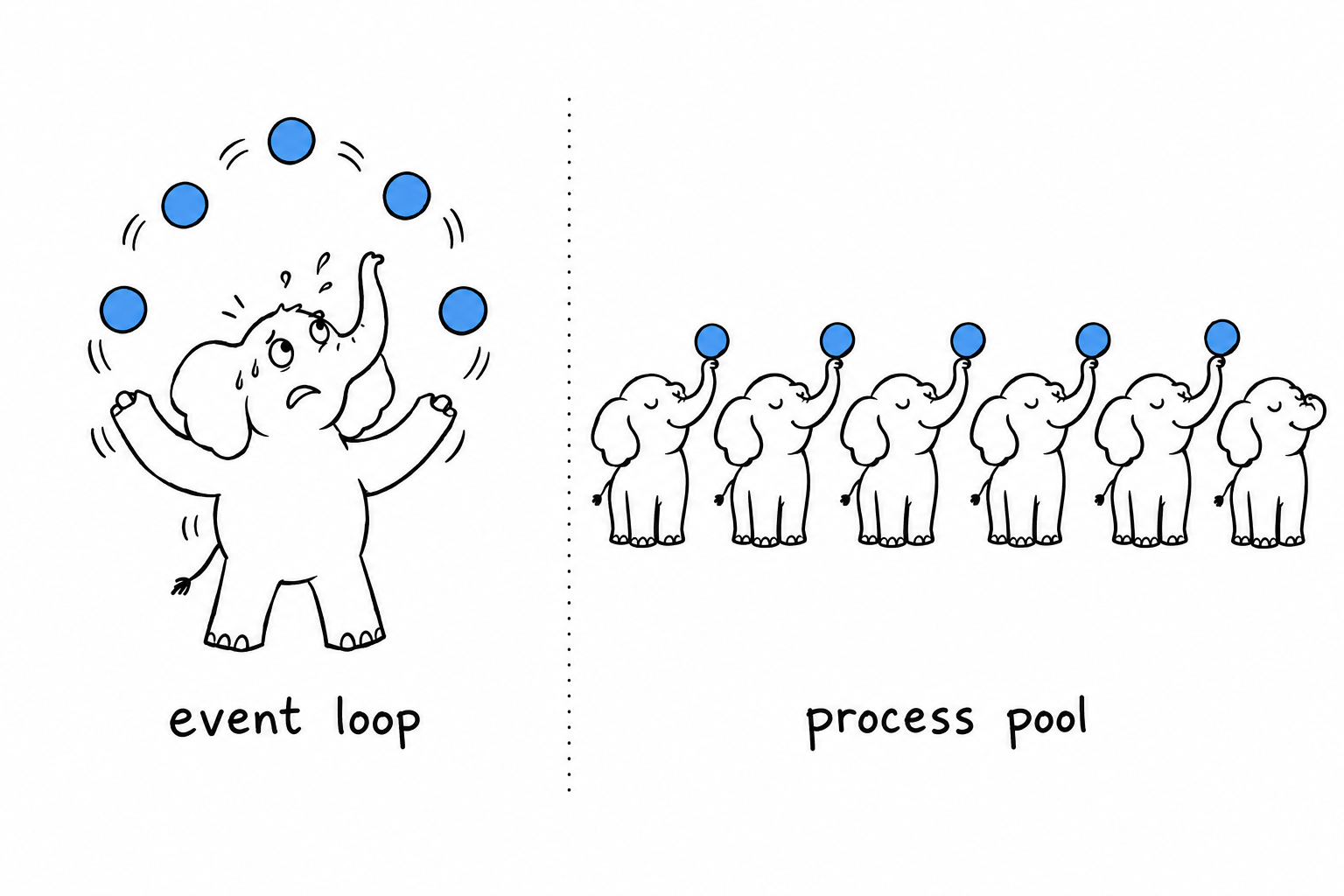
What you do not get
There are no threads in userland. A parallel extension exists for thread-safe (ZTS) builds, and almost nobody uses it. The standard build is NTS, non-thread-safe, because the shared-nothing model never needed threads.
There is also no built-in scheduler. Fibers (PHP 8.1) are stackful coroutines: a function can suspend itself, and whoever holds the fiber can resume it later. That is all. Nothing decides when to resume, nothing multiplexes sockets. A fiber is a building block, and async libraries build on it so that ordinary-looking code can yield in the middle of a blocking call.
<?php
declare(strict_types=1);

$fiber = new Fiber(function (string $greeting): string {
    $name = Fiber::suspend('who is there?');

    return "$greeting, $name";
});

$question = $fiber->start('Hello');   // runs until suspend()
echo $question, PHP_EOL;              // who is there?

$fiber->resume('Ada');                // runs to the return
echo $fiber->getReturn(), PHP_EOL;    // Hello, Ada
You will read code like this inside a library. You will not write it in an application. The Python equivalent is a generator-based coroutine before asyncio existed: the mechanism without the runtime.
When you do need async
Some workloads do not fit one-request-one-process: a websocket server holding ten thousand idle connections, long polling, a crawler making a hundred outbound HTTP calls at once. For those, PHP has async runtimes, and they are libraries, not language features. Alphabetically: AMPHP, ReactPHP, and Swoole or its fork OpenSwoole, the last two being extensions. The first two are pure PHP built on fibers and stream selection; Swoole brings its own event loop in C.
The worker runtimes from How PHP Runs, FrankenPHP and RoadRunner, are a different answer to a different question: they keep your application booted between requests, still one request at a time per worker. They cut startup cost. They do not make your code concurrent.
Before reaching for any of these, ask whether the problem is actually concurrency. A typical web application never needs them. Ten more FPM workers cost a configuration line.
Background work
The request has thirty seconds and a response to send. Anything longer, or anything the user does not wait for, leaves the request.
The idiom is a queue and a worker. The request pushes a job (a row in a table, a message in a broker) and returns. A CLI script, started by a process supervisor, loops forever pulling jobs and running them. It has no time limit and no memory limit unless you set them, so set them: memory_limit in the ini, and a counter that exits cleanly after a few thousand jobs so the supervisor restarts a fresh process. Leaking memory in a loop that never ends is the one place PHP’s per-request cleanup does not save you.
Cron covers the scheduled case. The CLI has the rest of the toolbox: proc_open() runs a subprocess with pipes, pcntl_fork() forks the current one (CLI only, never under FPM), and curl_multi_exec() performs parallel HTTP requests with no library at all:
<?php
declare(strict_types=1);

$urls = ['https://example.com/a', 'https://example.com/b', 'https://example.com/c'];
$multi = curl_multi_init();
$handles = [];

foreach ($urls as $url) {
    $handle = curl_init($url);
    curl_setopt($handle, CURLOPT_RETURNTRANSFER, true);
    curl_multi_add_handle($multi, $handle);
    $handles[$url] = $handle;
}

do {
    $status = curl_multi_exec($multi, $running);
    if ($running) {
        curl_multi_select($multi);
    }
} while ($running && $status === CURLM_OK);

foreach ($handles as $url => $handle) {
    echo $url, ': ', strlen((string) curl_multi_getcontent($handle)), " bytes\n";
    curl_multi_remove_handle($multi, $handle);
}
Three requests, one wait. That is as much parallelism as most scripts ever need.
Where the time goes
The interpreter is rarely the bottleneck. A request spends its time waiting on the database, the cache, the filesystem and other services. Optimising a loop that runs in two milliseconds while a query takes eighty is the classic mistake, and it is language-independent.
The one setting that matters is OPcache, described in How PHP Runs. Make sure it is on and that opcache.memory_consumption is large enough for the whole codebase (opcache_get_status() tells you). Two refinements sit on top:
- Preloading (
opcache.preload=preload.php) compiles a list of files once at FPM startup and keeps them linked in memory, so classes need no autoloading at all. It requires a restart to pick up changes, which is why it is a production setting. - The JIT compiles hot code paths to machine code. It makes CPU-bound work faster, sometimes a lot, and makes a typical web request faster by very little. Enable it (
opcache.jit=tracing,opcache.jit_buffer_size=64M), measure, keep it if it helped.
Autoloading has a cost, and Composer can remove most of it. composer dump-autoload -o generates a class map so no filesystem lookup happens per class; --classmap-authoritative goes further and never touches the filesystem for a class that is not in the map. Both belong in the deployment script. realpath_cache_size in the ini, a few megabytes, keeps PHP from re-resolving paths on every request.
Measuring
Nothing above is worth doing before a measurement. The language provides the two primitives:
<?php
declare(strict_types=1);

$numbers = range(1, 1_000_000);

$start = hrtime(true);
$doubled = array_map(fn (int $n): int => $n * 2, $numbers);
$mapTime = hrtime(true) - $start;

$start = hrtime(true);
$doubled = [];
foreach ($numbers as $n) {
    $doubled[] = $n * 2;
}
$loopTime = hrtime(true) - $start;

printf("array_map: %.1f ms\n", $mapTime / 1e6);
printf("foreach:   %.1f ms\n", $loopTime / 1e6);
printf("peak memory: %.1f MB\n", memory_get_peak_usage() / 1e6);
Both lines land in the tens of milliseconds for a million elements. The gap between them is small and depends on the PHP version. The lesson is not which one wins; it is that a million iterations cost less than one slow query, so write the readable one.
For a real profile, Xdebug has a profiler mode (xdebug.mode=profile) that writes call graphs your editor can open, and sampling profilers exist as extensions for production, where Xdebug’s overhead is unacceptable. Point either at one slow request and read the top of the list.
Memory follows the same rule. A request that builds a hundred-thousand-row array and dies at memory_limit needs a generator, as Functions and Closures showed, not a bigger limit. unset() releases a variable, and the garbage collector handles reference cycles on its own; gc_collect_cycles() forces a pass, which a long-running worker may call between jobs.
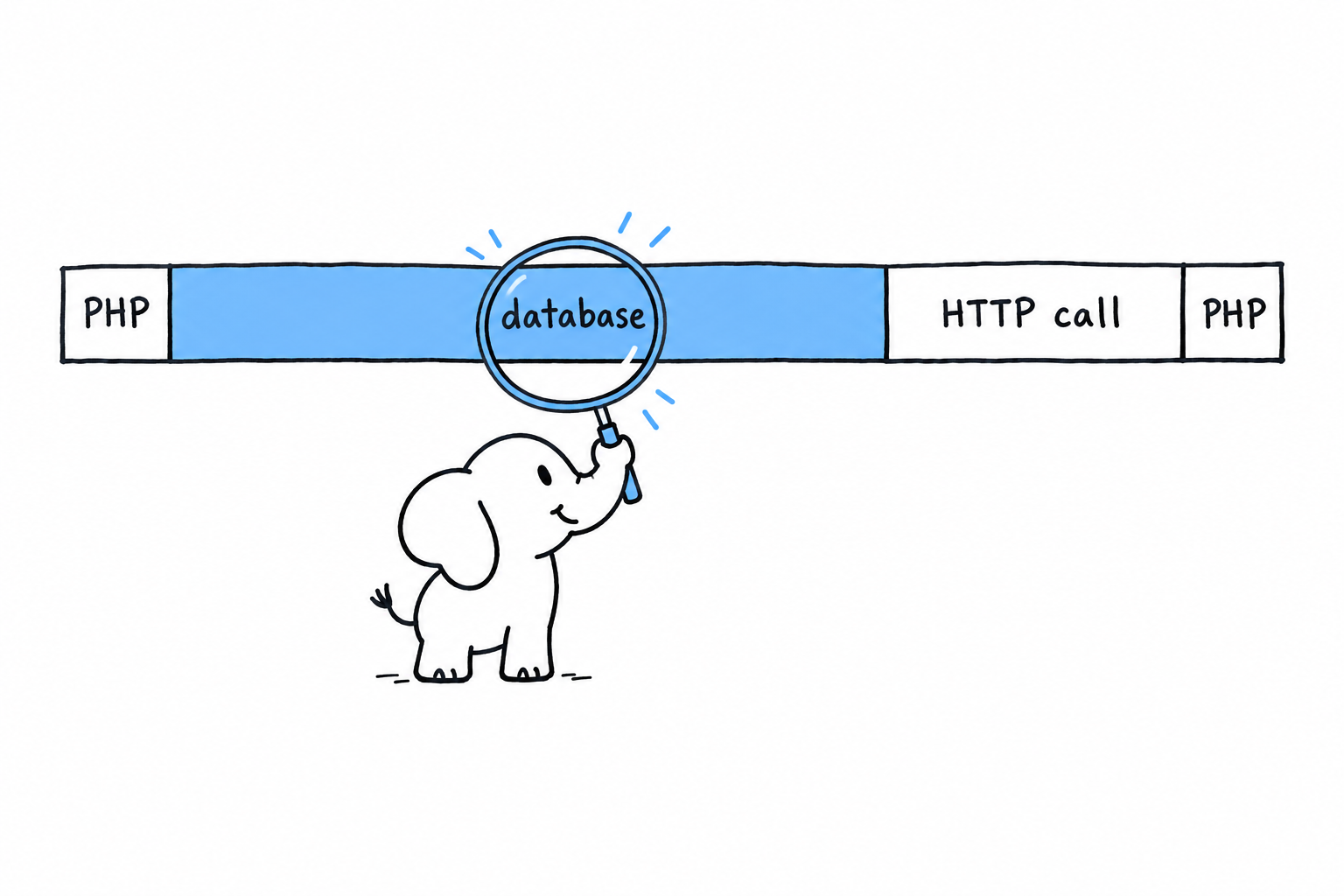
The trap
The first mistake is importing a concurrency model because the last language needed it. An async runtime under a CRUD application adds a layer, a set of libraries that must be fiber-aware, and a class of bugs (shared state between requests) that FPM made impossible. The gain is nothing, because the requests were never waiting on each other.
The second is optimising without a number. The JIT flag, the class map, the rewritten loop: each is a hypothesis. hrtime() on the slow path, before and after, turns it into a result.
With the runtime, the language and the tools covered, one reader is left. Returning to PHP After Years Away is for the developer whose last PHP had mysql_query in it.
Returning to PHP After Years Away
You wrote PHP once. Maybe a lot of it, maybe in 2008, maybe in 2015 on a project that was already old. You remember mysql_query, array(), require_once at the top of every file, and a language that let you get away with anything. Now you are back, and the first thing to know is this: almost every habit you remember has a modern replacement, and most of the old forms are deprecated or gone.
This chapter is a list of pairs. On the left, what you remember. On the right, what you write today. The rest of the book explains each replacement in depth; this is the map.
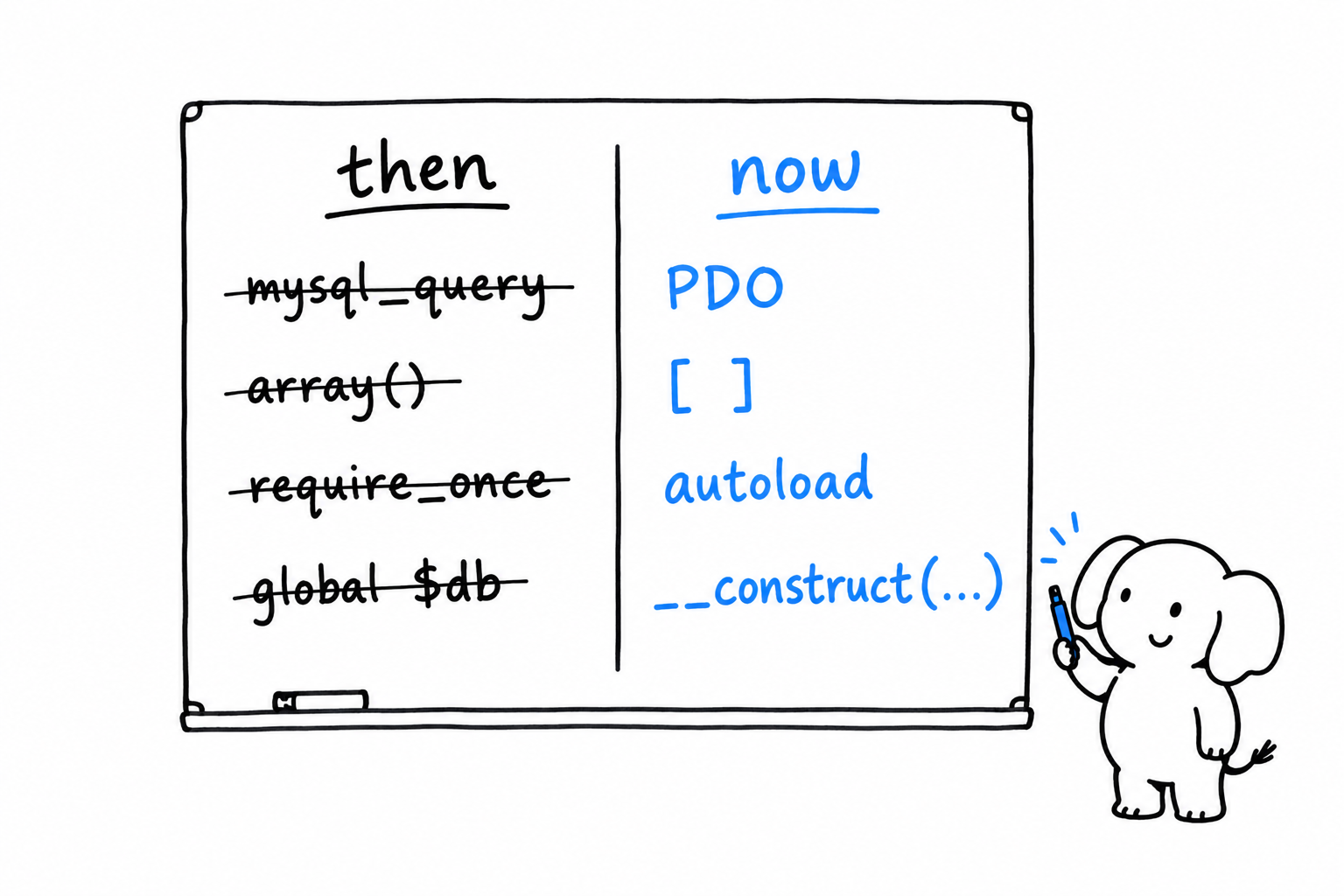
The database
You remember building SQL by hand and passing it to mysql_query(). The mysql_* functions were removed in PHP 7.0. Code that calls them does not run on any supported version of PHP. The replacement is PDO with prepared statements, which also closes the injection hole the old style opened:
<?php
declare(strict_types=1);

// then
// $result = mysql_query("SELECT * FROM users WHERE id = " . $_GET['id']);

// now
$pdo = new PDO('sqlite::memory:', options: [PDO::ATTR_ERRMODE => PDO::ERRMODE_EXCEPTION]);
$stmt = $pdo->prepare('SELECT * FROM users WHERE id = :id');
$stmt->execute(['id' => (int) ($_GET['id'] ?? 0)]);
$user = $stmt->fetch(PDO::FETCH_ASSOC);
mysqli still exists and is fine, but PDO speaks to every database with one API. A Web Request, Without a Framework shows it in context.
Loading code
You remember a wall of require_once lines, or a home-made __autoload() function. Today one line loads everything: require __DIR__ . '/vendor/autoload.php';. Composer generates that file from a namespace-to-folder map in composer.json, and __autoload() itself was removed in 8.0. Classes live one per file, named after the class, and are found on first use. Namespaces, Composer, and Autoloading covers the setup, which takes five minutes.
Composer also replaced the habit of copying a library into your project. Since 2012, composer require vendor/package fetches it from Packagist, pins the version in a lockfile, and updates it when you ask.
Syntax that got shorter
Small changes, but you will see them on every line.
// then
$list = array(1, 2, 3);
$name = isset($_GET['n']) ? $_GET['n'] : 'anon';
$double = function ($x) use ($factor) {
    return $x * $factor;
};
$callback = array($obj, 'method');
call_user_func_array($callback, array(1));
// now
$list = [1, 2, 3];
$name = $_GET['n'] ?? 'anon';
$double = fn($x) => $x * $factor;
$callback = $obj->method(...);
$callback(1);
[] arrived in 5.4, ?? in 7.0, arrow functions fn in 7.4, and the first-class callable syntax $obj->method(...) in 8.1. String callables like 'Class::method' and call_user_func() still work; nobody writes them anymore because the new form is checked by the editor and the analyser, and a callable is simply called with parentheses.
Types
You remember functions that accepted anything and returned whatever. Today functions declare their types, and one line per file makes PHP enforce them.
<?php
declare(strict_types=1);

// then
// function total($items, $rate) { ... }

// now
function total(array $items, float $rate): float
{
    return array_sum($items) * $rate;
}

total([10, 20], '1.2'); // TypeError: must be of type float, string given
Scalar types came in 7.0, return types with them, nullable ?int in 7.1, union types in 8.0, and typed properties in 7.4. declare(strict_types=1) switches off silent coercion for calls made from that file. Types has the precise rules.
Control flow and constants
You remember switch with its fallthrough and loose comparison, and a class full of const STATUS_ACTIVE = 'active';. match replaced the first, enums the second.
<?php
declare(strict_types=1);

enum Status: string
{
    case Active = 'active';
    case Archived = 'archived';
}

function label(Status $status): string
{
    return match ($status) {
        Status::Active => 'In use',
        Status::Archived => 'Put away',
    };
}
match (8.0) compares with ===, does not fall through, and throws if no arm fits. Enums (8.1) are real types: a function typed Status cannot receive the string 'deleted'. Enums and match goes further.
Classes
You remember a private property, a getter, and a setter, times ten per class. Constructor promotion and readonly collapse that to one line per property.
<?php
declare(strict_types=1);

final class Money
{
    public function __construct(
        public readonly int $cents,
        public readonly string $currency,
    ) {
    }
}

$price = new Money(1999, 'EUR');
echo $price->cents; // 1999
$price->cents = 0;  // Error: Cannot modify readonly property
Promotion arrived in 8.0, readonly in 8.1. Property hooks (PHP 8.4) handle the case where a getter really did compute something, by attaching get and set blocks to the property itself. Classes shows all of it.
Two things you remember are now removed or deprecated. PHP 4 style constructors, where the method was named after the class, were removed in 8.0. Dynamic properties, assigning $obj->whatever without declaring it, have been deprecated since 8.2 and are planned to become an error in the next major version.
Errors
You remember @mysql_connect(...) or die('no db'), and warnings printed into the middle of the page. Today errors are exceptions, and you catch them. Internal functions throw TypeError and ValueError instead of returning false with a warning, division by zero throws, and frameworks convert the remaining warnings into exceptions with an error handler. @ still exists. Treat it as a smell. Errors and Exceptions explains the hierarchy.
Globals
You remember global $db; at the top of every function. Today the dependency comes in through the constructor.
<?php
declare(strict_types=1);

final class UserRepository
{
    public function __construct(private readonly PDO $pdo)
    {
    }
}
The object that needs a database receives one. It can be tested with a different one. Frameworks automate the wiring with a container; the idea needs none.
register_globals, which turned every request parameter into a variable, was removed in 5.4. $_REQUEST still exists and nobody uses it: read $_GET or $_POST and say which you mean. extract() and variable variables ($$name) are still legal and appear in no modern codebase.
Text and dates
You remember date('Y-m-d', $timestamp) and utf8_encode(). Dates are DateTimeImmutable objects, and text is UTF-8 everywhere.
<?php
declare(strict_types=1);

$due = new DateTimeImmutable('2026-03-01', new DateTimeZone('UTC'));
echo $due->modify('+30 days')->format('Y-m-d'); // 2026-03-31
utf8_encode() and utf8_decode() only ever handled Latin-1 and have been deprecated since 8.2; mb_convert_encoding() does the job for any encoding. ereg_* was removed in 7.0, preg_* stayed. The ${var} form of string interpolation has been deprecated since 8.2; write {$var}. Strings, Numbers, Dates, and JSON has the rest.
Small things that are gone
each()andcreate_function(), removed in 8.0. Useforeachand closures.- The
(unset)cast, removed in 8.0. - Implicit nullable parameters,
Foo $x = nullwithout the?, deprecated in 8.4. Write?Foo $x = null. split(), removed in 7.0. Useexplode()orpreg_split().mb_internal_encoding('UTF-8')at the top of files. The default has been UTF-8 since 5.6.
Getting a PHP 5 codebase onto PHP 8
It will not run as is. The mysql_* calls alone guarantee that. The mechanical part, at least, is automated: Rector rewrites old syntax to new syntax, version by version, from a config that names your target. Point it at the code, review the diff, run the tests you hopefully have, and repeat. PHPStan or Psalm then find what Rector could not. Tests, Static Analysis, and Tooling introduces both.
Plan for the work. A site still running PHP 5 today is running a version that stopped receiving security fixes in 2018. It is a liability before it is a codebase.
The rhythm of releases
PHP now ships one minor version every November: 8.0 in 2020, 8.1 in 2021, and so on to 8.5 in 2025. Each version gets two years of active support and two more of security fixes; php.net/supported-versions has the dates. A yearly release means a yearly, small, deprecation list to read, and a codebase that never drifts far from current.
Judge the language by its release notes, not by the codebase you are returning to. The codebase is a snapshot of when it was written. The language kept moving.
Where to Go from Here lists the places to keep up.
Where to Go from Here
The book stops here. The language does not, and neither does the project you were handed. Four places keep you current, and none of them belongs to a vendor.
The manual
php.net is the reference, and it is a good one. Every function has a page with its signature, its changelog by version, and examples that run. The user-contributed notes under each page are a mixed bag; the text above them is not. Bookmark the migration guides, one per version (php.net/manual/en/migration85.php and its siblings): they list every deprecation and every new feature, and reading the one for your project’s next version is the cheapest upgrade planning you will do.
The RFC wiki
Every change to the language goes through a public proposal, a discussion on the internals mailing list, and a vote by the core developers. The proposals live at wiki.php.net/rfc, accepted, declined, and in progress. Reading the accepted RFCs for a version tells you not just what changed but why, with the alternatives that were rejected and the arguments against. When a feature looks odd, its RFC usually explains the constraint that made it so.
The Foundation and the FIG
The PHP Foundation funds the core developers who maintain the interpreter and shepherds the language’s direction. Its blog reports on releases and on what is being worked on. The PHP-FIG (Framework Interoperability Group) publishes the PSRs and the PER Coding Style, the interfaces and conventions that let libraries from different authors work together. When a codebase mentions PSR-something, the FIG site has the two-page spec.
The framework your project uses
Most PHP projects sit on a framework, and the framework’s own documentation is where to learn it. Full-stack frameworks: CakePHP, Laminas, Laravel, Symfony, Yii. Micro-frameworks built around PSR-15 middleware: Mezzio, Slim. Content platforms with their own conventions: Drupal, Joomla, TYPO3, WordPress.
One habit pays off from the first day. When you read framework code, sort what you see into two piles: the language, and the framework. A readonly promoted constructor, an enum in a match, a ?-> chain: that is PHP, and it means the same thing everywhere. A facade, a service container binding, a magic __call that routes to a query builder: that is the framework, and it is documented by the framework. Confusing the two piles is how people come to believe that PHP is whatever their first framework made it look like.
A longer road
This book skipped the basics on purpose. If you want the ground-up version, with a small game, a command line tool and a web application built from nothing, the companion volume, The PHP Book, takes that road at a walking pace. It is published from the same repository as this one.
Beyond the written word, PHP has user groups in most cities and conferences on most continents. A room full of people who have solved the problem you are about to meet is worth an afternoon.
The promise
Two to three hours ago, you opened a codebase and saw $this-> and :: and a runtime model you did not recognise. You now know how PHP runs, how it types, how it packages code, and where it will surprise you. The old reputation is filed where it belongs, in the chapter about the past.
The codebase is legible. Go read it.
Appendix
Three lookup tables for the moments when you need a fact, not a chapter. A - Coming from Python, JavaScript, or Java maps the constructs you already know to their PHP spelling, one row each. B - PHP 8.0 to 8.5 at a Glance lists what each version added, so you know what your project’s PHP can use. C - Vocabulary defines the words that come up in PHP conversations and nowhere else.
A - Coming from Python, JavaScript, or Java
One row per construct, the spelling you know on the left, the modern PHP spelling on the right. Where PHP offers an old form and a new one, only the new one is listed.
| Concept | Python | JavaScript | Java | PHP |
|---|---|---|---|---|
| Variable | x = 1 | let x = 1 | int x = 1; | $x = 1; |
| Constant | X = 1 (convention) | const X = 1 | static final int X = 1; | const X = 1; |
| String interpolation | f"hi {name}" | `hi ${name}` | "hi " + name | "hi {$name}" |
| String concat | a + b | a + b | a + b | $a . $b |
| Multi-line string | """...""" | `...` | """...""" | <<<TXT ... TXT; |
| Integer division | a // b | Math.trunc(a / b) | a / b | intdiv($a, $b) |
| Exponent | a ** b | a ** b | Math.pow(a, b) | $a ** $b |
| Strict equality | a == b | a === b | a.equals(b) | $a === $b |
| Null coalescing | a if a is not None else b | a ?? b | Optional.ofNullable(a).orElse(b) | $a ?? $b |
| Ternary | a if c else b | c ? a : b | c ? a : b | $c ? $a : $b |
| List literal | [1, 2] | [1, 2] | List.of(1, 2) | [1, 2] |
| Dict literal | {"k": 1} | {k: 1} | Map.of("k", 1) | ['k' => 1] |
| List append | xs.append(v) | xs.push(v) | xs.add(v) | $xs[] = $v; |
| Dict lookup with default | d.get("k", 0) | d.k ?? 0 | d.getOrDefault("k", 0) | $d['k'] ?? 0 |
| Length | len(xs) | xs.length | xs.size() | count($xs) |
| String length | len(s) | s.length | s.length() | mb_strlen($s) |
| Slice | xs[1:3] | xs.slice(1, 3) | xs.subList(1, 3) | array_slice($xs, 1, 2) |
| Iterate list | for v in xs: | for (const v of xs) | for (var v : xs) | foreach ($xs as $v) |
| Iterate dict | for k, v in d.items(): | for (const [k, v] of Object.entries(d)) | for (var e : d.entrySet()) | foreach ($d as $k => $v) |
| Map | [f(v) for v in xs] | xs.map(f) | xs.stream().map(f) | array_map($f, $xs) |
| Filter | [v for v in xs if p(v)] | xs.filter(p) | xs.stream().filter(p) | array_filter($xs, $p) |
| Lambda | lambda x: x * 2 | x => x * 2 | x -> x * 2 | fn($x) => $x * 2 |
| Closure capture | by reference | by reference | effectively final | by value (use ($x) or fn) |
| Default argument | def f(x=1): | function f(x = 1) | overload | function f(int $x = 1) |
| Named argument | f(x=1) | f({x: 1}) | none | f(x: 1) |
| Variadic | def f(*xs): | function f(...xs) | void f(int... xs) | function f(int ...$xs) |
| Class | class A: | class A {} | class A {} | class A {} |
| Constructor | def __init__(self, x): | constructor(x) {} | A(int x) {} | public function __construct(public int $x) {} |
| Instance member | self.x | this.x | this.x | $this->x |
| Static member | A.x | A.x | A.x | A::$x |
| Interface | Protocol | none (TS: interface) | interface A {} | interface A {} |
| Enum | class C(Enum): | none (TS: enum) | enum C { A, B } | enum C { case A; case B; } |
| Catch exception | except E as e: | catch (e) | catch (E e) | catch (E $e) |
| Safe navigation | none | a?.b | Optional.map | $a?->b |
| String to int | int(s) | parseInt(s) | Integer.parseInt(s) | (int) $s |
| Type check | isinstance(x, A) | x instanceof A | x instanceof A | $x instanceof A |
print(x) | console.log(x) | System.out.println(x) | echo $x; | |
| Import | from a import B | import { B } from 'a' | import a.B; | use A\B; |
| Package manager | pip, pyproject.toml | npm, package.json | Maven, pom.xml | Composer, composer.json |
| Test runner | pytest | Jest, Vitest | JUnit | PHPUnit, Pest |
| Formatter | black, ruff | Prettier | google-java-format | PHP-CS-Fixer, PHP_CodeSniffer |
| Static analysis | mypy, pyright | tsc | the compiler | PHPStan, Psalm |
| Run a script | python a.py | node a.js | java A.java | php a.php |
| REPL | python | node | jshell | php -a |
Four things that are different, not just spelled differently
- A request starts from nothing and ends with nothing. No process stays alive between two requests. How PHP Runs.
- Arrays are values. Assign or pass one and you get a copy. Objects are handles. Arrays.
- Closures capture by value, at creation time. A later change to the outer variable is not seen. Functions and Closures.
- Strict typing is a per-file switch.
declare(strict_types=1)governs the calls made from that file, and only that file. Types.
B - PHP 8.0 to 8.5 at a Glance
One section per version, headline features only. Find your project’s version, then read down from there to see what you can use.
PHP 8.0, November 2020
- Named arguments:
str_pad(string: 'a', length: 3). - Attributes:
#[Route('/home')]as structured metadata read by reflection. - Constructor property promotion:
public function __construct(private int $x) {}. - Union types:
int|string $id. matchexpression: strict comparison, no fallthrough, exhaustive.- Nullsafe operator:
$user?->address?->city. mixedandstaticas types.throwas an expression:$x = $y ?? throw new Exception();.str_contains(),str_starts_with(),str_ends_with().Stringableinterface, implemented automatically by any class with__toString().WeakMap.- JIT compiler, inside OPcache.
- Saner string-to-number comparisons:
0 == 'foo'isfalse. - Trailing comma allowed in parameter lists.
- Internal functions throw
TypeErrorandValueErrorinstead of warning and returningnullorfalse.
PHP 8.1, November 2021
- Enums, pure and backed:
enum Suit: string { case Hearts = 'H'; }. readonlyproperties:public readonly int $x.- First-class callable syntax:
strlen(...). - Fibers: stackful coroutines, the building block of async libraries.
newin initializers:public function __construct(private Logger $l = new NullLogger()) {}.- Pure intersection types:
Countable&Traversable. neverreturn type.finalclass constants.- Array unpacking with string keys:
[...$defaults, ...$options]. array_is_list().- Explicit octal notation:
0o16.
PHP 8.2, December 2022
readonlyclasses:final readonly class Point {}.- Disjunctive normal form types:
(A&B)|null. - Standalone
true,falseandnulltypes. - Dynamic properties deprecated;
#[\AllowDynamicProperties]opts a class back in. #[\SensitiveParameter]to redact an argument from stack traces.- Constants in traits.
Random\Randomizerand therandomextension.- Enum cases usable in constant expressions.
PHP 8.3, November 2023
- Typed class constants:
const string NAME = 'x';. #[\Override]attribute: the engine checks that a parent method exists.json_validate().- Dynamic class constant fetch:
Foo::{$name}. readonlyproperties can be reinitialised inside__clone().Randomizer::getBytesFromString(),Randomizer::getFloat().- Negative array indices behave consistently.
mb_str_pad().
PHP 8.4, November 2024
- Property hooks:
public string $name { get => ...; set => ...; }. - Asymmetric visibility:
public private(set) int $x. newwithout parentheses when chaining:new Foo()->bar().- Lazy objects:
ReflectionClass::newLazyGhost(),newLazyProxy(). #[\Deprecated]attribute for your own code.array_find(),array_find_key(),array_any(),array_all().mb_trim(),mb_ltrim(),mb_rtrim(),mb_ucfirst(),mb_lcfirst().- New DOM extension with an HTML5 parser:
Dom\HTMLDocument. - BCMath object API:
BcMath\Number. - PDO driver subclasses:
Pdo\Sqlite,Pdo\Mysql,Pdo\Pgsql, viaPdo::connect(). request_parse_body()for form bodies on any HTTP method.- Implicitly nullable parameters (
Foo $x = nullwithout?) deprecated. exitanddieare now functions.
PHP 8.5, November 2025
- Pipe operator:
$slug = $title |> trim(...) |> strtolower(...);. clonewith property updates:clone($point, ['x' => 3]).#[\NoDiscard]attribute, warning when a return value is ignored;(void)cast to silence it on purpose.array_first(),array_last().- Closures and first-class callables in constant expressions (attribute arguments, default values, constants).
- Attributes on constants.
- New
uriextension:Uri\Rfc3986\Uri,Uri\WhatWg\Url. - Fatal errors now include a backtrace.
get_error_handler(),get_exception_handler().#[\DelayedTargetValidation].PHP_BUILD_DATEconstant.- The backtick shell-execution operator is deprecated.
Support policy
Each version gets two years of active support (bug fixes) followed by two years of security fixes only. A version released in November 2025 is therefore active until late 2027 and patched until late 2029. Dates move with each release; php.net/supported-versions has the current table. Running a version past its security window is a risk you take knowingly or not at all.
Finding your project’s version
php -v prints the interpreter you run locally. composer.json declares what the project supports under require.php ("php": "^8.3"), and config.platform.php pins the version Composer resolves against, which is the one to trust when the two differ. Production may run something else again; phpinfo() or php -v on the server settles it.
C - Vocabulary
The words that come up in PHP conversations and rarely anywhere else. One or two sentences each.
SAPI. Server API: the layer that connects the interpreter to whatever runs it. The command line, PHP-FPM, mod_php and the embedded runtimes are all SAPIs over the same engine.
CLI. The command-line SAPI, invoked as php file.php. It has no execution time limit and no memory limit by default, unlike the web SAPIs.
FPM. FastCGI Process Manager: a pool of PHP processes waiting for requests behind a web server. The standard way to serve PHP.
FastCGI. The protocol the web server uses to hand a request to FPM and read the response back.
mod_php. The Apache module that embeds PHP in the web server process itself. Older than FPM and still around.
OPcache. The bytecode cache. Compiled files stay in shared memory so the next request skips parsing. On in every serious setup.
JIT. Just-in-time compilation of hot code to machine code, inside OPcache, since 8.0. Helps CPU-bound scripts; changes little for typical web traffic.
Preloading. An OPcache option that compiles and links a set of files once at server start, so every request begins with them already loaded.
APCu. A memory cache shared between the PHP processes of one machine. For values you compute once and read often, when an external store is overkill.
Extension. A compiled C module that adds functions or classes to PHP: pdo_mysql, intl, mbstring, xdebug. php -m lists the loaded ones.
PECL. The historical repository of extensions not bundled with PHP, with its own installer.
PIE. The newer installer for extensions, Composer-style, meant to succeed the PECL workflow.
ZTS and NTS. Thread-safe and non-thread-safe builds of the interpreter. NTS is the default and the one FPM uses; ZTS exists for the rare threaded SAPIs and the parallel extension.
php.ini. The configuration file. The CLI and FPM read different ones, which explains most “it works in the terminal” mysteries.
Composer. The package manager. Reads composer.json, writes composer.lock, fills vendor/, generates the autoloader.
Packagist. The public package registry Composer fetches from.
vendor. The folder Composer installs packages into. Never edited, never committed.
Autoload. The mechanism that loads a class file the first time the class is used, so no require line is ever written by hand.
PSR-4. The standard mapping from namespace to folder that autoloaders follow: App\Billing\Invoice lives in src/Billing/Invoice.php.
PHP-FIG. Framework Interoperability Group: the body that publishes the PSRs and the coding style.
PSR. PHP Standards Recommendation: a numbered interface or convention (PSR-3 logging, PSR-7 HTTP messages, PSR-15 middleware) that libraries agree on so they can be swapped.
PER Coding Style. The current code style standard from the FIG, successor of PSR-12. What formatters enforce.
RFC. Request for Comments: the public proposal every language change goes through before a vote of the core developers.
PHP Foundation. The non-profit that, since 2021, employs core developers to maintain and advance the interpreter.
php-src. The source repository of the interpreter itself, written in C.
Zend Engine. The core of the interpreter: the compiler and the executor. The name survives in a few settings and error messages.
Superglobal. A built-in array visible in every scope: $_GET, $_POST, $_SERVER, $_COOKIE, $_FILES, $_SESSION, $_ENV.
Docblock. A /** ... */ comment above a symbol, carrying @param and @return annotations that editors and static analysers read. Where generics live.
Attribute. Structured metadata attached to a class, method, property or parameter with #[...], read through reflection. What annotations were in Java.
Trait. A block of methods and properties copied into any class that uses it. Horizontal reuse without inheritance.
Enum. A type with a fixed set of named cases, optionally backed by an int or a string, with methods and interfaces. Since 8.1.
Fiber. A stackful coroutine that can suspend and resume from anywhere in its call stack. The primitive async libraries build on; not something application code drives directly.
Generator. A function that yields values one at a time and keeps its state between calls. Lazy iteration without building an array.
SPL. Standard PHP Library: the bundled set of data structures, iterators, exceptions and interfaces such as ArrayIterator, SplQueue, Countable, RuntimeException.
PDO. PHP Data Objects: the database abstraction with one API over every driver, prepared statements included.
mbstring. The multibyte string extension. mb_strlen, mb_substr and friends count characters where the plain functions count bytes.
intl. The internationalisation extension: collation, number and date formatting, Unicode normalisation, wrapping the ICU library.
Xdebug. The step debugger and profiler. Development only.
PHPUnit. The xUnit-style test framework most PHP tests are written with.
Pest. A test framework with a describe-and-expect syntax, running on PHPUnit’s engine.
PHPStan. A static analyser that finds type errors and impossible code without running it, with levels from 0 to 10.
Psalm. The other static analyser, with levels from 8 down to 1 and a focus on type soundness and taint analysis.
Rector. An automated refactoring tool that rewrites code to a newer PHP version or a newer library API.
phpt. The test file format of the interpreter itself, in php-src. You meet it if you contribute to PHP or read its bug reports.
strict_types. The per-file declaration declare(strict_types=1); that makes scalar type mismatches on calls from that file throw instead of coerce.
Copy-on-write. The engine trick that makes array assignment cheap: the copy shares memory with the original until one of them is modified.
Late static binding. static:: resolving to the class the call was made on, not the class where the method is written. self:: is the other one.
Magic method. A method with a reserved double-underscore name that the engine calls on its own: __construct, __toString, __get, __call, __clone, __invoke.