Classes
A modern PHP class is short, typed, and mostly immutable. The constructor declares the properties, the types are checked at runtime, and most of the boilerplate you remember from Java, or from PHP 5, is gone. Here is one, whole:
<?php
declare(strict_types=1);

namespace App\Billing;

final class Invoice
{
    private array $lines = [];

    public function __construct(
        public readonly string $number,
        public readonly \DateTimeImmutable $issuedAt,
    ) {
    }

    public function addLine(string $label, int $cents): static
    {
        $this->lines[] = ['label' => $label, 'cents' => $cents];

        return $this;
    }

    public function total(): int
    {
        return array_sum(array_column($this->lines, 'cents'));
    }
}

$invoice = new Invoice('2026-0042', new \DateTimeImmutable('2026-09-14'));
$invoice->addLine('Hosting', 1200)->addLine('Support', 800);

echo $invoice->number, ': ', $invoice->total(), PHP_EOL; // 2026-0042: 2000
Read it top to bottom. namespace puts the class in App\Billing, so its full name is App\Billing\Invoice (the Composer chapter explains how that maps to a file). final forbids subclassing; modern PHP code makes classes final by default and opens them on purpose. The constructor has no body: writing public readonly string $number in the parameter list declares the property, types it, and assigns it, all in one line. This is constructor promotion (PHP 8.0), and it removed most of the ceremony from PHP classes. readonly (PHP 8.1) makes the property assignable once, in the constructor, and never again. static as a return type means “the class of the object this was called on”, which is what a fluent method wants.
Two symbols do all the member access. -> reaches an instance member, :: reaches a static one or a constant. $this is the current object, and you always write it: there is no implicit this.
Objects travel by handle
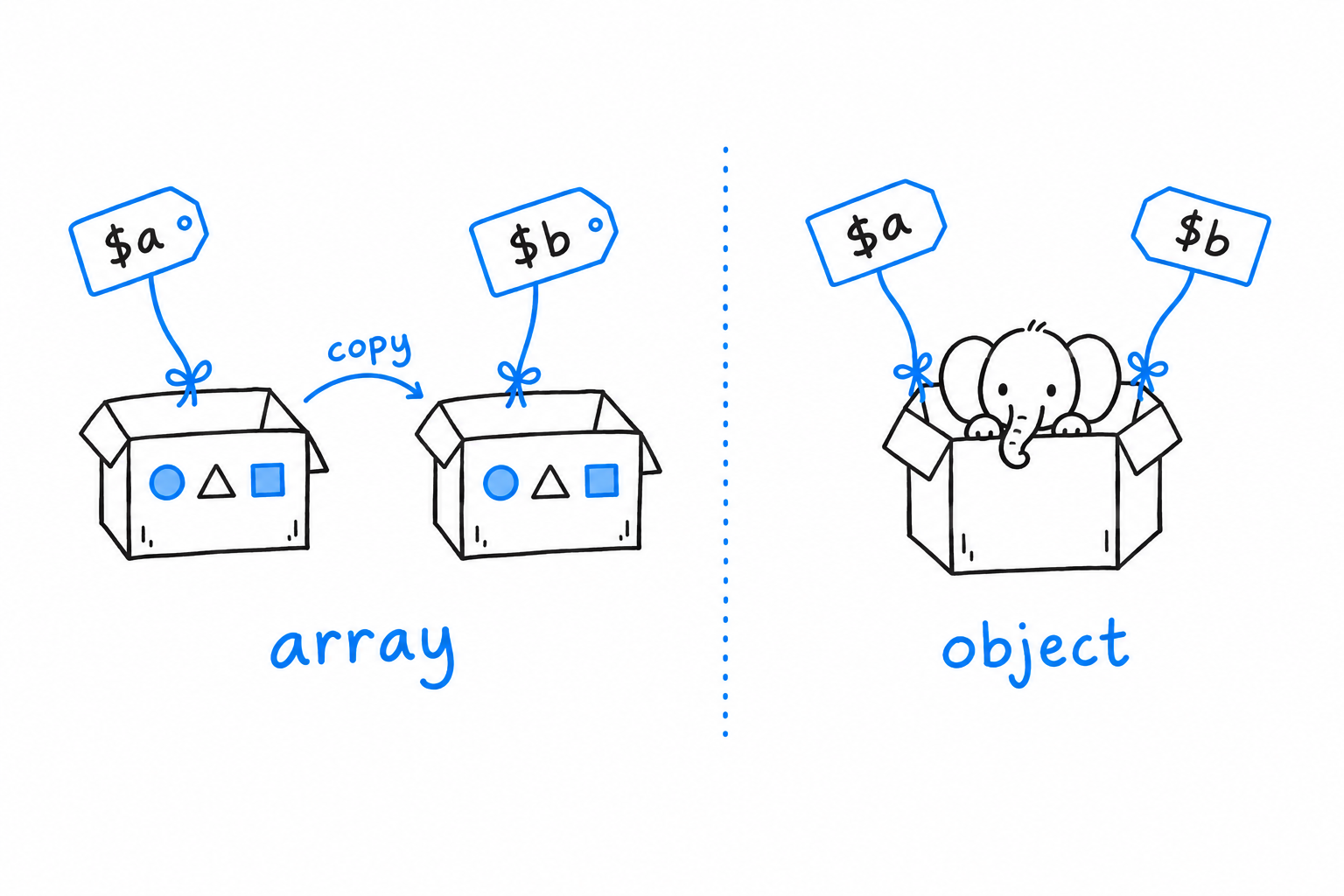
Arrays copy when you assign them (the Arrays chapter has the details). Objects do not. Assigning or passing an object copies a handle to the same object, the way Java, Python and JavaScript do it:
<?php
declare(strict_types=1);

final class Cart
{
    public array $items = [];
}

function addApple(Cart $cart): void
{
    $cart->items[] = 'apple';
}

$cart = new Cart();
addApple($cart);
echo count($cart->items), PHP_EOL; // 1, the caller sees the change
No & is involved: reference parameters (&$x) are a different mechanism, for variables, and you almost never need them with objects.
clone $cart makes a shallow copy: a new object whose properties hold the same values, so an object stored inside is shared between the two copies. Define __clone() if the copy needs its own inner objects.
Two comparisons exist. == compares state, property by property; === asks whether both sides are the same object. $a === clone $a is false.
Immutability without getters
The classic PHP 5 class had a private property, a getter, and sometimes a setter. Three modern features replace that pattern, and you will see all three in codebases written after 2024.
readonly you have met. When every property is readonly, mark the class instead (PHP 8.2):
<?php
declare(strict_types=1);

final readonly class Money
{
    public function __construct(
        public int $amount,
        public string $currency,
    ) {
    }

    public function add(Money $other): self
    {
        return new self($this->amount + $other->amount, $this->currency);
    }
}
Every property is public and nobody can change it. You get a value object with no getters at all.
Asymmetric visibility (PHP 8.4) lets the outside read a property that only the class can write:
// PHP 8.4
final class Counter
{
    public private(set) int $count = 0;

    public function increment(): void
    {
        $this->count++;
    }
}

$c = new Counter();
$c->increment();
echo $c->count; // 1
$c->count = 5;  // Error: Cannot modify private(set) property Counter::$count
That is the getter, gone. Where you need logic on read or write, property hooks (PHP 8.4) attach it to the property itself, like a C# property or Python’s @property:
// PHP 8.4
final class User
{
    public string $email {
        set(string $value) {
            if (!filter_var($value, FILTER_VALIDATE_EMAIL)) {
                throw new \InvalidArgumentException("Invalid email: $value");
            }
            $this->email = strtolower($value);
        }
    }

    public string $domain {
        get => substr($this->email, strpos($this->email, '@') + 1);
    }
}

$u = new User();
$u->email = 'Ada@Example.org';
echo $u->domain; // example.org
To the caller these are plain properties. Inside, set validates and normalises, and get computes. A property with only a get hook and no backing store is a computed property.
Interfaces, abstract classes, traits
Interfaces and abstract classes work as they do in Java and C#: an interface lists method signatures and constants, an abstract class may carry implementation, a class implements many interfaces and extends one parent. #[\Override] (PHP 8.3) on a method makes PHP check that the parent really has it, which catches typos in overrides.
Traits are the part with no exact equivalent in most languages. A trait is a block of methods and properties that the compiler copies into every class that uses it. Ruby’s mixins are the closest anchor; Rust’s traits are not, despite the name.
<?php
declare(strict_types=1);

trait HasTimestamps
{
    private ?\DateTimeImmutable $createdAt = null;

    public function touch(): void
    {
        $this->createdAt ??= new \DateTimeImmutable();
    }
}

final class Article
{
    use HasTimestamps;
}

$a = new Article();
$a->touch();
Traits are handy for cross-cutting helpers and easy to overuse. A class that uses five traits is five files you have to read to know what it does. Prefer composition where you can.
static versus self is a one-paragraph subject. self names the class where the code is written; static names the class of the object at runtime. In a static factory method inside a parent class, new static() builds the subclass that was actually called; new self() always builds the parent.
Construction
PHP has one constructor per class and no method overloading. Two idioms fill the gap: named arguments (PHP 8.0) for optional parameters, and static factory methods for alternative ways to build:
<?php
declare(strict_types=1);

final readonly class Period
{
    private function __construct(
        public \DateTimeImmutable $start,
        public \DateTimeImmutable $end,
    ) {
    }

    public static function fromStrings(string $start, string $end): self
    {
        return new self(new \DateTimeImmutable($start), new \DateTimeImmutable($end));
    }

    public static function year(int $year): self
    {
        return self::fromStrings("$year-01-01", "$year-12-31");
    }
}

$fy = Period::year(2026);
echo $fy->end->format('Y-m-d'), PHP_EOL; // 2026-12-31
A private constructor plus public factories reads as well as a set of overloaded constructors, and it names each variant.
Since PHP 8.4 you can chain a call on a fresh object without wrapping it in parentheses: new Period(...)->start used to need (new Period(...))->start.
For immutable objects, “change” means “make a modified copy”. PHP 8.5 gives that its own syntax: clone($money, ['amount' => 500]) returns a copy with the listed properties replaced. The usual visibility rules apply, and a readonly property can only be written from inside its class, so the call lives in a withAmount() method rather than at the call site. Before 8.5, that same method cloned and assigned inside __clone(), which PHP 8.3 permitted for readonly properties.
Strings, magic, and metadata
Any object can print itself by implementing __toString(). Declaring it makes the class implement Stringable (PHP 8.0) automatically, so you can type a parameter as string|Stringable and accept both.
The other double-underscore methods are hooks the engine calls: __get and __set run when code touches a property that does not exist, __call when it calls a method that does not exist. Frameworks and ORMs use them to build fluent APIs and lazy models. Recognise them; do not reach for them in application code. Related: creating a property that was never declared ($obj->foo = 1 with no $foo in the class) has been deprecated since PHP 8.2 and is planned to become an error in the next major version. Declare your properties.
Attributes (PHP 8.0) are structured metadata on a class, method, property or parameter, read through reflection. Java annotations and C# attributes are the direct anchor:
<?php
declare(strict_types=1);

#[\Attribute(\Attribute::TARGET_METHOD)]
final readonly class Route
{
    public function __construct(public string $path) {}
}

final class HomeController
{
    #[Route('/')]
    public function index(): string
    {
        return 'Hello';
    }
}

$method = new \ReflectionMethod(HomeController::class, 'index');
foreach ($method->getAttributes(Route::class) as $attribute) {
    echo $attribute->newInstance()->path, PHP_EOL; // /
}
An attribute is itself a class marked #[\Attribute]. Nothing happens at runtime until something calls getAttributes(); the metadata is inert until read. Routing, validation, serialisation and test frameworks all build on this.
Invoice::class yields the fully qualified name as a string, which is what you pass around instead of hardcoding 'App\Billing\Invoice'. $x instanceof Invoice checks type at runtime and is false rather than an error when $x is not an object. Lazy objects (PHP 8.4) let a class be instantiated without running its constructor until a property is first touched, a tool for dependency injection containers and ORMs rather than everyday code.
There are no generics. A Collection class holds mixed as far as the engine is concerned; the @template docblocks described in Types give PHPStan and Psalm what the engine lacks.
The trap
A function that receives an object and “just tweaks it a bit” tweaks the caller’s object too. If you meant a local modification, clone first, or design the class as readonly and return a new instance.
And readonly is shallow. It freezes the property slot, not what the slot points to. A readonly array $items cannot be reassigned, but a readonly Cart $cart still lets anyone holding $cart push items into it. Immutability of the whole graph is a design decision, not a keyword.
With classes in hand, the question is how PHP represents a fixed set of choices. Enums and match answers it.