Concise Control Flow with match and ?->
Some values are not one of three or four cases. They are one of two: something, or nothing at all. That is the last fixed set this chapter deals with, and it earns a piece of syntax of its own.
The nullsafe operator
null means “no value here”, as Data Types put it, and -> reaches into an object for a property or a method, as in Chapter 5. Put the two together and you get a question every program eventually asks: what happens when you use -> on something that might be null?
<?php
declare(strict_types=1);

class Address
{
    public function __construct(
        public string $city,
    ) {
    }
}

class Customer
{
    public function __construct(
        public string $name,
        public ?Address $address = null,
    ) {
    }
}

$customer = new Customer('Ada');

echo $customer->address->city; // Error: Attempt to read property "city" on null
Ada has no address on file, so $customer->address is null, and reaching one step further with ->city fails on the spot: there is no property to read on nothing. The classic fix is a guard before the access:
<?php

$city = null;
if ($customer->address !== null) {
    $city = $customer->address->city;
}

echo $city ?? 'No address on file';
It works, and it does not scale. Chain a few more levels, $order->customer->address->city say, and you either nest one guard per link, or write one long condition that checks three things at once and names none of them.
The nullsafe operator, ?->, does the guard for you:
<?php
declare(strict_types=1);

$city = $customer->address?->city;

echo $city ?? 'No address on file';
?-> looks at what stands on its left before going any further. If it is null, the whole expression becomes null right there, with no error and no exception, ready for ?? or whatever else you do with a missing value. If it is not null, ?-> behaves exactly like ->. In a longer chain, $order?->customer?->address?->city stops at the first null it meets and gives null for the entire expression, without trying the accesses after it.
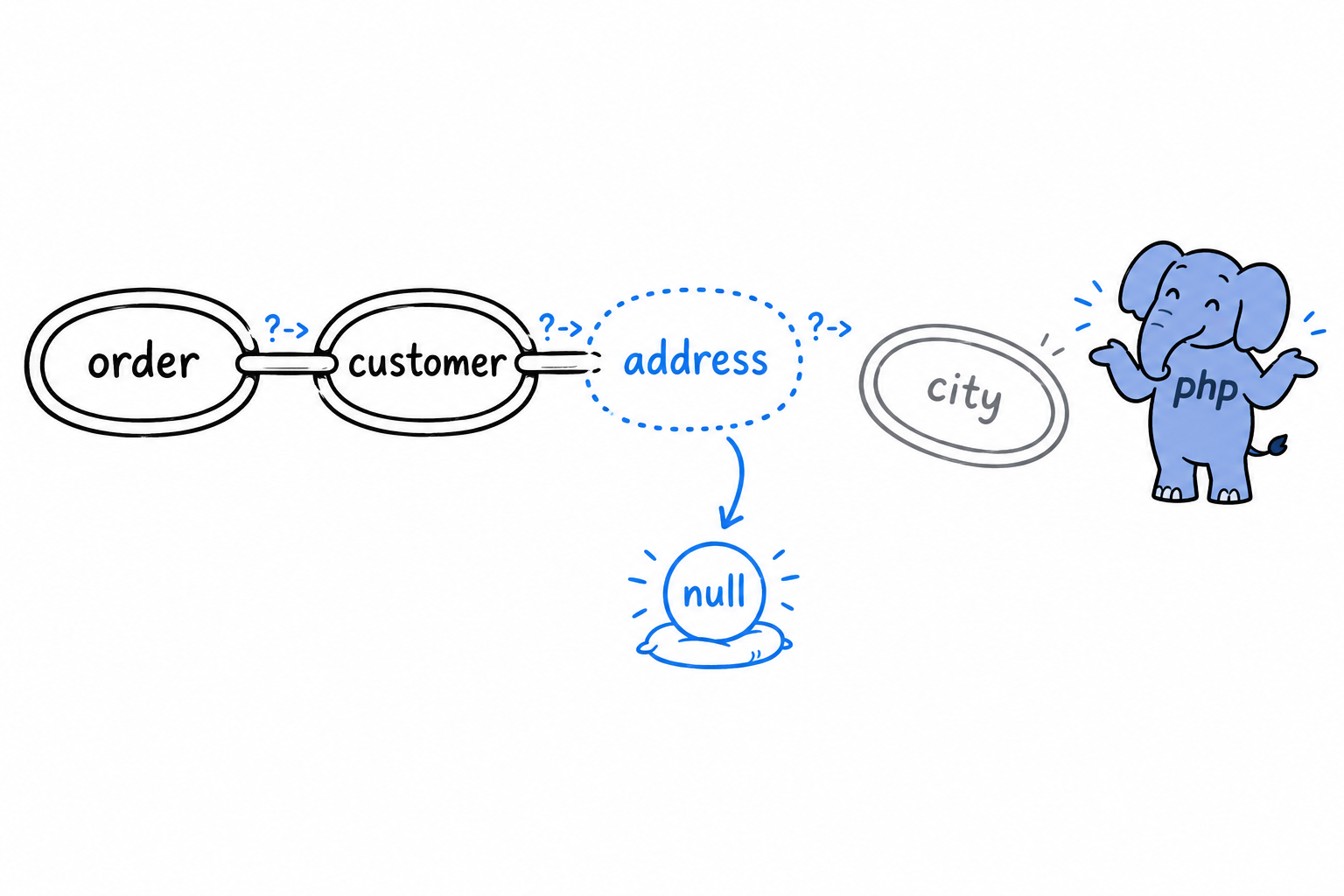
?->stops at the firstnulland hands it back. Everything after it is skipped.
Warning
?->is for values that may legitimately be absent: an optional address, a related record that may not exist yet. It is not a way to avoid deciding whethernullbelongs there at all. Sprinkled everywhere out of habit, it hides a design that never settled what is optional. Where absence is not normal, keep the plain->and let the error tell you something is wrong.
match as the clean alternative to a long if/elseif chain
Enums are where match looks best, but it does not need them. match is PHP’s answer to any if/elseif chain that checks one value against several known possibilities. Here is such a chain:
<?php
declare(strict_types=1);

function shippingCost(string $countryCode): float
{
    if ($countryCode === 'US') {
        return 5.00;
    } elseif ($countryCode === 'CA') {
        return 7.50;
    } elseif ($countryCode === 'FR' || $countryCode === 'DE') {
        return 9.00;
    } else {
        return 15.00;
    }
}
The same function as a match:
<?php
declare(strict_types=1);

function shippingCost(string $countryCode): float
{
    return match ($countryCode) {
        'US' => 5.00,
        'CA' => 7.50,
        'FR', 'DE' => 9.00,
        default => 15.00,
    };
}
Shorter, yes. More important, every branch is visibly an alternative to every other one, at a glance, where the elseif version has to be read in order to be sure nothing slips between two steps.
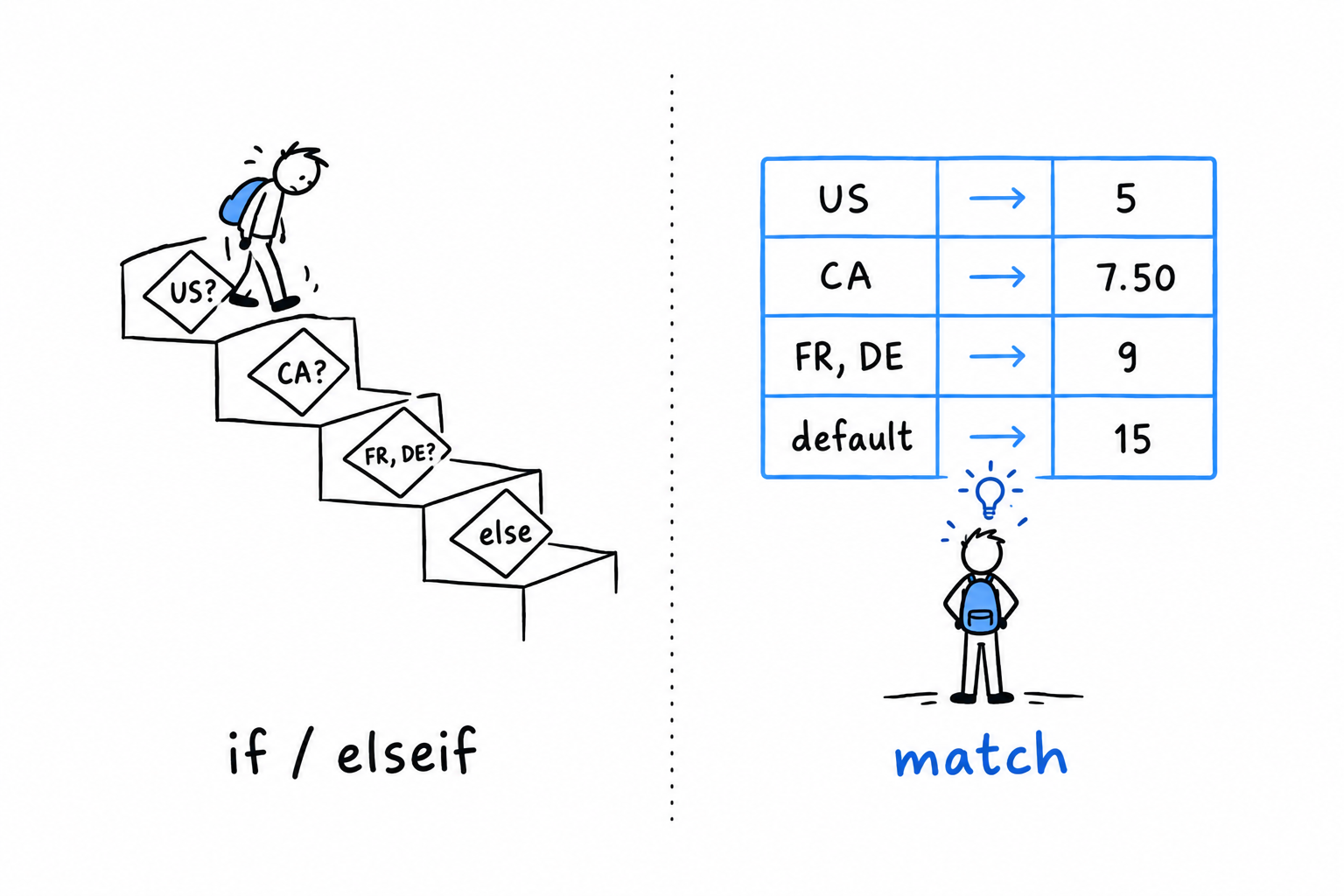
That gives you a rule of thumb to carry through the rest of the book. Reach for if/elseif when the conditions are genuinely different kinds of checks: a range here, a combination of two flags there. Reach for match the moment you notice the question is “which one of these known values is it?” Enums make that question obvious. It comes up everywhere else too.