Namespaces, Packages, and Composer
Every example so far has fit in one file. That stops now. After Chapter 5 and Chapter 6 you have classes and enums, and a project made of a dozen of them does not belong in a single script. You need to spread code across files, and you need those files to stay out of each other’s way.
Naming is the trap. The day you install a package with Composer, PHP’s package manager, you share your project with code you did not write and cannot rename. If that package defines a class called Product, and you have a Product too, PHP has no way to tell them apart. A namespace is a prefix on a name, and that prefix is what keeps App\Models\Product and Vendor\Package\Product from colliding. Two different names, nothing to guess.
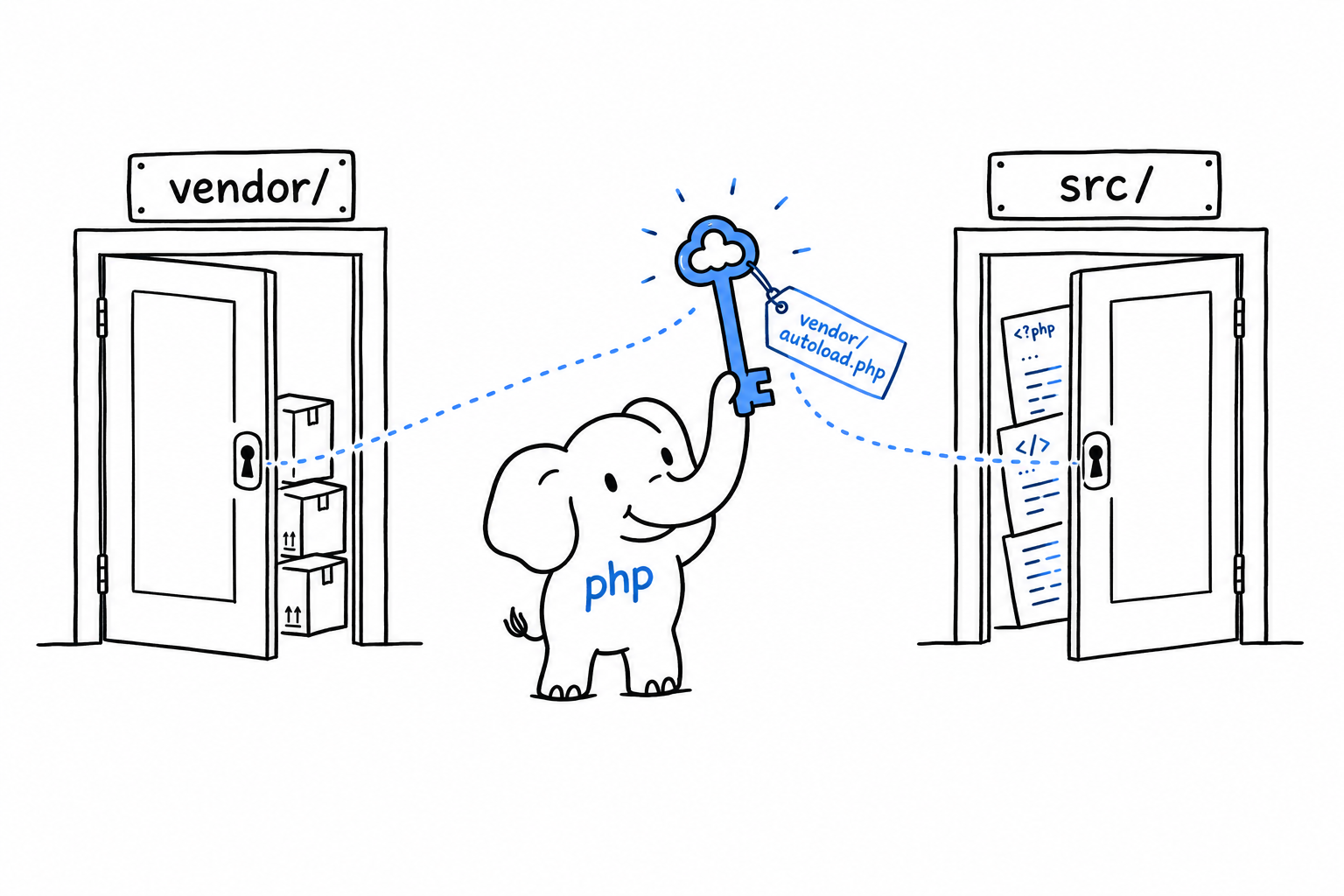
Composer comes first, because it is the reason the rest exists. Then you give your own classes a namespace, import them with use so you can keep writing short names, and lay out a src/ folder that mirrors those namespaces, the way real PHP projects are laid out. PSR-4 ties the knot: a convention that lets Composer find any class from its name alone.
That last piece is the reward. The line require 'vendor/autoload.php' already finds and loads every package you install. By the end of the chapter it will find your own classes too. Add a file, use the class, and it is simply there. No list of require lines to maintain at the top of every file.