Syntax
PHP looks like C with a $ in front of every variable, -> for members, and . for string concatenation. If you read Java, JavaScript or C#, you already read PHP. The rest of this chapter is the list of places where your fingers will type the wrong thing.
One file, top to bottom
<?php
declare(strict_types=1);

$name = 'world';
$count = 3;

echo "Hello, {$name}!", PHP_EOL;
echo 'Hello, ' . $name . '! Count: ' . $count . PHP_EOL;
The file opens with <?php. Everything before that tag, even a blank line, is sent to the output as-is, because PHP began life as a template language. A file that contains only code opens with <?php and never closes the tag: a ?> at the end followed by a stray newline would leak that newline into your HTTP response.
declare(strict_types=1); comes next, on its own line. It turns off automatic conversion of scalar arguments in calls made from this file. Types explains exactly what it does and does not cover. For now: put it in every file, and think of a file without it as a file with a warning sign on it.
Variables start with $ and are never declared. Assign, and the variable exists. There is no let, no var, no type in front. Variable names are case-sensitive; function and class names are not, though nobody relies on that.
Statements end with a semicolon. echo takes a comma-separated list and prints it; print does the same with one argument and is rarely seen. PHP_EOL is the platform’s newline.
Strings
The concatenation operator is ., not +. Writing $a + $b with two strings makes PHP try to add them as numbers, which is a TypeError for non-numeric strings under PHP 8.
Single quotes give you the bytes you typed. Double quotes interpolate variables and translate escapes like \n. Wrap anything beyond a plain variable in braces:
<?php
declare(strict_types=1);

$user = ['name' => 'Ada'];
$items = 3;

echo "Hi {$user['name']}, you have {$items} items\n";
echo 'Hi {$user[name]}\n'; // printed literally, backslash included
For multi-line text, a heredoc interpolates and a nowdoc does not. The closing marker may be indented (since PHP 7.3), and that indentation is removed from every line:
<?php
declare(strict_types=1);

$title = 'Report';

$html = <<<HTML
    <h1>{$title}</h1>
    <p>Generated by PHP</p>
    HTML;

$raw = <<<'TXT'
    No {$interpolation} in here.
    TXT;

echo $html, PHP_EOL, $raw, PHP_EOL;
Three arrows
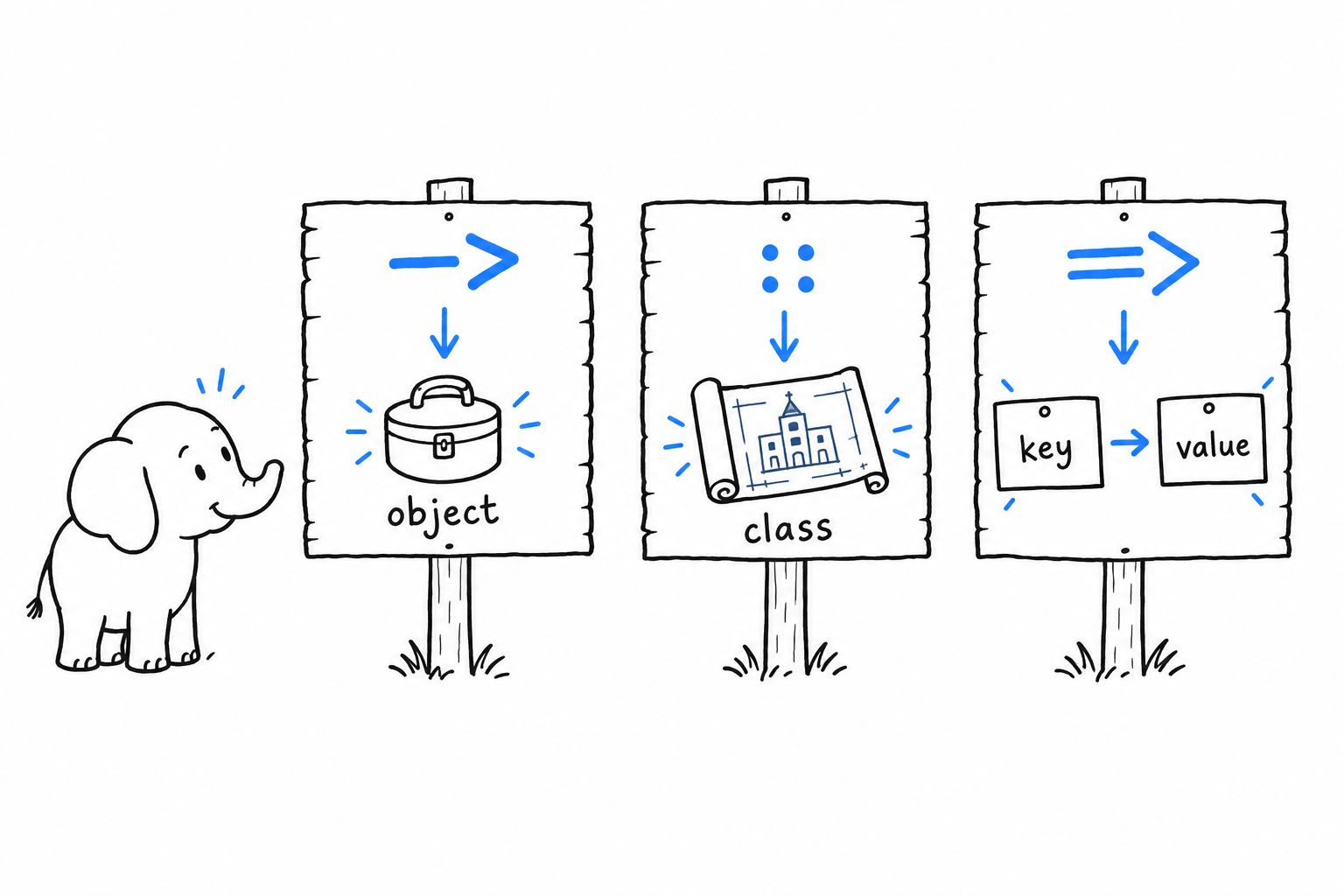
PHP has three arrow-shaped tokens, and they never overlap.
-> reaches into an instance: $user->name, $user->save(). :: reaches into a class: User::create(), User::MAX_AGE, self::$count. => pairs a key with a value inside an array literal or a match arm: ['id' => 1].
<?php
declare(strict_types=1);

final class Money
{
    public const string CURRENCY = 'EUR'; // typed constant, PHP 8.3

    public function __construct(public readonly int $cents)
    {
    }

    public static function zero(): self
    {
        return new self(0);
    }
}

$price = new Money(1999);
echo $price->cents, ' ', Money::CURRENCY, ' ', Money::zero()->cents, PHP_EOL;
// 1999 EUR 0
Inside a method, the current instance is $this. Classes and objects get their own chapter, Classes; this example only shows which arrow goes where.
Equality
Use ===. Treat == as a legacy operator. The double equals converts both sides to a common type before comparing, which produced the famous absurdities of old PHP. Since PHP 8 a number compared to a non-numeric string is compared as strings, so 0 == 'foo' is false and '1' == '01' is still true. Saner, but still a guessing game. Triple equals compares value and type, with no guessing.
The same rule applies to !== versus !=, and to in_array() and array_search(), which take a third true argument to compare strictly.
<=> is the spaceship: it returns -1, 0 or 1, and exists for sort callbacks.
Null, in three operators
<?php
declare(strict_types=1);

$config = ['debug' => null, 'owner' => null];

$debug = $config['debug'] ?? false;      // false: ?? treats null like missing
$config['level'] ??= 'info';             // assign only if null or missing
$length = $config['owner']?->name;       // null, no error: nullsafe chain
$mode = $config['debug'] ? 'on' : 'off'; // plain ternary, same as everywhere

var_dump($debug, $config['level'], $length, $mode);
?? is null coalescing and also swallows “undefined key” and “undefined variable”, which makes it the idiomatic way to read an optional array entry. ??= assigns only when the left side is null or missing. ?-> (PHP 8.0) stops a chain at the first null and yields null. The shorthand ternary ?: exists too ($a ?: $b returns $a if truthy), and is fine with booleans, misleading with anything else.
Control flow, all at once
<?php
declare(strict_types=1);

$scores = ['ada' => 92, 'linus' => 71, 'grace' => 85];

foreach ($scores as $who => $score) {
    if ($score >= 90) {
        $grade = 'A';
    } elseif ($score >= 80) {
        $grade = 'B';
    } else {
        $grade = 'C';
    }
    echo "{$who}: {$grade}", PHP_EOL;
}

for ($i = 0; $i < 3; $i++) {
    echo $i;
}
echo PHP_EOL;

$attempts = 0;
while ($attempts < 3) {
    $attempts++;
}

$label = match (true) {
    $attempts === 0 => 'never tried',
    $attempts < 3 => 'a few tries',
    default => 'gave it everything',
};
echo $label, PHP_EOL;
Nothing here needs explaining except two details. foreach is the loop for arrays and any iterable, and it gives you the key and the value together with as $key => $value. match is an expression, compares with ===, has no fall-through, and throws if nothing matches; switch still exists, compares with ==, falls through, and is what you find in older code. Enums and match shows what match is for.
Everything else on one screen
<?php
declare(strict_types=1);

namespace App\Billing;         // one per file, mirrors the folder

use App\Money;                 // import a class from another namespace
use function App\format_cents; // functions and constants can be imported too

const TAX_RATE = 0.2;          // compile-time constant, namespaced
define('LEGACY', true);        // runtime constant, global, older style

// one-line comment
# also a one-line comment, rarer
/* block
   comment */

/**
 * Docblock: read by editors, PHPStan and Psalm, not by PHP itself.
 */
function total(int ...$cents): int
{
    return array_sum($cents);
}

$parts = [100, 250];
echo total(...$parts), PHP_EOL; // 350: ... unpacks on both sides
... unpacks an array into arguments and, in a parameter list, collects the rest into an array. Named arguments (total(cents: 5)) have existed since 8.0. null is a value, lowercase by convention, with true and false. Namespaces and use do exactly what you expect from Java packages or ES imports; Namespaces, Composer, and Autoloading covers how files get found.
Side by side
| Python | JavaScript | Java | PHP | |
|---|---|---|---|---|
| Concatenate | a + b | a + b | a + b | $a . $b |
| Strict equality | a == b | a === b | a.equals(b) | $a === $b |
| Null coalescing | a or b | a ?? b | (none) | $a ?? $b |
| Null-safe member | (none) | a?.b | (none) | $a?->b |
| Lambda | lambda x: x * 2 | x => x * 2 | x -> x * 2 | fn($x) => $x * 2 |
| Map literal | {'k': 1} | {k: 1} | Map.of("k", 1) | ['k' => 1] |
| Interpolation | f"{x}" | `${x}` | (none) | "{$x}" |
| Instance member | obj.name | obj.name | obj.name | $obj->name |
| Static member | Cls.name | Cls.name | Cls.name | Cls::$name |
| Ternary | a if c else b | c ? a : b | c ? a : b | $c ? $a : $b |
The trap
Two things trip every newcomer in the first hour. The first is ==: a comparison that looks right, passes the obvious tests, and then decides that '1e1' == '10' and null == false. Type === until it is a reflex, and let strict_types catch the rest.
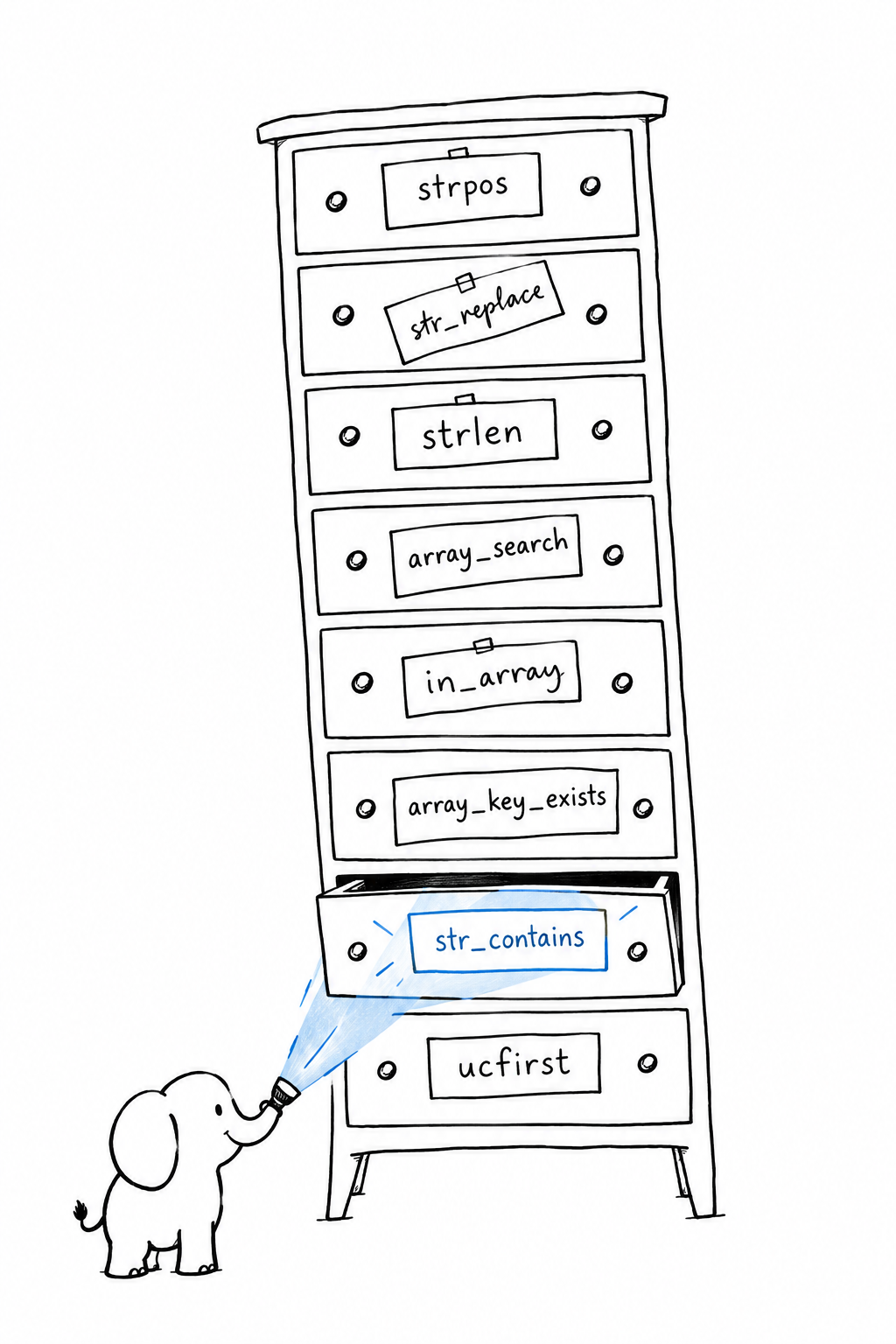
The second is the standard library. strpos($haystack, $needle) but array_search($needle, $haystack). str_replace with underscores, strlen without. array_key_exists next to in_array. The naming was never designed; it accumulated. Newer functions are consistent (str_contains, array_is_list, array_find), the old ones will not change, and the fix is not memory but an editor with completion and a static analyser that flags the wrong argument order.
With the syntax out of the way, the interesting questions start. What does int actually enforce? Types answers that with more nuance than you might like.