match Pattern Syntax
Chapter 6 gave match its proper introduction, next to enums, where it shines most. Three details did not fit there, and you will want all three the first time you write a match with more than two or three arms.
Multiple conditions per arm
An arm does not have to test a single value. Separate several with commas, and the arm matches if any one of them equals the subject:
<?php

$dayNumber = 6;

$dayType = match ($dayNumber) {
    1, 2, 3, 4, 5 => 'Weekday',
    6, 7 => 'Weekend',
    default => 'Invalid',
};

echo $dayType; // Weekend
Read the comma as “or”. 1, 2, 3, 4, 5 => means “if the subject is 1, or 2, or 3, or 4, or 5”. Without it you would write five arms that all return 'Weekday', which is exactly the repetition match exists to remove.
Order matters: first match wins
match checks its arms from top to bottom and stops at the first one that fits. Most of the time you never think about it, because well-designed conditions do not overlap. Pair match (true) (testing boolean conditions instead of a single value, as in Chapter 3) with conditions that can overlap, and order stops being a formality:
<?php

$score = 85;

$grade = match (true) {
    $score >= 90 => 'A',
    $score >= 80 => 'B',
    $score >= 70 => 'C',
    default => 'F',
};

echo $grade; // B
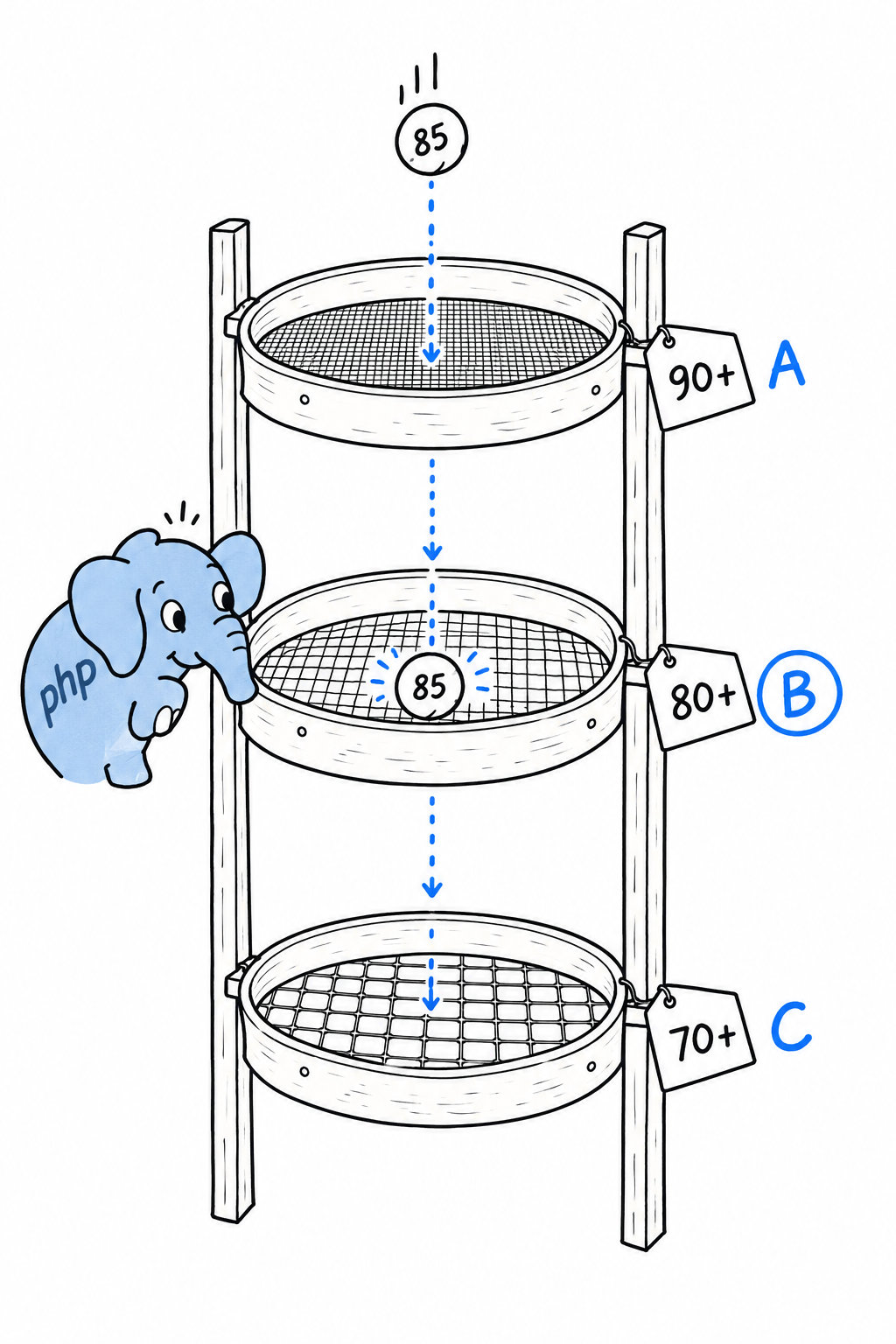
Move $score >= 70 to the top, and 85 satisfies it before the B arm gets a look. So does 95. The A and B arms become unreachable code, and PHP will not say a word about it. Try it: reorder the arms and run the file again.
Tip
When arms can overlap, put the most restrictive condition first, like sieves stacked from finest to coarsest.
Arms are expressions, not just values
An arm does not have to be a bare literal. Every arm of a match is a full expression, evaluated and returned only when that arm is chosen. Call a function, construct an object, run anything PHP accepts as an expression:
<?php

enum LogLevel
{
    case Info;
    case Warning;
    case Error;
}

function formatMessage(string $level, string $text): string
{
    return "[" . strtoupper($level) . "] {$text}";
}

$level = LogLevel::Warning;

$output = match ($level) {
    LogLevel::Info => formatMessage('info', 'Request completed'),
    LogLevel::Warning => formatMessage('warning', 'Disk usage above 80%'),
    LogLevel::Error => (new RuntimeException('Disk full'))->getMessage(),
};

echo $output; // [WARNING] Disk usage above 80%
The last arm builds an exception and calls a method on it, in one go; the parentheses around new RuntimeException(...) are needed so PHP knows to call getMessage() on the finished object rather than parsing the line some other way. Arms have no obligation to be short or trivial. They have to be expressions, and in PHP that covers almost everything, which is what makes match a real replacement for a lot of small helper functions, not just a tidier switch.