List and Array Destructuring
Real arrays are rarely flat lists. They nest, and more often than not they carry keys instead of positions. Destructuring follows the shape of the data, whatever that shape is.
Nested destructuring
If an array contains other arrays, the pattern mirrors that structure directly:
<?php

$point = [[1, 2], 3];

[[$x, $y], $z] = $point;

echo "x={$x}, y={$y}, z={$z}\n"; // x=1, y=2, z=3
Put the two sides next to each other: [[$x, $y], $z] and [[1, 2], 3]. The pattern is a tracing of the data. That symmetry is the whole appeal. Past one level of depth, a chain like $point[0][0] starts hiding what you are after, while the pattern says “give me exactly this shape” in one line.
Keyed destructuring
Coordinates come as positions. Almost everything else you will unpack in an application comes with keys: a database row, decoded JSON, a submitted form. For those, name the keys instead:
<?php

$userData = [
    'name' => 'Priya',
    'age' => 29,
    'email' => 'priya@example.com',
];

['name' => $name, 'age' => $age] = $userData;

echo "{$name} is {$age}.\n"; // Priya is 29.
email is not mentioned, so it is left alone. You name only the keys you want, and the rest of the array stays where it is.
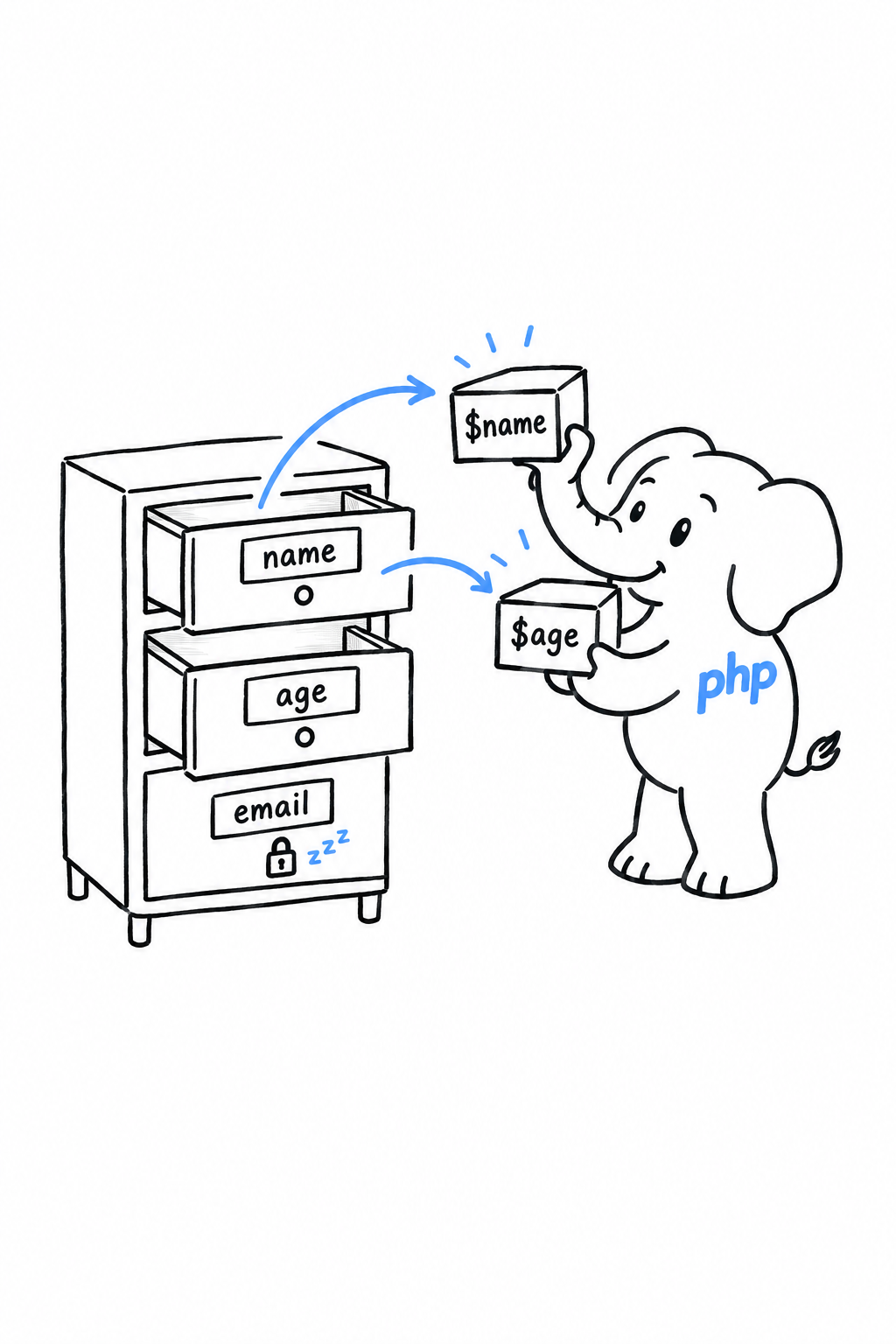
This is where destructuring stops being a shorthand and becomes clearer than the alternative. One line says “this code needs a name and an age”; two lines of $userData['name'] and $userData['age'] say it more slowly.
Keys and nesting combine:
<?php

$response = [
    'status' => 'ok',
    'user' => ['name' => 'Priya', 'age' => 29],
];

['user' => ['name' => $name, 'age' => $age]] = $response;

echo "{$name}, {$age}\n"; // Priya, 29
Swapping two variables
Destructuring has one small, satisfying party trick: swapping two variables without a third one to hold the spare.
<?php

$a = 1;
$b = 2;

[$a, $b] = [$b, $a];

echo "a={$a}, b={$b}\n"; // a=2, b=1
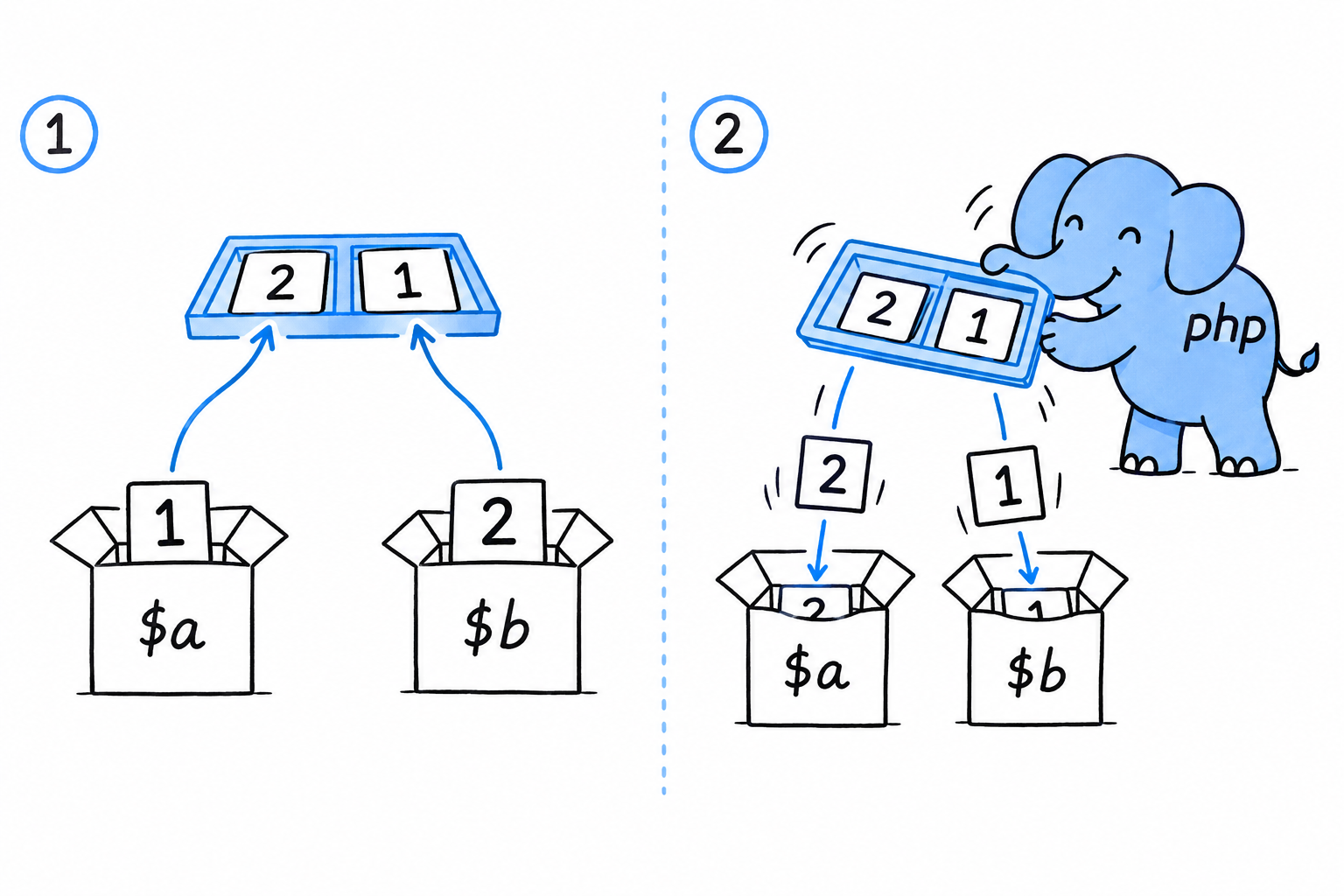
PHP builds the array [$b, $a] on the right first, which captures both original values, and only then pours them into $a and $b on the left. By the time $a is overwritten, the old value of $b has already been read. That ordering is what makes the swap safe, and it is the cleanest way to swap two values in PHP: no $temp variable required.
A word of caution
Destructure an array that lacks a key or a position you asked for, and nothing throws. The missing element becomes null, with a warning in strict error-reporting setups. Try it: remove 'age' from $userData above and run the file again.
Warning
Destructuring matches a shape; it never checks it. PHP will let you unpack a three-element array as if it had five.
Treat it as a convenience for code where you already trust the shape of the data. When the data comes from outside your control, validate first, destructure second.