Control Flow
Strip the guessing game down to its skeleton and two words remain: if and while. One decides, the other repeats. Everything a program does beyond running top to bottom comes from those two moves, and PHP has a few variations on each.
if / elseif / else
<?php

$temperature = 18;

if ($temperature > 30) {
    echo "Hot.\n";
} elseif ($temperature > 15) {
    echo "Pleasant.\n";
} else {
    echo "Bring a jacket.\n";
}
Same shape as the comparison in the game: PHP runs the first block whose condition is true and skips the rest, or falls back to else. It is elseif, one word. else if, two words, works too, but only elseif is a single token to PHP, so it is the convention worth adopting.
The condition does not have to be a boolean, but write it as if it did. PHP converts whatever you hand it: 0, "", null and [] all count as false, everything else as true. Leaning on that is exactly the kind of type juggling Data Types warned you about. Prefer an explicit comparison whenever the value is not already obviously a boolean.
An if/elseif chain is at its best when each branch tests something different, the way $temperature > 30 and $temperature > 15 do. When you catch yourself writing several branches that all compare the same value against a list of possibilities, that repetition is a signal to reach for the next tool.
match
PHP 8 added match, and once you have used it, switch starts to feel like a relic:
<?php

$httpStatus = 404;

$message = match (true) {
    $httpStatus >= 200 && $httpStatus < 300 => "Success",
    $httpStatus >= 400 && $httpStatus < 500 => "Client error",
    $httpStatus >= 500 => "Server error",
    default => "Unknown",
};

echo $message; // Client error
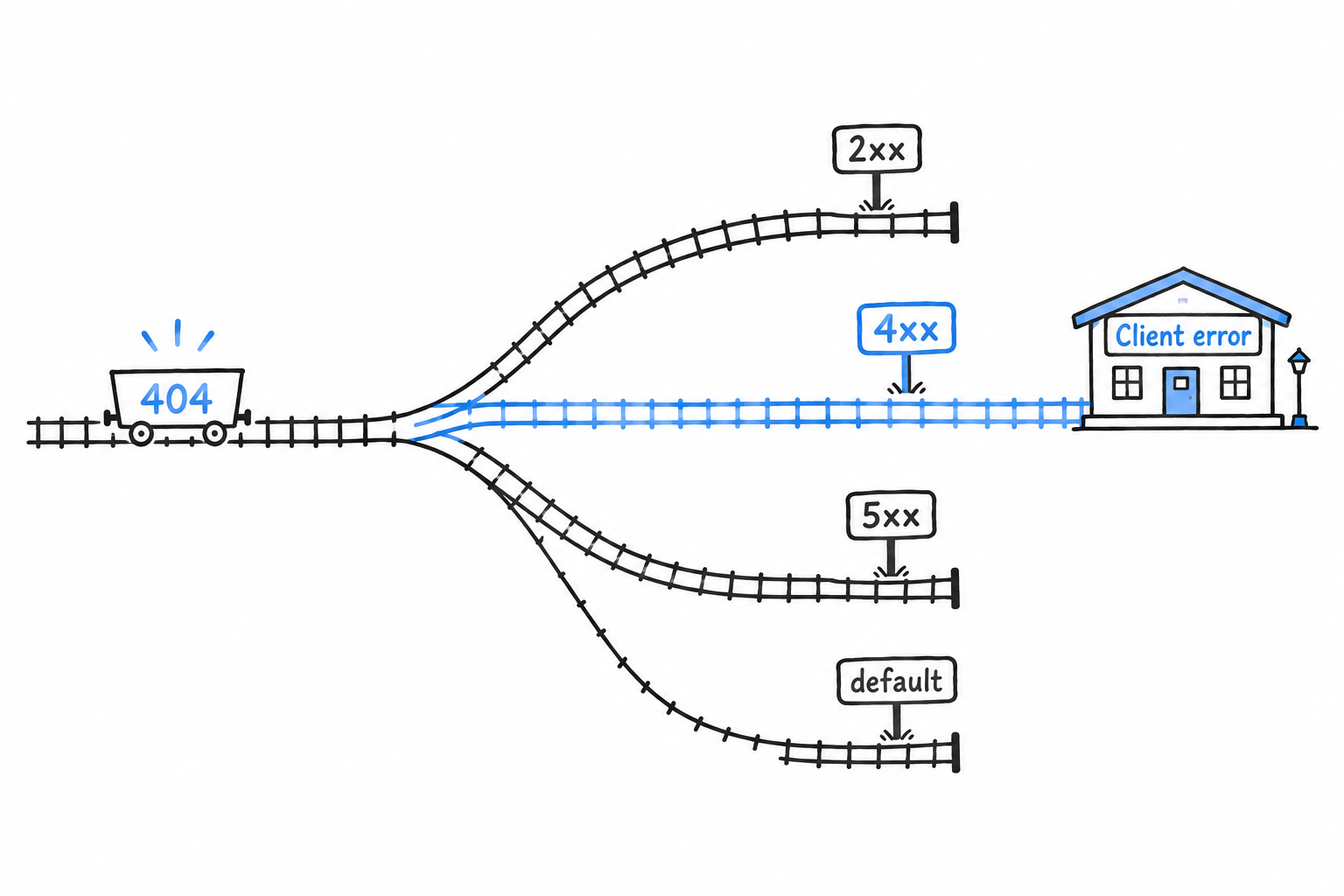
match is an expression: it produces a value, which you assign, as above, instead of a statement you branch inside of. Two more things make it a real upgrade over switch. Its comparisons are strict, ===, so no juggling sneaks a wrong branch through. And it has no fallthrough, so there is no break to forget. Chapter 6 pairs match with enums, and the two turn out to be made for each other.
Loops
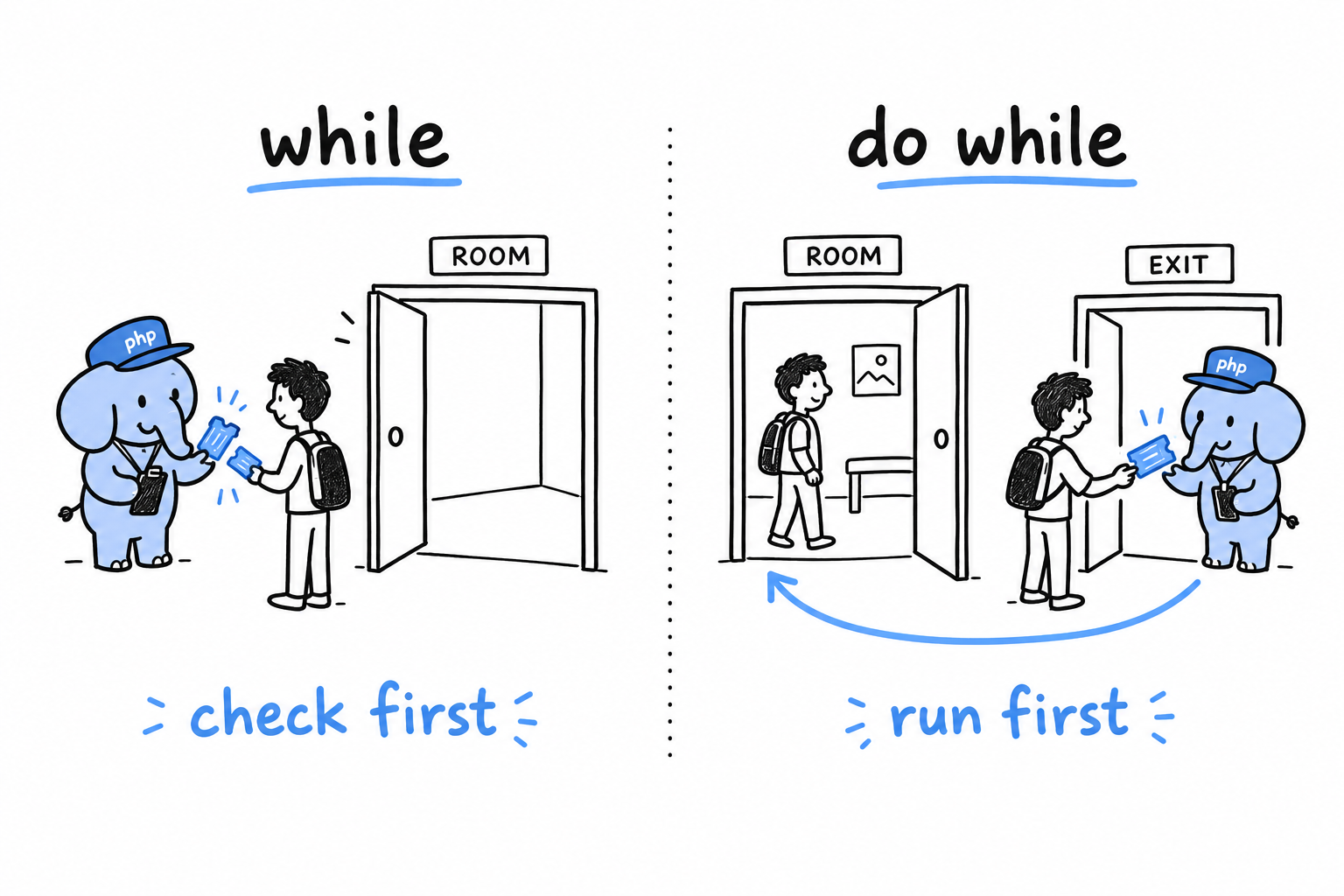
while runs as long as its condition holds, and checks it before each pass:
<?php

$count = 3;
while ($count > 0) {
    echo "{$count}...\n";
    $count--;
}
echo "Go!\n";
The game’s while (true) was the extreme case: a condition that never turns false, and break as the only way out.
do...while checks the condition after each pass instead, so the body runs at least once:
<?php

do {
    echo "This runs once even if the condition is already false.\n";
} while (false);
for is the classic three-part loop, at home whenever you need a counter:
<?php

for ($i = 0; $i < 5; $i++) {
    echo "{$i}\n";
}
Start value, condition, step, all on one line: $i starts at 0, the body runs while $i < 5, and $i++ adds one after every pass.
foreach walks a collection directly, no counter to maintain, and it is the loop you will reach for constantly once arrays arrive in Chapter 8:
<?php

$fruits = ["apple", "banana", "cherry"];

foreach ($fruits as $fruit) {
    echo "{$fruit}\n";
}

$prices = ["apple" => 0.5, "banana" => 0.3];

foreach ($prices as $name => $price) {
    echo "{$name}: \${$price}\n";
}
The second form, as $name => $price, pulls out the key and the value in one go. It appears so often in real PHP code that you may as well commit it to memory right now.
break and continue, one more time
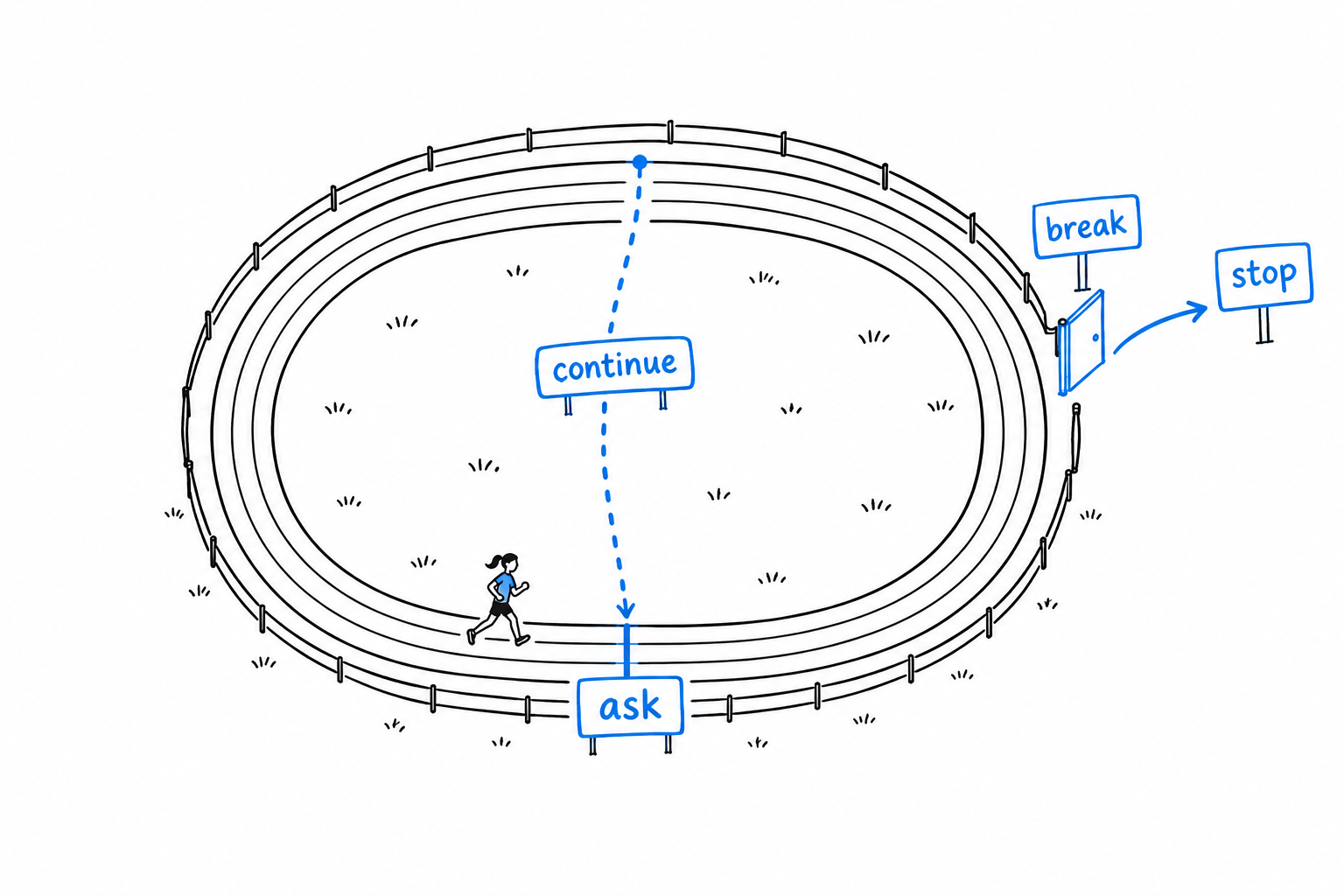
You met both in the game: break leaves the loop at once, continue skips to the next round.
<?php

foreach ([1, 2, 3, 4, 5] as $n) {
    if ($n === 3) {
        continue; // skip 3, keep going
    }
    if ($n === 5) {
        break; // stop entirely once we hit 5
    }
    echo "{$n}\n";
}
// prints 1, 2, 4
Both accept an optional number: break 2 leaves two nested loops at once. Reach for it only when it reads clearer than restructuring the loops. Nested break levels are obvious while you write them and baffling a month later.
Try it: rewrite the game’s three-way comparison as a match (true) that produces the message, then print it. The break has to stay outside the match, since a match produces a value and does nothing else. That small friction is the difference between an expression and a statement, felt in your own fingers.
Branch, repeat, steer. The rest of the book never adds a new kind of move, only bigger shapes made of these.