Implementing a Classic OOP Design Pattern
A design pattern is a name for a shape of code that shows up so often, across so many different problems, that people learned to recognize it on sight. You have been building one for three sections without naming it. The PaymentMethod family is most of the Strategy pattern, one of the most common in all of object-oriented programming. This section finishes it.
The idea
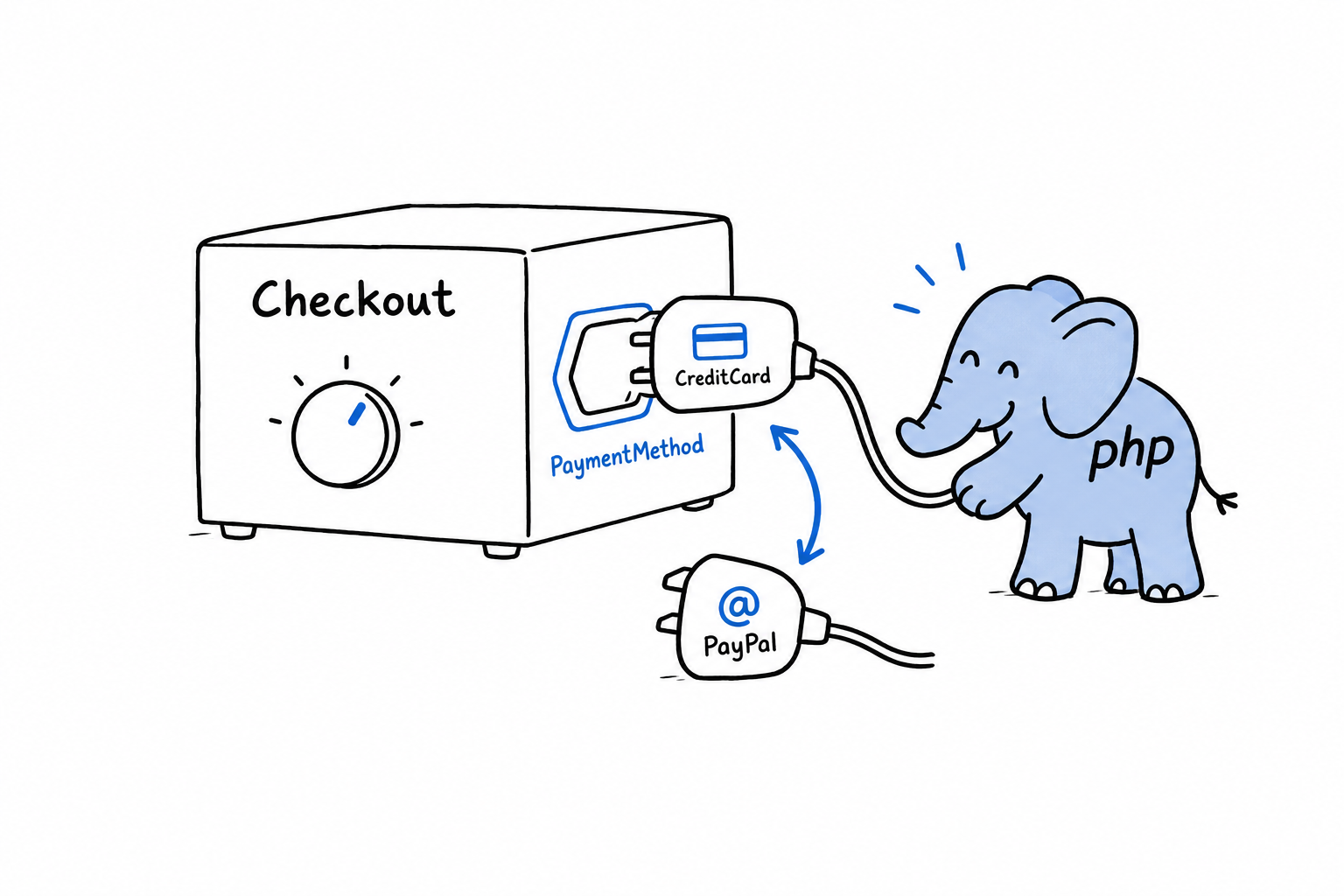
Take a behavior that can vary: how a payment is charged, how a list is sorted, how a price is discounted. Pull it out behind an interface. Hand it to a class that uses the behavior without knowing which version it received. That last step is the polymorphism from earlier in this chapter. Strategy adds one piece, the context: a class whose whole job is to hold a strategy, delegate to it, and let it be swapped, even after the context exists.
Building it
An interface this time, not an abstract class. There is no shared code worth forcing on every payment method, only a contract, and that is exactly the case the previous section said an interface fits best:
<?php
declare(strict_types=1);

interface PaymentMethod
{
    public function charge(float $amount): string;
}

final class CreditCard implements PaymentMethod
{
    public function __construct(private string $last4)
    {
    }

    public function charge(float $amount): string
    {
        return sprintf('Charged $%.2f to card ending %s.', $amount, $this->last4);
    }
}

final class PayPal implements PaymentMethod
{
    public function __construct(private string $email)
    {
    }

    public function charge(float $amount): string
    {
        return sprintf('Charged $%.2f via PayPal account %s.', $amount, $this->email);
    }
}
Nothing new here: the same two classes as earlier in the chapter, implementing an interface instead of extending a base. Now the context:
<?php
declare(strict_types=1);

final class Checkout
{
    public function __construct(private PaymentMethod $paymentMethod)
    {
    }

    public function setPaymentMethod(PaymentMethod $paymentMethod): void
    {
        $this->paymentMethod = $paymentMethod;
    }

    public function complete(float $amount): void
    {
        echo $this->paymentMethod->charge($amount) . "\n";
    }
}
Checkout holds a PaymentMethod, any PaymentMethod, and complete() hands the work to whichever one it is holding. Notice what is missing. There is no if asking “are you a card or a PayPal account?” That absence is the tell of Strategy done right: the context calls charge() and trusts the interface.
Using it and swapping strategies at runtime
<?php
$checkout = new Checkout(new CreditCard('4242'));
$checkout->complete(42.00);

$checkout->setPaymentMethod(new PayPal('damien@example.com'));
$checkout->complete(19.99);
$ php checkout.php
Charged $42.00 to card ending 4242.
Charged $19.99 via PayPal account damien@example.com.
Same $checkout object, same complete() call, two different outcomes, because setPaymentMethod() swapped the strategy in between. Picture the alternative: an if ($type === 'credit_card') inside Checkout, growing a new branch with every payment method the product adds. With Strategy, next quarter’s bank transfer is one new class that implements PaymentMethod, and Checkout does not change. It already works, for the same reason processPayment() worked earlier in the chapter: it was written against the interface, never against a particular class.
Try it: write BankTransfer, pass it to setPaymentMethod(), and complete a third payment. Count the lines you changed in Checkout.
That is the entire pattern. An interface describing a swappable behavior, classes implementing it, and a context that delegates to whichever one it holds. No new syntax, no library, nothing specific to PHP: the interfaces and polymorphism you already had, arranged on purpose to solve a recognizable problem. Once you have built one this way, you will start seeing the same shape everywhere, under other names, in code you did not write.
A strategy is a behavior you can unplug and replace. The context is the socket.