Abstract Classes and Interfaces Revisited
Nothing stops you from writing new PaymentMethod() and charging forty-two dollars to it. The base class from the previous section has a working charge(), so PHP obliges, and money gets “charged” to a payment method attached to no card, no account, nothing at all. PaymentMethod was only ever meant as a foundation for subclasses, but a comment saying so is not a rule. abstract turns that intention into something PHP enforces.
Making the contract explicit
<?php
declare(strict_types=1);

abstract class PaymentMethod
{
    abstract public function charge(float $amount): string;

    protected function receipt(float $amount): string
    {
        return sprintf('$%.2f processed on %s', $amount, date('Y-m-d'));
    }
}

class CreditCard extends PaymentMethod
{
    public function __construct(private string $last4)
    {
    }

    public function charge(float $amount): string
    {
        return $this->receipt($amount) . " (card ending {$this->last4})";
    }
}
Two things changed. abstract class PaymentMethod means PHP refuses new PaymentMethod() outright: a fatal error, enforced by the language rather than left as a convention you hope people follow. And charge() became abstract public function charge(float $amount): string;, a signature with no body, exactly like an interface method. Every non-abstract subclass must now implement charge(), or PHP refuses to load that subclass too.
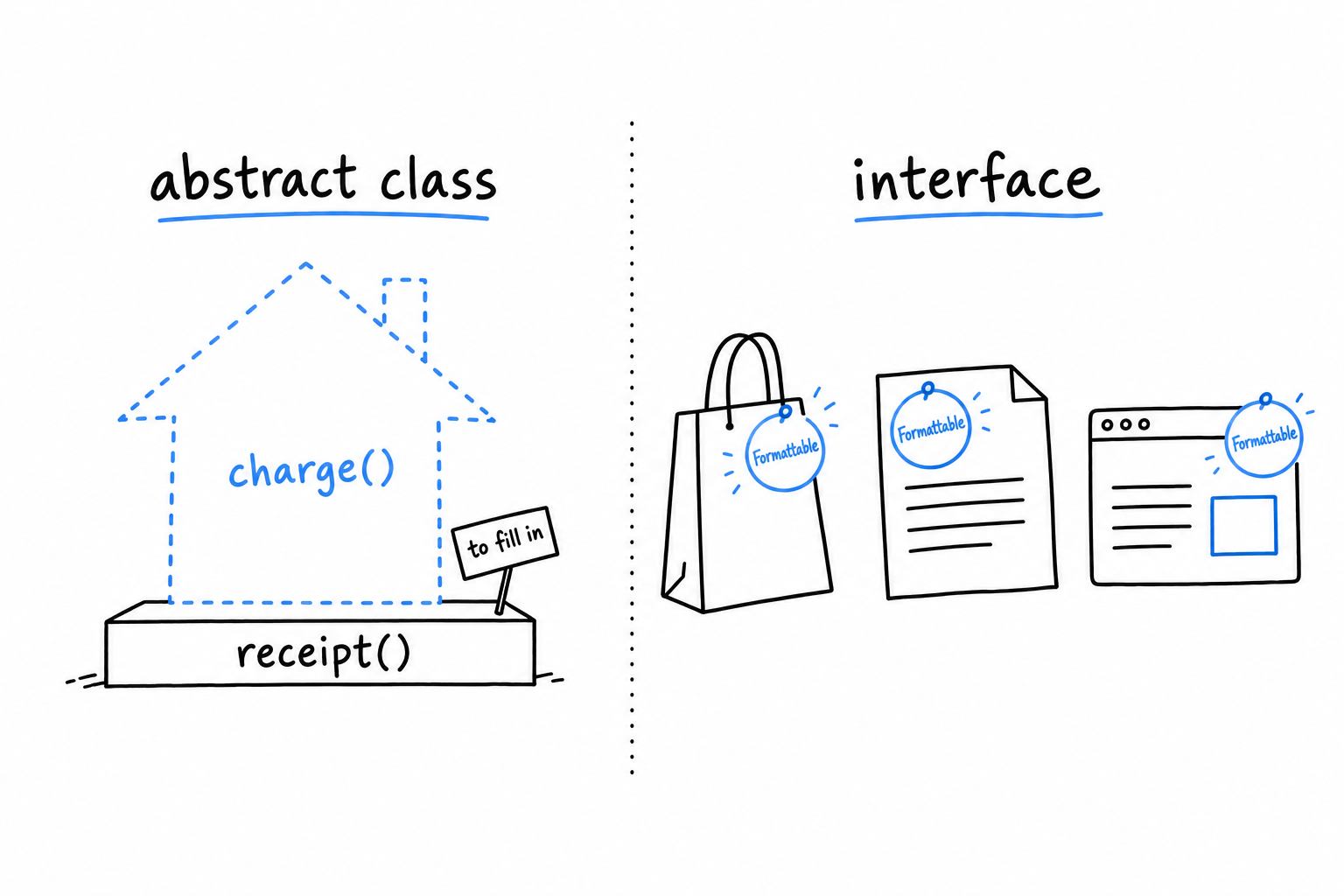
What the base class kept is receipt(): a real, working method that every subclass inherits for free. That pairing is the point of an abstract class. A contract the language enforces, bundled with shared code written once. A plain interface can only give you the first half.
Tip
receipt()isprotected: visible toPaymentMethodand its subclasses, hidden from everyone else. That is the usual visibility for a helper a base class offers to its children and to nobody else.
Compare this to Formattable
Go back to the Formattable interface from Chapter 11:
<?php
interface Formattable
{
    public function format(): string;
}
An interface is nothing but a contract. No method bodies, not even optional ones a class could choose to inherit. Every class implementing Formattable writes its own format() from scratch, because there is nothing to inherit.
That is not a shortcoming; it is the job. An interface names a capability that classes with nothing else in common can all claim. A Product, a LogEntry and an HttpResponse share no ancestor and never will, yet each can promise format(). A class can implement as many interfaces as it likes, which is how PHP gets by without multiple inheritance. An abstract class is a real ancestor: a class can extend only one, and everything the parent carries comes along with it, properties, working methods, constructor logic.
An interface is a badge a class wears. An abstract class is a parent it descends from. You get one parent, and as many badges as you want.
When to reach for which
Reach for an abstract class when you have real code every subclass should share, and you also want to force each subclass to fill in the parts that must differ. receipt() shared, charge() mandatory but unique to each subclass: the example above is the textbook case.
Reach for an interface when all you need is the guarantee that a method exists, with no assumption that the classes are related. It is also the only option when a class already extends something and still needs to promise a second, unrelated capability.
They are not rivals, and PHP does not make you choose:
<?php
declare(strict_types=1);

interface Formattable
{
    public function format(): string;
}

abstract class PaymentMethod implements Formattable
{
    abstract public function charge(float $amount): string;

    public function format(): string
    {
        return static::class;
    }
}
PaymentMethod gets both. The enforced structure of an abstract class for its own family of subclasses, and a separate Formattable badge that lets any code in the system call format() on it without knowing, or caring, that payments are involved. static::class is the name of the concrete class at runtime, so a CreditCard formats as CreditCard, and the parent never had to know its children by name.