Classes, Inheritance, and Polymorphism
A shop takes credit cards. Then it takes PayPal. Next quarter it will take bank transfers. Each one charges money in its own way, yet from the checkout’s point of view they are all the same thing: a way to pay. Inheritance is how you tell PHP that several classes are variations on one idea, sharing what they have in common and differing only where they must. Every class you have written since Chapter 5 has stood alone. Time to make some of them related.
extends and method overriding
A class builds on another with extends, inheriting its properties and methods and replacing whichever ones need to behave differently:
<?php
declare(strict_types=1);

class PaymentMethod
{
    public function charge(float $amount): string
    {
        return sprintf('Charged $%.2f.', $amount);
    }
}

class CreditCard extends PaymentMethod
{
    public function __construct(private string $last4)
    {
    }

    public function charge(float $amount): string
    {
        $base = parent::charge($amount);
        return $base . " (card ending {$this->last4})";
    }
}
Read class CreditCard extends PaymentMethod as “a credit card is a payment method”. Everything PaymentMethod knows how to do, CreditCard knows too, without writing a line. The one method CreditCard defines for itself is charge(), and since the parent already has a charge(), the child’s version takes its place. That is called overriding.
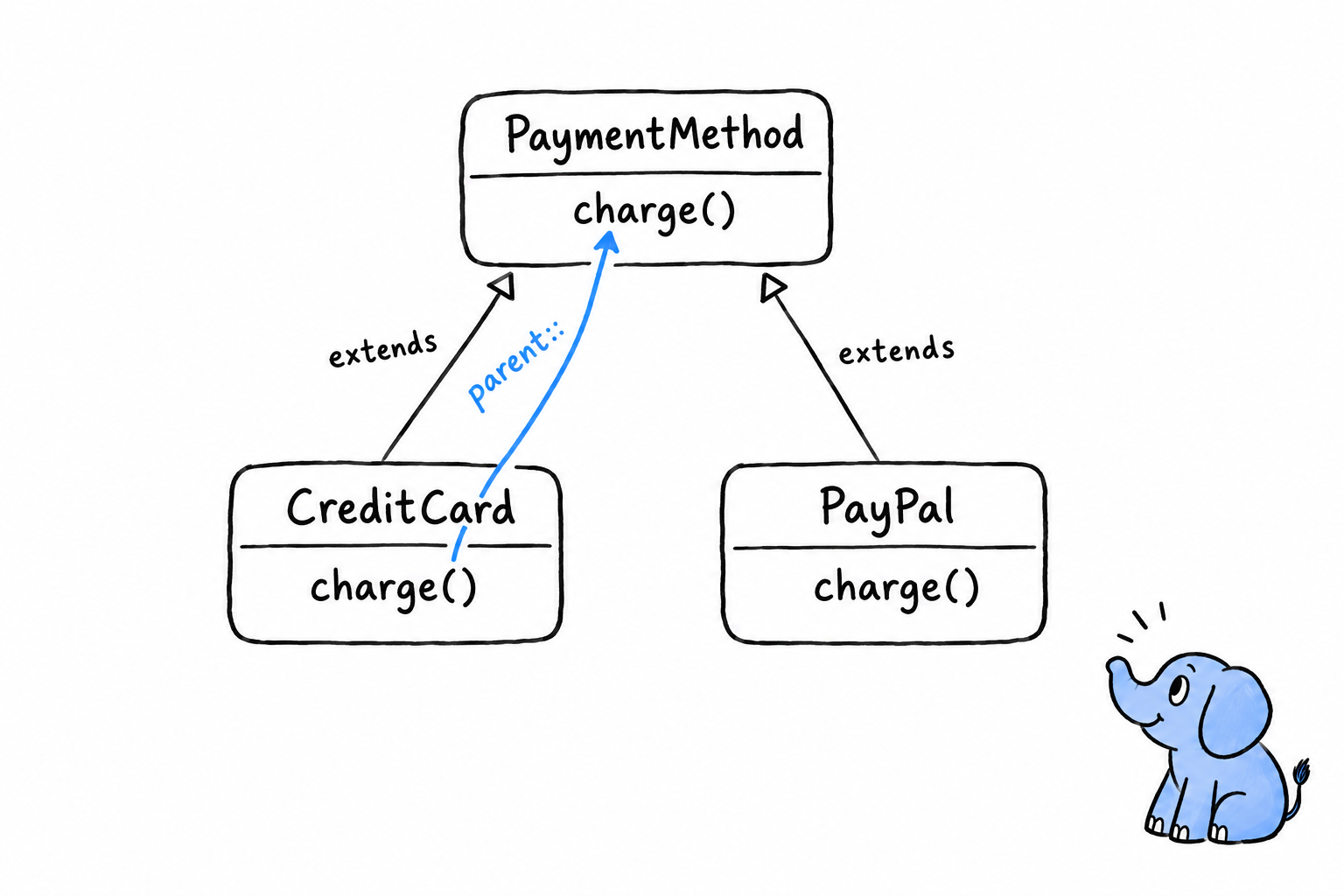
Now look at the first line of the override. parent::charge($amount) calls the parent’s original charge(), the very method that was just replaced, and builds on its result instead of throwing it away. parent:: is how an override says “do what you were going to do, then let me add something.” The base class still formats the amount; CreditCard only appends the last four digits. Without parent::, that sprintf() line would be copied into every subclass, which is exactly the duplication inheritance is meant to remove.
extendssays “is a”.parent::says “and also”.
A second subclass
Add another payment method the same way, with a charge() that does something else entirely:
<?php
declare(strict_types=1);

class PayPal extends PaymentMethod
{
    public function __construct(private string $email)
    {
    }

    public function charge(float $amount): string
    {
        return sprintf('Charged $%.2f via PayPal account %s.', $amount, $this->email);
    }
}
PayPal never calls parent::charge(). Nothing forces an override to reuse the parent’s version; it only has to exist. A subclass may keep the parent’s behavior, add to it, or replace it outright, and all three are ordinary uses of inheritance. CreditCard and PayPal share the promise that every PaymentMethod can charge(), and only one of them shares any code.
Polymorphism: the actual payoff
Here is why any of this was worth setting up. Write a function against the base type and hand it any subclass:
<?php
declare(strict_types=1);

function processPayment(PaymentMethod $method, float $amount): void
{
    echo $method->charge($amount) . "\n";
}

$methods = [
    new CreditCard('4242'),
    new PayPal('damien@example.com'),
];

foreach ($methods as $method) {
    processPayment($method, 42.00);
}
$ php payments.php
Charged $42.00. (card ending 4242)
Charged $42.00 via PayPal account damien@example.com.
processPayment() asks for a PaymentMethod. It never mentions CreditCard or PayPal. Yet give it either one and the right charge() runs. The same call, $method->charge($amount), does the right thing for whatever object is actually behind $method. That is polymorphism.
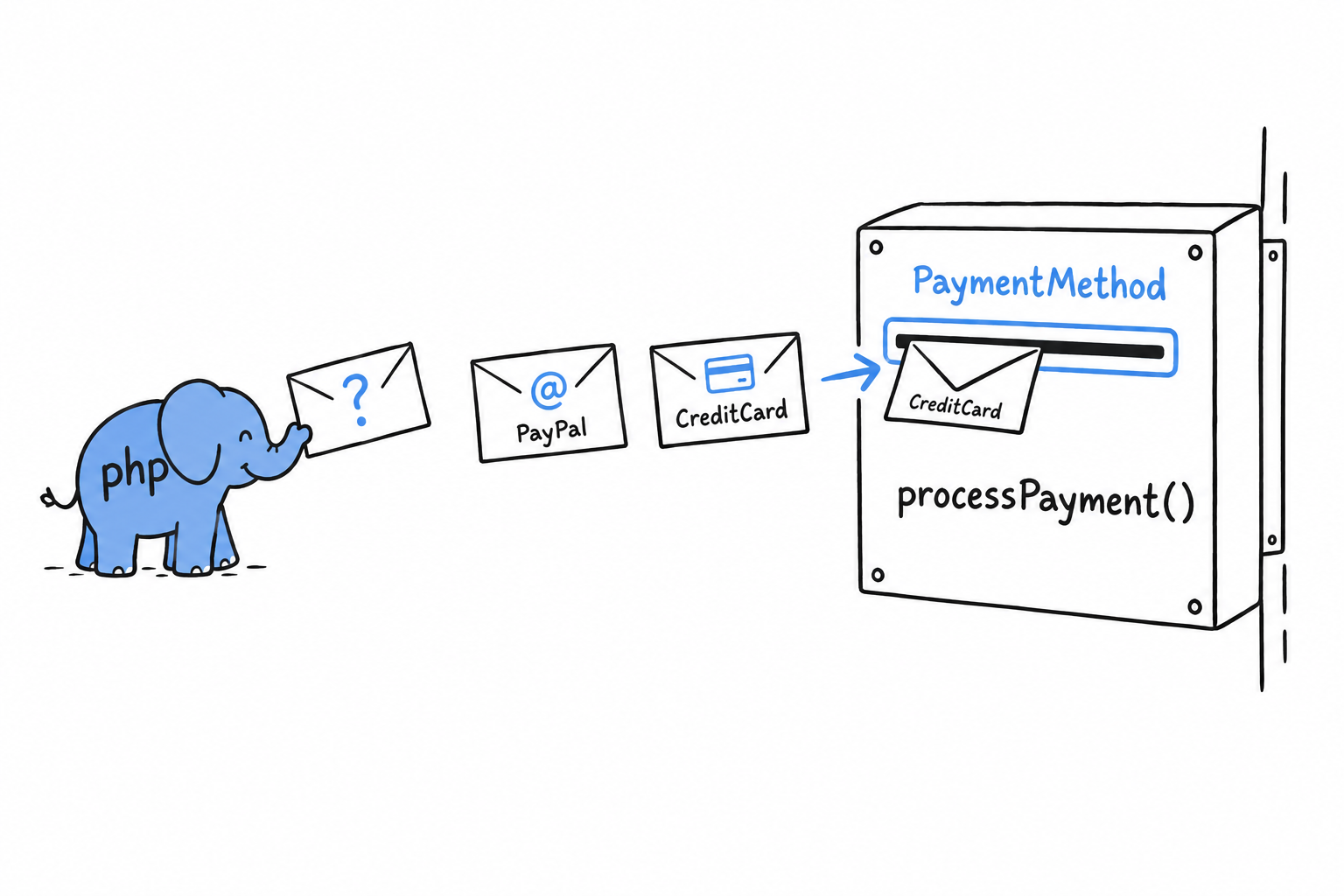
Think of a letterbox. It does not care who wrote the envelope, only that the envelope fits the slot. PaymentMethod is the slot, and every subclass is an envelope cut to that size, including the ones nobody has written yet. Add BankTransfer next month: as long as it extends PaymentMethod and implements charge(), neither processPayment() nor the loop changes. They were never written against a specific class, only against the shape every PaymentMethod guarantees.
Try it: write BankTransfer, add new BankTransfer() to the $methods array, and run again. Count the lines you changed in processPayment().
This should feel familiar. It is the same move as programming against an interface in Chapter 11: interfaces and inheritance are two roads to the same place, code that does not need to know which concrete class it holds. The next section puts the two roads side by side and asks when to take which.