Defining Shared Behavior with Interfaces
Suppose you need to print a human-readable summary of an object: an invoice line, a product, a log entry, whatever it happens to be that week. You could give every class a describe() method and hope everyone remembers the name. Or you could make it a rule that PHP itself checks. That is what an interface is for.
<?php

interface Formattable
{
    public function format(): string;
}
An interface looks like a class with all the bodies removed. format(): string is a signature, not an implementation: no braces, no logic, just a promise. Any class that says it implements Formattable must have a public format() method returning a string, and PHP holds it to that promise. Leave the method out, or return the wrong type, and the code will not run.
Implementing it
A class opts in with implements:
<?php

readonly class Product
{
    public function __construct(
        public string $name,
        public float $price,
    ) {
    }
}

readonly class InvoiceLine implements Formattable
{
    public function __construct(
        private Product $product,
        private int $quantity,
    ) {
    }

    public function format(): string
    {
        $total = $this->product->price * $this->quantity;
        return sprintf('%dx %s, $%.2f', $this->quantity, $this->product->name, $total);
    }
}
InvoiceLine implements Formattable is a claim PHP verifies for you. If format() were missing, or declared to return an int, you would get a fatal error the moment PHP loaded the class, not three calls deep in production. Try it: rename format() to describe() and run the file.
A class can implement more than one interface, separated by commas. That is one of the ways PHP makes up for classes having a single parent.
Why bother: programming against the interface
Here is the part that pays for itself. Write a function that type-hints the interface, not the concrete class:
<?php

function printSummary(Formattable $item): void
{
    echo $item->format() . "\n";
}

printSummary(new InvoiceLine(new Product('Keyboard', 49.90), 2));
printSummary() does not know it received an InvoiceLine, and does not care. It knows it received something that can format(). Add a Refund class tomorrow, or a Discount, or a ShippingFee, implement Formattable on it, and printSummary() needs no change at all. It already works, because it was never written against a specific class in the first place.
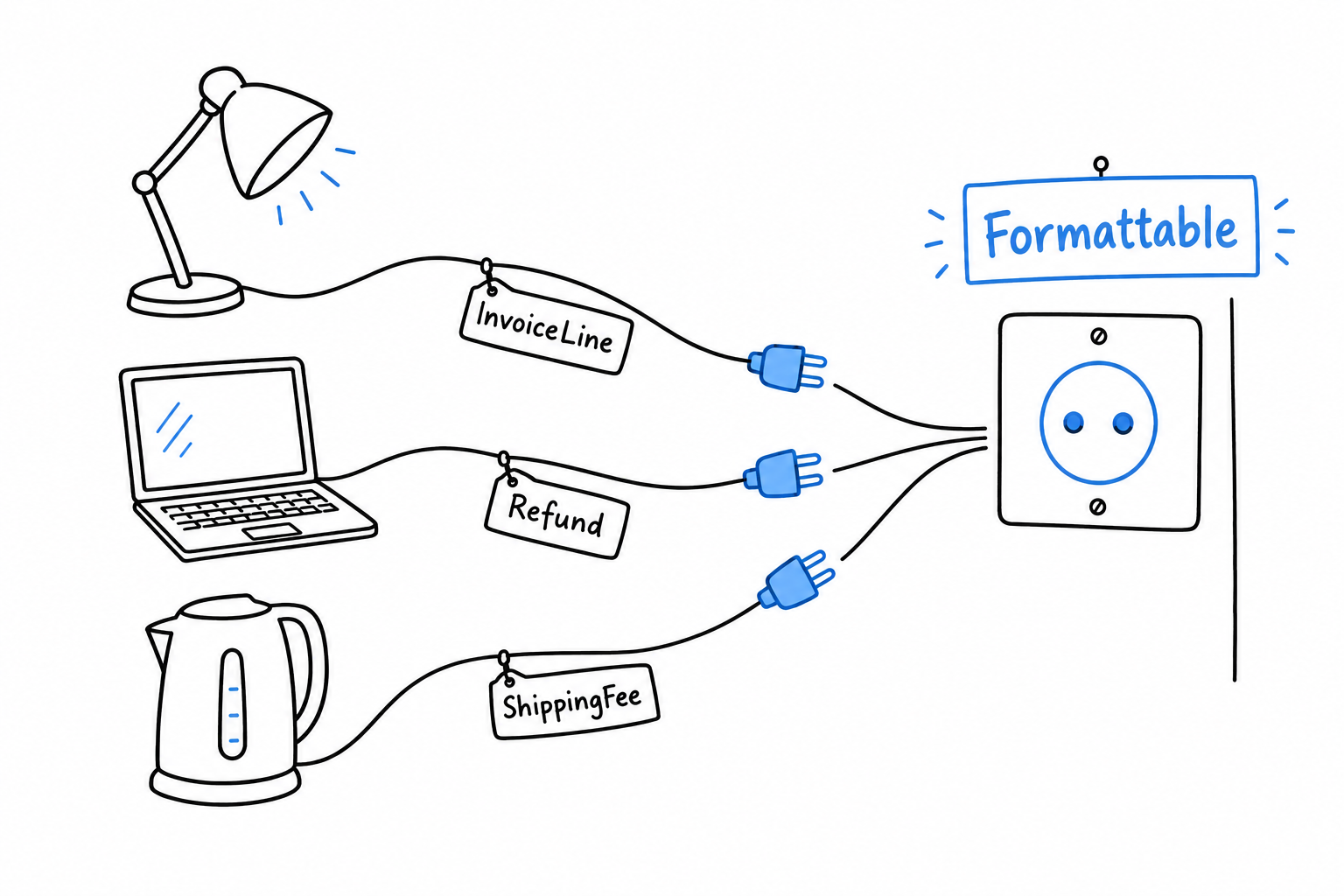
A wall socket does not care whether you plug in a lamp or a laptop, only that the plug has the right shape. Formattable is the shape, and printSummary() is the socket.
Tests raise the stakes. Had printSummary() type-hinted InvoiceLine directly, testing it on its own would mean building a real InvoiceLine with a real Product behind it. With Formattable, a test can hand it any object that honors the contract, including a deliberately fake one built for the occasion, with no Product in sight. Chapter 12 puts that to direct use.
Type-hint the contract, not the class. The function then works with every class that signs it, including the ones you have not written yet.
instanceof
Occasionally you need to ask, at runtime, whether an object satisfies an interface:
<?php

if ($item instanceof Formattable) {
    echo $item->format() . "\n";
}
Reach for this rarely. A pile of instanceof checks before a method call usually means the method belongs on an interface you should be type-hinting against, not that you need more instanceof.
A note on naming
PHP has no special syntax to mark an interface as “just” a contract rather than something more structural. Formattable, Countable, Stringable, ArrayAccess are all ordinary interfaces, some built into the language, some yours. Convention favors an adjective ending in -able for a single-capability contract (Formattable, Comparable, Sortable). PHP does not require it, but the next reader will thank you. Several of PHP’s own built-in interfaces show up in Chapter 20.