How to Write Tests with PHPUnit
Start a fresh project, as in Chapter 7:
$ composer init --no-interaction
$ composer require --dev phpunit/phpunit
The --dev flag matters. PHPUnit is a tool you use while building the project, not something the project needs to run. Composer keeps development-only dependencies apart for that reason: they never ship.
The code under test
Here is a small class worth testing, the kind you have been writing since Chapter 5:
<?php
// src/Rectangle.php

declare(strict_types=1);

final class Rectangle
{
    public function __construct(
        private readonly float $width,
        private readonly float $height,
    ) {
    }

    public function area(): float
    {
        return $this->width * $this->height;
    }

    public function isSquare(): bool
    {
        return $this->width === $this->height;
    }
}
Nothing new: a readonly class, two properties, two methods. The question a test answers is simple. Does it actually do what it claims?
Your first test
A test is a class that extends PHPUnit’s TestCase, with methods whose names start with test. Each method sets up a situation, then makes a claim about the result:
<?php
// tests/RectangleTest.php

declare(strict_types=1);

use PHPUnit\Framework\TestCase;

final class RectangleTest extends TestCase
{
    public function testAreaOfARectangle(): void
    {
        $rectangle = new Rectangle(8.0, 7.0);

        $this->assertEquals(56.0, $rectangle->area());
    }
}
Read the method as a sentence: build a rectangle 8 by 7, then claim its area is 56. assertEquals(expected, actual) is the claim. If the two values differ, the test fails and PHPUnit shows you both sides. Run it:
$ vendor/bin/phpunit tests
PHPUnit 10.5.0 by Sebastian Bergmann and contributors.

.                                                                   1 / 1 (100%)

Time: 00:00.012, Memory: 6.00 MB

OK (1 test, 1 assertion)
One dot per passing test. That is the whole feedback loop for the rest of this chapter: change the code, run the tests, count the dots.
Try it: change 56.0 to 57.0 and run again. The dot becomes an F, and PHPUnit tells you which claim broke, with the value it expected and the value it got.
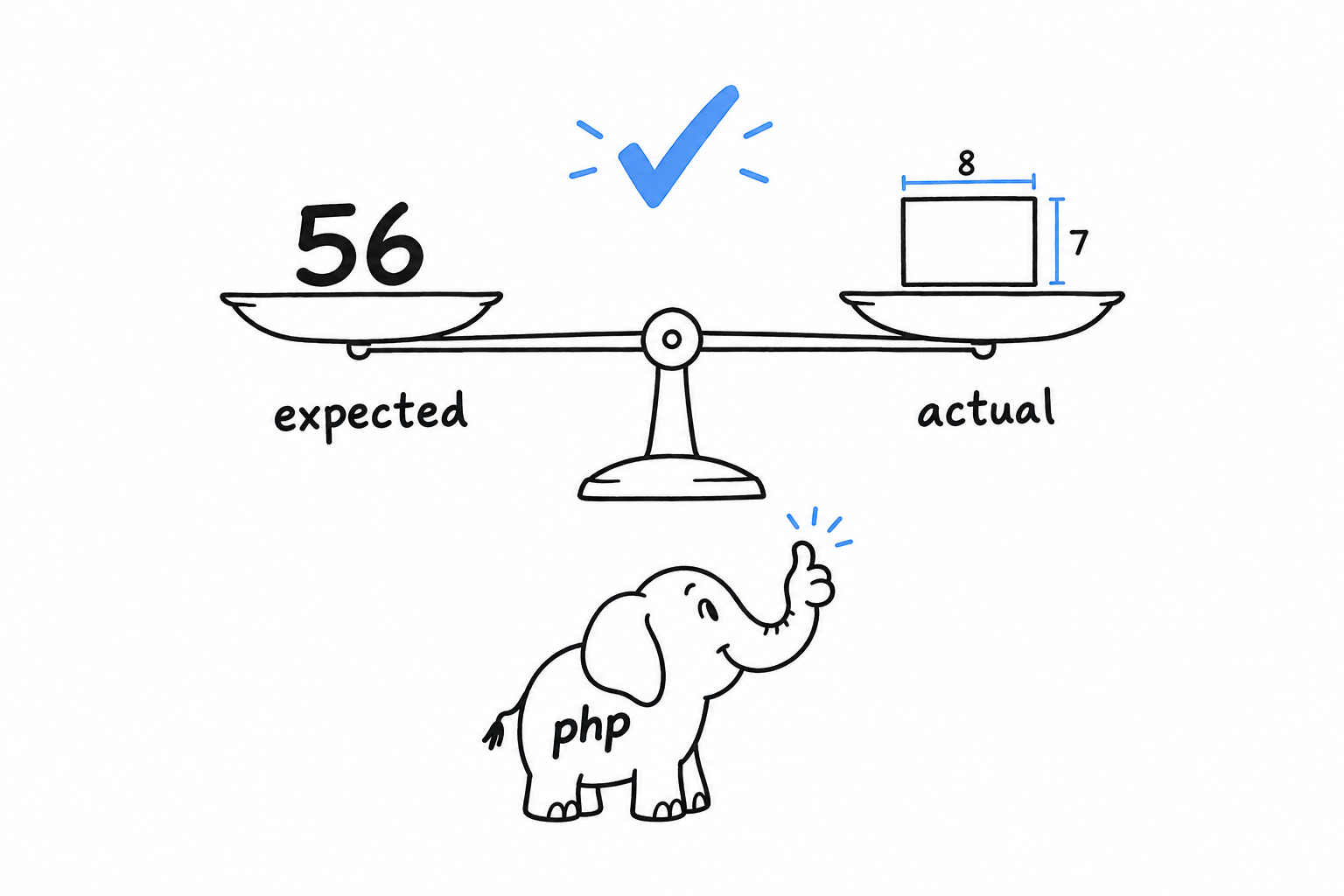
A test is a claim about your code. PHPUnit checks whether the claim still holds.
#[Test] as an alternative to the test prefix
PHP 8 attributes (Chapter 20 covers them properly) give PHPUnit a second way to mark a method as a test, with no naming constraint:
<?php

use PHPUnit\Framework\Attributes\Test;
use PHPUnit\Framework\TestCase;

final class RectangleTest extends TestCase
{
    #[Test]
    public function itCalculatesArea(): void
    {
        $rectangle = new Rectangle(8.0, 7.0);

        $this->assertEquals(56.0, $rectangle->area());
    }
}
Either style is fine; pick one per project and stick to it. This book keeps the test prefix: no use statement, and the intent is clear from the name alone.
More assertions: assertTrue, and assertEquals vs. assertSame
<?php

final class RectangleTest extends TestCase
{
    public function testASquareIsDetected(): void
    {
        $square = new Rectangle(5.0, 5.0);

        $this->assertTrue($square->isSquare());
    }

    public function testEqualsVsSame(): void
    {
        $this->assertEquals(1, "1");   // passes, loose comparison, like ==
        $this->assertSame(1, "1");     // fails, strict comparison, like ===
    }
}
assertTrue() does what it says. The second method is the interesting one, because one of its two lines fails.
assertEquals() compares like ==, and assertSame() compares like ===. This is the exact distinction from Chapter 3, wearing an assertion-shaped hat. For assertEquals(), 1 and "1" are equal enough. assertSame() refuses: it checks the type and the value together.

Default to assertSame(). It catches a whole family of bugs (a function returning a string where you expected an integer) that assertEquals() lets through without a word. Reach for assertEquals() only when the loose comparison is really what you mean to test.
A failing assertion tells you exactly what went wrong:
$ vendor/bin/phpunit tests
1) RectangleTest::testEqualsVsSame
Failed asserting that 1 is identical to '1'.
That message does real work: “not identical” rather than “unequal” points straight at the type mismatch. Read failure messages closely; PHPUnit is more specific than it looks.