Defining an Enum
Pure enums
Four suits, no more, no less. Here they are as an enum:
<?php
declare(strict_types=1);

enum Suit
{
    case Hearts;
    case Diamonds;
    case Clubs;
    case Spades;
}

$card = Suit::Hearts;

var_dump($card);          // enum(Suit::Hearts)
var_dump($card === Suit::Hearts); // true
enum opens the definition the way class does, and each case line declares one of the allowed values. An enum is a type with a fixed, closed list of values, and those values are called cases. Suit::Hearts is written like a class constant: you reach a case through the enum’s name.
The var_dump line shows something a string never told you. Suit::Hearts is a single, unique value. There is exactly one in your whole program, however many variables point at it, which is why the === on the next line says true without a second thought.
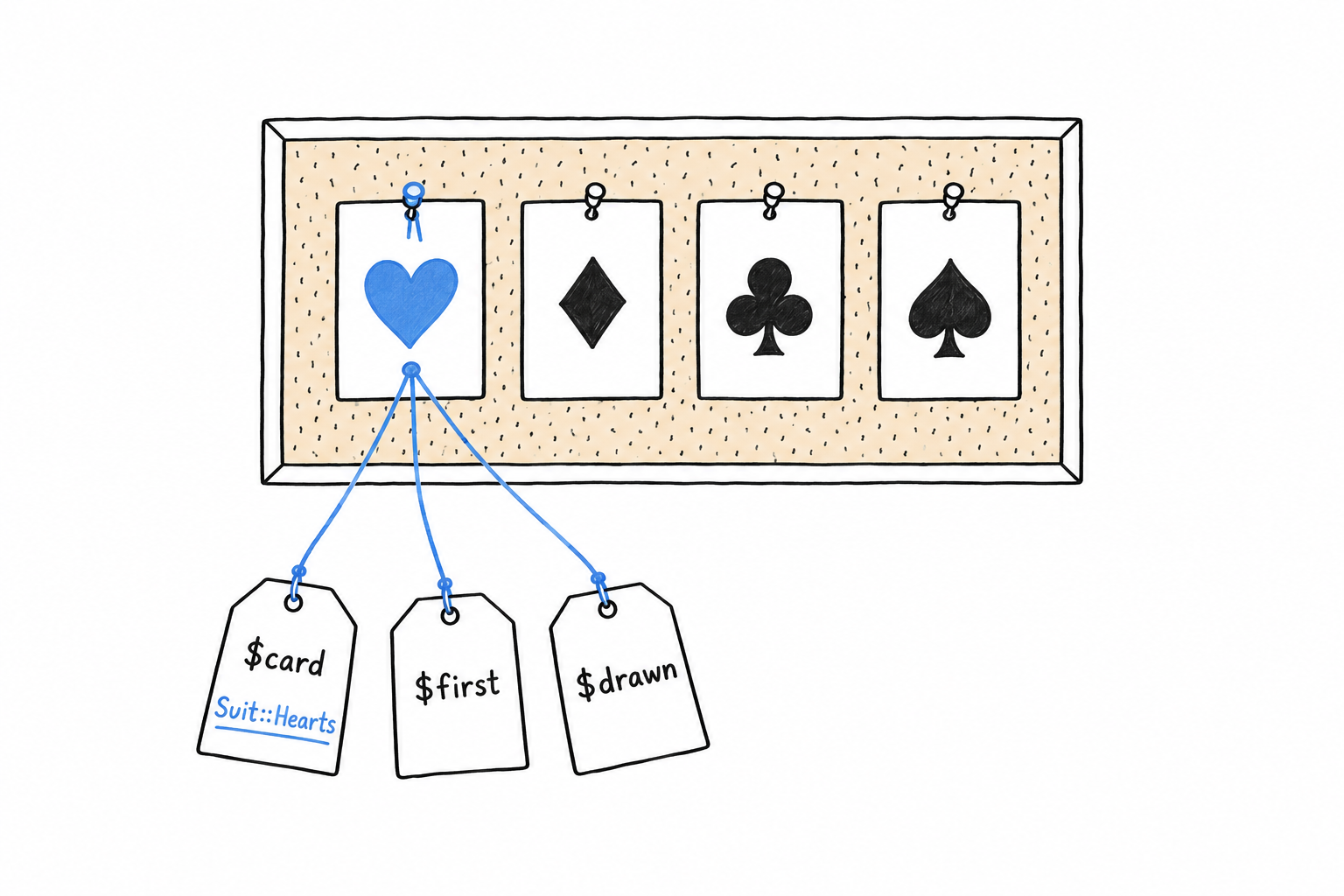
That uniqueness makes the type safe. A parameter typed Suit cannot hold anything but one of the four cases, and PHP stops a wrong value at the type level rather than with a bug report three weeks later.
<?php
declare(strict_types=1);

function describe(Suit $suit): string
{
    return "You drew a {$suit->name}.";
}

echo describe(Suit::Spades); // You drew a Spades.
Every case carries a built-in ->name property: the identifier you declared it with, as a string. Handy for logging, but it is only a label. Building program logic on it would be building on the spelling of your own code.
Try it: call describe('Spades') with a plain string and read the TypeError. That message is the enum doing its job.
Backed enums
A pure enum’s cases are nothing but themselves: Suit::Hearts is not secretly a string or a number. Then an order has to be saved in a database column, or sent as JSON to another program, and the outside world does not know what Status::Shipped is. It knows 'shipped'. A backed enum ties every case to a scalar value of your choice, a form that can leave your program and come back.
<?php
declare(strict_types=1);

enum Status: string
{
    case Pending = 'pending';
    case Shipped = 'shipped';
    case Cancelled = 'cancelled';
}

$status = Status::Shipped;

echo $status->value; // shipped
: string after the name says the enum is backed by strings, and from then on every case must declare its value: PHP checks that when it reads the definition. Integers work the same way (enum Status: int). Strings are the usual choice, because 'shipped' explains itself in a database row, where a bare 2 sends you back to the enum to find out what it means.
Going the other way, from a raw value to a case, takes one of two methods:
<?php

$status = Status::from('shipped');   // Status::Shipped
echo $status->name;                  // Shipped

$status = Status::tryFrom('bogus');  // null, no matching case
var_dump($status);
from() converts a value into the matching case and throws a ValueError if nothing matches. tryFrom() returns null instead. Choosing between them means asking where the value comes from. If an unknown value can only mean a bug in your own code, use from() and let it fail loudly. If it arrives from user input or an external API, “not a valid status” is a normal outcome, and tryFrom() hands it to you as a null to handle.
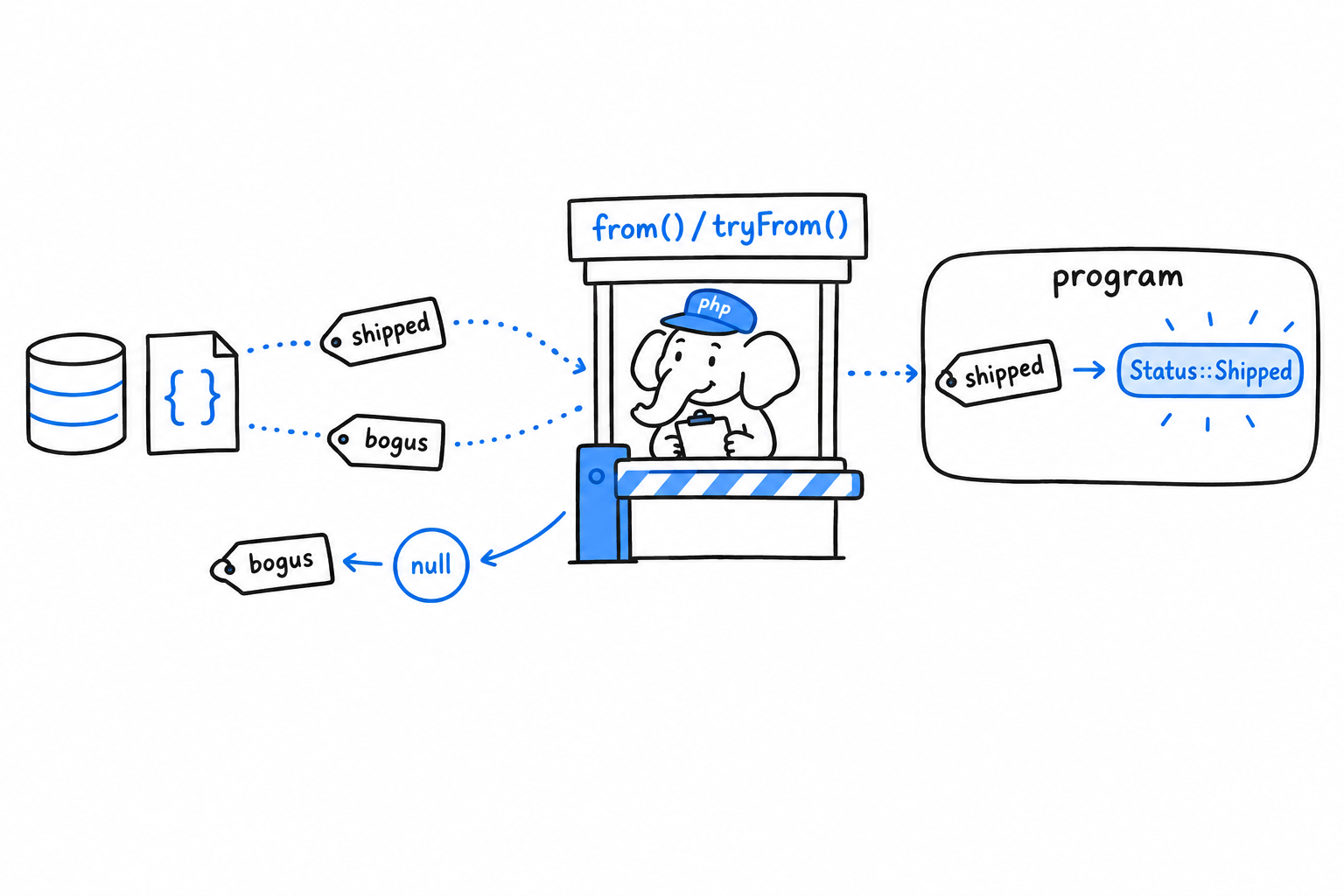
from()throws on an unknown value.tryFrom()returnsnull. Pick by asking who produced the value.
Enums can have methods
An enum is not only a list of names. It can carry behavior, exactly as a class does:
<?php
declare(strict_types=1);

enum Status: string
{
    case Pending = 'pending';
    case Shipped = 'shipped';
    case Cancelled = 'cancelled';

    public function label(): string
    {
        return match ($this) {
            Status::Pending => 'Awaiting shipment',
            Status::Shipped => 'On its way',
            Status::Cancelled => 'Order cancelled',
        };
    }
}

echo Status::Shipped->label(); // On its way
label() works like any method from Chapter 5: inside it, $this is the case the method was called on. The mapping from a case to its human-readable label now lives in one place, right next to the cases themselves, instead of being scattered through the codebase as if ($status === 'shipped') checks that slowly drift apart.
The match inside label() compares $this against each case and returns the text beside the one that fits. That is match doing what it does best, and the next section takes it apart.