Methods and Constructor Promotion
A method is a function that lives inside a class. You have already written one, totalPrice() on Product. What sets it apart from an ordinary function fits in a single variable, $this, and once that is clear, PHP’s shortest way of writing a constructor is one small step away.
$this
Inside a method, $this is the object the method was called on. It is how a method reaches the data of this particular instance, and not some other instance of the same class:
<?php
declare(strict_types=1);

class Product
{
    public string $name;
    public float $price;
    public int $quantity;

    public function __construct(string $name, float $price, int $quantity)
    {
        $this->name = $name;
        $this->price = $price;
        $this->quantity = $quantity;
    }

    public function totalPrice(): float
    {
        return $this->price * $this->quantity;
    }

    public function applyDiscount(float $percentage): void
    {
        $this->price -= $this->price * ($percentage / 100);
    }
}

$mug = new Product('Coffee mug', 8.50, 3);
$mug->applyDiscount(10);

echo $mug->price; // 7.65
applyDiscount() does not take the product as a parameter. It does not need to: $this already is the product it was called on. Call $mug->applyDiscount(10), and inside the method $this is $mug. Call the same method on another Product, and $this is that one instead.
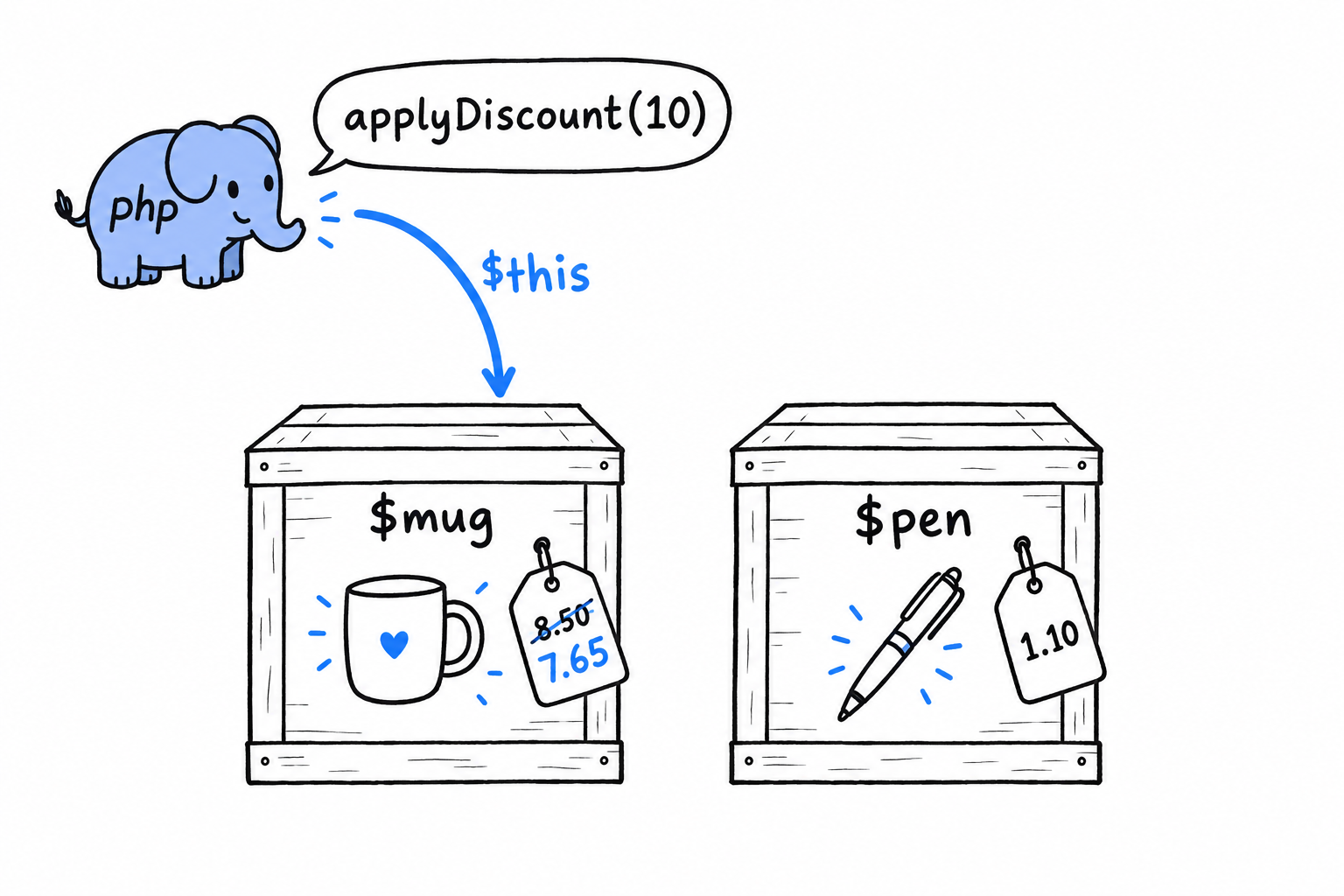
$this is implicit, and always available inside any non-static method. It is what keeps an object’s methods in step with that same object’s data, without you passing the object into every one of its own methods by hand.
Call a method on an object, and
$thisis that object. Nothing to pass, nothing to declare.
Try it: create a second product, $pen = new Product('Pen', 1.10, 5);, call $mug->applyDiscount(10), then print $pen->price. The pen is untouched. The discount only reached the object $this pointed to.
The constructor, the long way
Look at Product’s constructor again. Three parameters in, three matching assignments, one line each, no logic beyond “put this where it belongs.” The shape is so common in PHP, and so repetitive, that it earned its own shorthand.
Constructor property promotion
Since PHP 8, adding a visibility keyword to a constructor parameter declares the property and assigns it in one stroke:
<?php
declare(strict_types=1);

class Product
{
    public function __construct(
        public string $name,
        public float $price,
        public int $quantity,
    ) {
    }

    public function totalPrice(): float
    {
        return $this->price * $this->quantity;
    }
}

$mug = new Product('Coffee mug', 8.50, 3);
echo $mug->totalPrice(); // 25.5
Set this next to the version at the top of the section. From the outside, the two classes are identical: same properties, same types, same constructor signature. Inside, the promoted version has no separate property declarations, no $this->name = $name; three times over, and an empty constructor body. Writing public string $name as a parameter does three jobs at once: it declares the property, types it, and stores the incoming argument in it.
This is the idiomatic, modern way to write a constructor whose only job is “keep what I was given”, and that describes a large share of the constructors you will write in real PHP code. You will see it constantly from here on.
readonly properties, briefly
One more keyword, because it pairs so naturally with promotion. Mark a promoted property readonly, and it can be set once, during construction, and never reassigned:
<?php
declare(strict_types=1);

class Product
{
    public function __construct(
        public readonly string $name,
        public float $price,
        public int $quantity,
    ) {
    }
}

$mug = new Product('Coffee mug', 8.50, 3);
$mug->name = 'Travel mug'; // Error: Cannot modify readonly property Product::$name
A price and a quantity are expected to change; that is the whole point of applyDiscount(). A product’s name rarely has a good reason to. readonly lets you say so in the class definition itself, and PHP enforces it, instead of the rule living in a comment or a convention someone eventually forgets. It comes back later in the book, once enums and value objects enter the picture.