Introduction
You have been handed a PHP codebase. Maybe you asked for it, more likely you did not. You open the first file, you see $this-> and -> and :: and a function called htmlspecialchars, and a thought forms: is this going to be the language everyone warned me about?
The PHP people warned you about was real, and it is mostly gone. What is left is a typed, object-oriented, garbage-collected language with a package manager, a standard coding style, a serious static analysis ecosystem, a release every November, and a runtime model that is unlike anything you have used, which is the one thing you actually need to learn.
What was true
PHP started in 1995 as a set of templates with a bit of logic in them. For its first decade it was permissive to a fault. Variables appeared out of nowhere, "abc" == 0 was true, errors were printed to the page and execution continued, database queries were built by string concatenation, and the standard library was assembled one function at a time by whoever needed it that week, which is why strpos sits next to str_replace and array_key_exists sits next to in_array.
A whole generation learned to program on that PHP, wrote a great deal of it, and much of it still runs. That is the PHP of the jokes.
What changed
PHP 7 (2015) doubled performance and added scalar type declarations. PHP 8 (2020) added a real type system with union types, match, named arguments, attributes, enums, readonly, first-class callables and a JIT compiler. PHP 8.4 added property hooks and asymmetric visibility. PHP 8.5 added a pipe operator. The comparison rules were fixed, dynamic properties were deprecated, the old mysql_* functions were removed, and the interpreter now throws a TypeError where it used to guess.
Around the language, the community built Composer, the package manager every project uses; the PHP-FIG standards, so that libraries from different authors fit together; PHPUnit and Pest for testing; PHPStan and Psalm, two static analysers that give you most of what a compiler would; and Rector, which rewrites old code to new syntax. Since 2021 the PHP Foundation has employed core developers so the language has a future that does not depend on volunteers’ evenings.
What still bites
Not everything was fixed, and a book for busy people should say so up front. Strings are byte sequences, so strlen('é') is 2 and you want the mb_ functions for text. The standard library still has its inconsistent names and argument orders. == still coerces, though far less wildly than before. Strict typing is a per-file switch you must turn on. Arrays copy when you assign them. There are no generics in the language itself. Each of these has a modern practice that neutralises it, and each is covered where you will meet it.
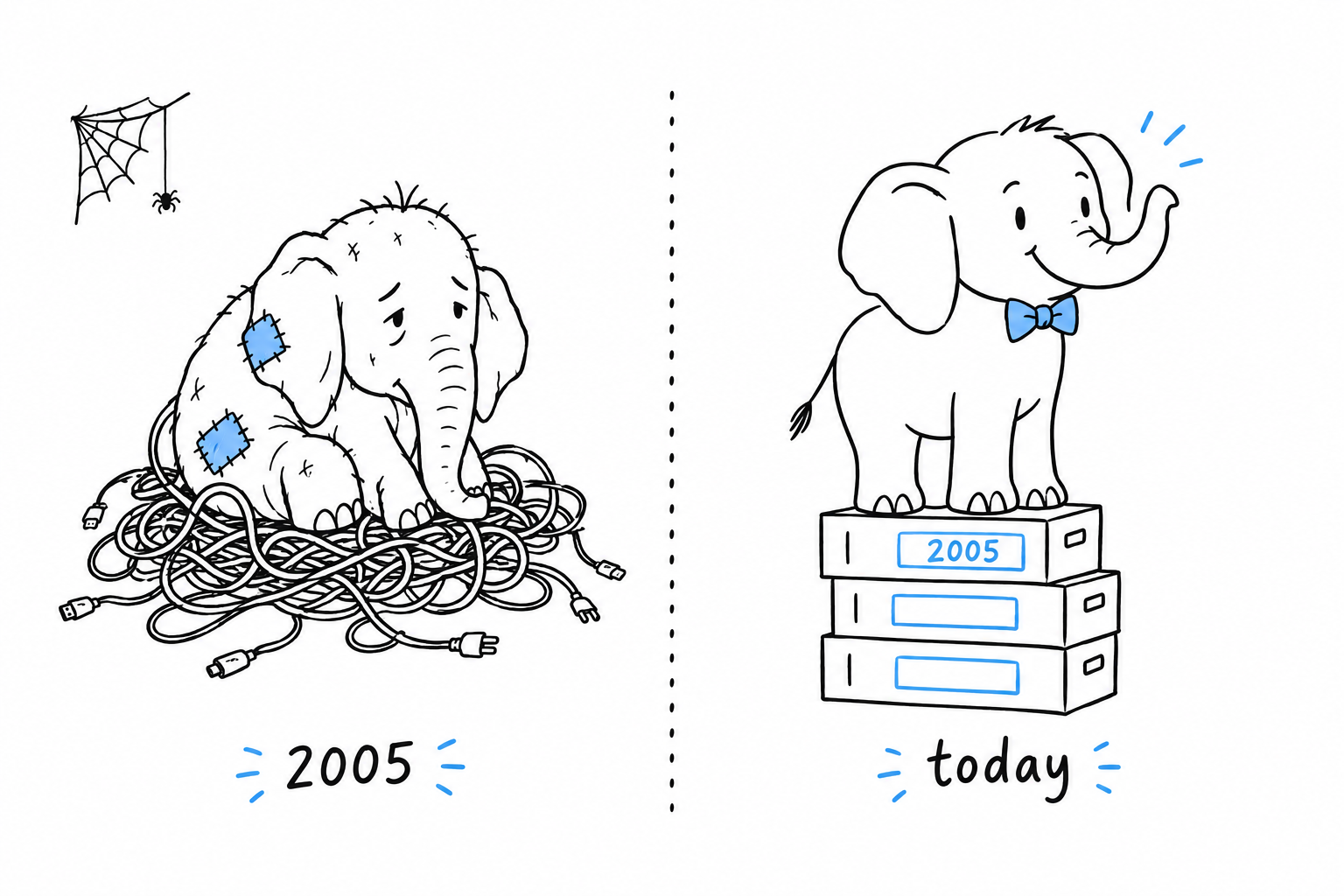
The reputation stayed in 2010. The language did not.
The one idea to get first
A PHP web request starts with nothing, runs your code top to bottom, sends its answer, and throws everything away. No shared memory between requests, no application object that stays alive, no event loop, no threads. The web server hands a request to PHP, PHP produces a response, PHP forgets.
If you come from Node, Java, Go or an ASGI Python server, this is the single largest difference, and most PHP idioms follow from it: why there is no connection pool by default, why “global state” is a per-request thing, why a crash affects one visitor, why scaling is a matter of adding processes, why OPcache exists, and why long-running PHP servers like FrankenPHP or RoadRunner are a topic in their own right. How PHP Runs covers it, and it is the one chapter not to skip.
How to read this book
Each chapter answers one question and stands on its own. The bold sentences carry the story: read only those and you get the delta between PHP and what you already know. Read the code blocks and you get the syntax. Read the rest when a detail matters to you.
The comparisons to Python, JavaScript, Java and a few other languages are anchors, not translations. Skip the ones for languages you do not know. Nothing depends on them.
Every example runs on a bare PHP install with php file.php. No framework, no library, so that the lesson is about PHP itself. Install PHP first: your package manager has it, php.net lists official builds, and the official Docker image is php:8.5-cli. Then keep a terminal open and run what you read.
Three chapters serve a particular reader. Returning to PHP After Years Away maps old habits to modern practice, for developers returning to the language. Coming from Python, JavaScript, or Java is a lookup table. PHP 8.0 to 8.5 at a Glance tells you what your project’s PHP version can do.
Two to three hours from now, the codebase you opened will look different. Not simpler, necessarily. Just legible.