Recoverable Errors with Exceptions
The previous section was about bugs. This one is about trouble your code should expect: a file that might not exist, an age that might be negative, an API that might refuse the request. None of it means the program is broken. It means a decision is needed, and the function that spots the problem is rarely the one equipped to make it. An exception is how a function says “here is a problem, and here is what I know about it” to whoever, higher up the call stack, can deal with it.
try, catch, finally
The shape is the same as in most languages that have exceptions:
<?php

declare(strict_types=1);

function readConfig(string $path): array
{
    if (!file_exists($path)) {
        throw new \RuntimeException("Config file not found: {$path}");
    }

    return json_decode(file_get_contents($path), associative: true);
}

try {
    $config = readConfig('config.json');
    echo "Loaded " . count($config) . " settings.\n";
} catch (\RuntimeException $e) {
    echo "Couldn't load config: {$e->getMessage()}\n";
    $config = [];
} finally {
    echo "Config load attempt finished.\n";
}
Run it with no config.json next to the file. readConfig() reaches the throw, and normal execution stops right there: nothing after the throw runs, and neither does the echo "Loaded..." line back in the caller. Control jumps to the nearest enclosing catch whose type matches, skipping everything in between, however many function calls deep that turns out to be.
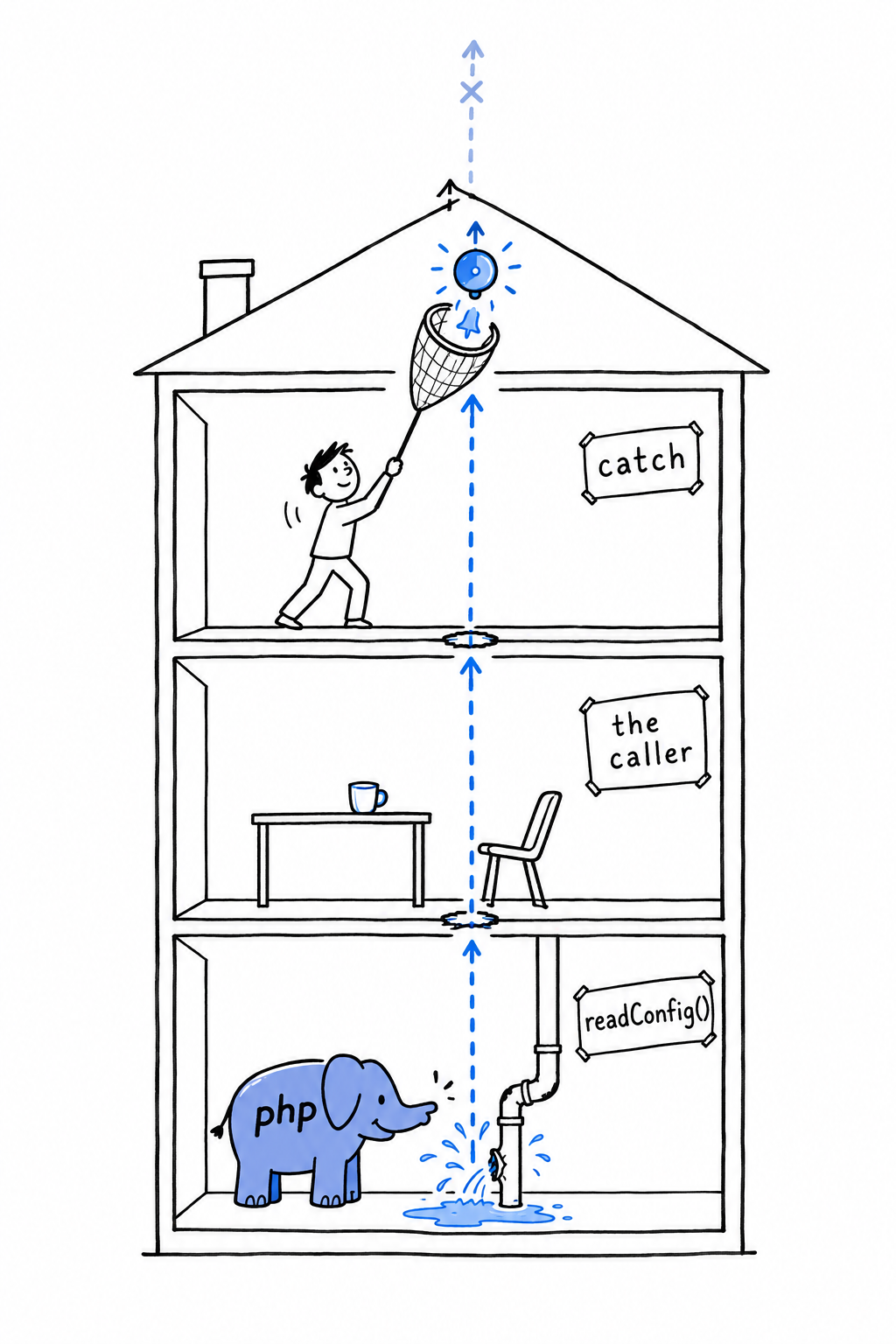
Think of a leak on the ground floor of a building. Nobody there can fix it, so the alarm climbs, floor by floor, and every floor it crosses drops what it was doing, until someone with a net catches it. If nobody does, the alarm reaches the roof, and PHP stops the program, printing the message and the path the exception took.
finally runs whatever happened: exception caught, exception not caught, or no exception at all. That makes it the place for cleanup that must happen no matter what, like closing a file or releasing a lock.
Tip
Try it: create a
config.jsoncontaining{"debug": true}and run again. Thecatchblock is skipped this time, andfinallystill prints its line.
Exception versus Error, and Throwable
PHP’s exception hierarchy has two parallel branches growing from the same interface, Throwable.
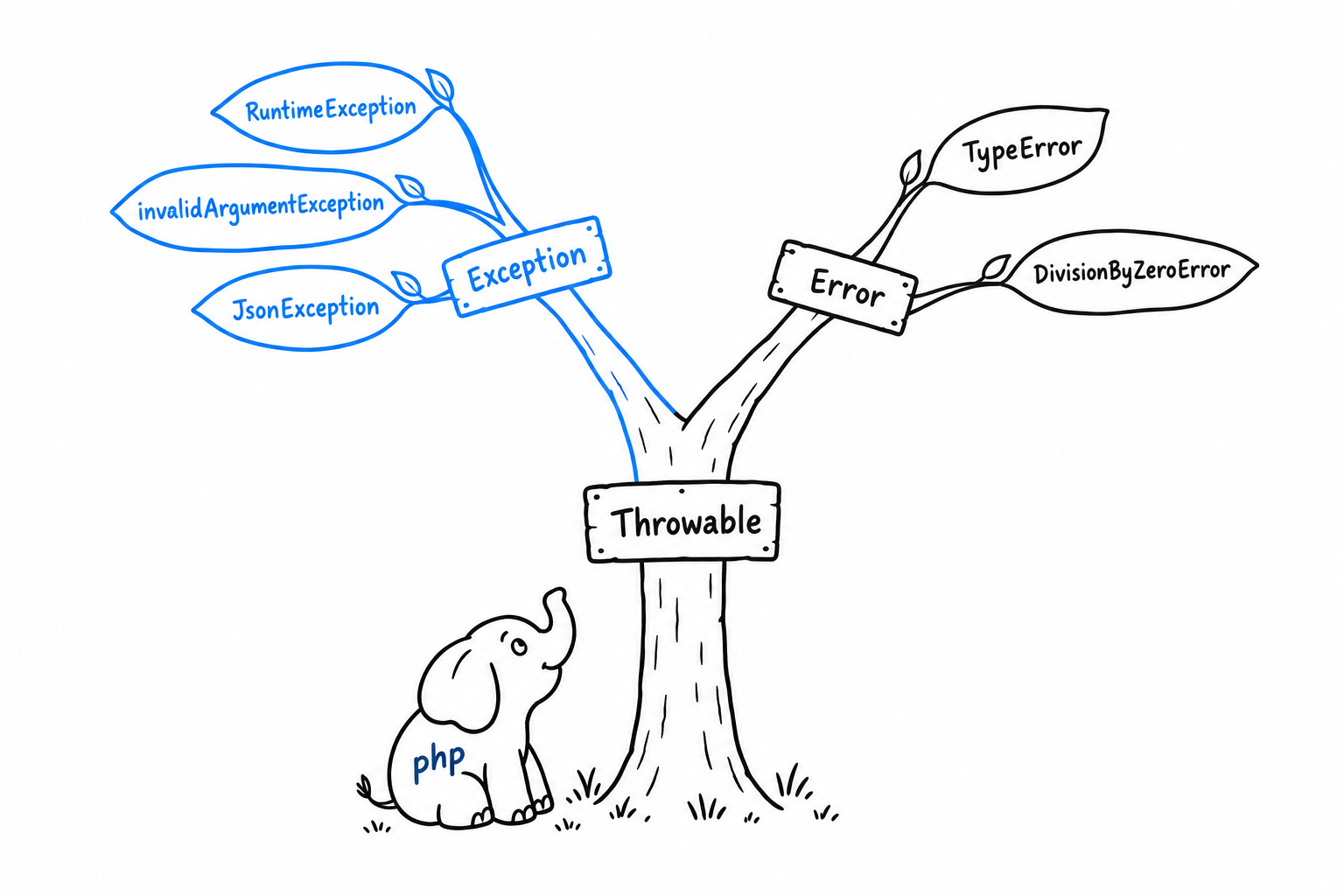
Exception and its subclasses (InvalidArgumentException, RuntimeException, JsonException) are for conditions a well-written program can anticipate and recover from. Error and its subclasses (TypeError, DivisionByZeroError) are the bugs of the previous section.
The split is what lets a catch be precise. catch (\Exception $e) catches exceptions and lets an Error fly past; catch (\Throwable $e) catches both. Reach for \Throwable only at the very edge of an application, in a top-level handler that logs whatever nobody else handled before the process exits. Never use it as a routine catch type in ordinary code: catching it casually is how bugs turn into “handled” cases that never get fixed.
Catching several types at once
A single catch can list several types separated by |, when you want to handle them the same way:
<?php

declare(strict_types=1);

try {
    $result = $client->send($request);
} catch (ConnectionException|TimeoutException $e) {
    echo "Network problem, retrying: {$e->getMessage()}\n";
    $result = retry($request);
}
If the handling differs between the two, write two catch blocks. The | is for when the response really is identical, not a shortcut to avoid a second block.
Writing your own exception
RuntimeException and InvalidArgumentException cover a lot of ground, but naming your own exceptions is one of the most common things you will do in real PHP. A specific exception type tells the caller exactly what went wrong, and lets them catch that and nothing else, instead of guessing from a message string:
<?php

declare(strict_types=1);

class InvalidAgeException extends \Exception
{
    public function __construct(
        public readonly int $age,
    ) {
        parent::__construct("Invalid age: {$age}. Must be between 0 and 150.");
    }
}

function registerUser(string $name, int $age): void
{
    if ($age < 0 || $age > 150) {
        throw new InvalidAgeException($age);
    }

    echo "Registered {$name}, age {$age}.\n";
}

try {
    registerUser('Alice', -5);
} catch (InvalidAgeException $e) {
    echo "Registration failed: {$e->getMessage()}\n";
    echo "Offending value was: {$e->age}\n";
}
Extending \Exception brings the whole standard machinery for free: getMessage(), getCode(), getPrevious(), and a stack trace through getTraceAsString(). The call to parent::__construct() is what wires your message into that machinery; skip it and getMessage() comes back empty. Beyond that, the class is yours. InvalidAgeException keeps the offending $age in a readonly property, so the catch block gets structured data to work with, not just a string to parse.
This small pattern, a specific exception carrying the context that caused it, comes back in Chapter 14. Get comfortable with it now, because the harder question is not how to throw. It is when.