Unrecoverable Errors: Fatal Errors and Error
Some problems have nothing to do with bad luck. No file went missing, no user typed nonsense: your code is wrong. You called a method that does not exist. You passed a string to a function that demanded an integer, with strict types on. You divided by zero. There is nothing sensible a program can do about a bug except stop and let you fix it.
PHP represents this family with the Error class and its subclasses. Three you will meet constantly:
<?php

declare(strict_types=1);

function half(int $n): int
{
    return $n / 0; // DivisionByZeroError
}

function double(int $n): int
{
    return $n * 2;
}

double("four"); // TypeError: strict_types is on, no silent conversion

$user = null;
$user->getName(); // Error: Call to a member function getName() on null
DivisionByZeroError, TypeError and the plain Error you get from calling a method on null all do the same job: they tell you, as precisely as they can, that the program reached a state it had no business being in. Run the file. It stops at double("four"), the first wrong thing it actually executes. Comment that line out, run again, and the call on null takes its turn; call half(3) and the division does. This is exactly what declare(strict_types=1), which you met in Data Types, is for: making a wrong call fail loudly, on the spot, instead of letting it slide.
Why this used to be worse
Code written before PHP 7 is full of null checks and is_int() guards scattered through function bodies, and there was a reason for them. Back then, most of these situations threw nothing you could catch. Calling a method on null was a fatal error that halted the script, full stop; no try in the world could step in. A type mismatch might silently convert the value, or print a warning to a log nobody watched, and carry on with garbage.
PHP 7 introduced Error to fix this, and PHP 8 sharpened it further. Nearly everything in this family is now a real object implementing Throwable, the same interface Exception implements. So you can write catch (Error $e) and keep the program running. You very often should not.
Catchable doesn’t mean “should catch”
The question is not whether PHP can hand you the problem as an object. Since PHP 8, it almost always can. The question is whether catching it fixes anything. Compare:
<?php

declare(strict_types=1);

// Reasonable: the input is genuinely unpredictable, and there's a sensible fallback.
try {
    $config = json_decode($configJson, associative: true, flags: JSON_THROW_ON_ERROR);
} catch (\JsonException $e) {
    $config = [];
}

// Unreasonable: papering over a bug instead of fixing it.
try {
    $total = $order->getTotal(); // $order might be null due to a bug upstream
} catch (\Error $e) {
    $total = 0; // now every bug in this code path just... returns zero, silently
}
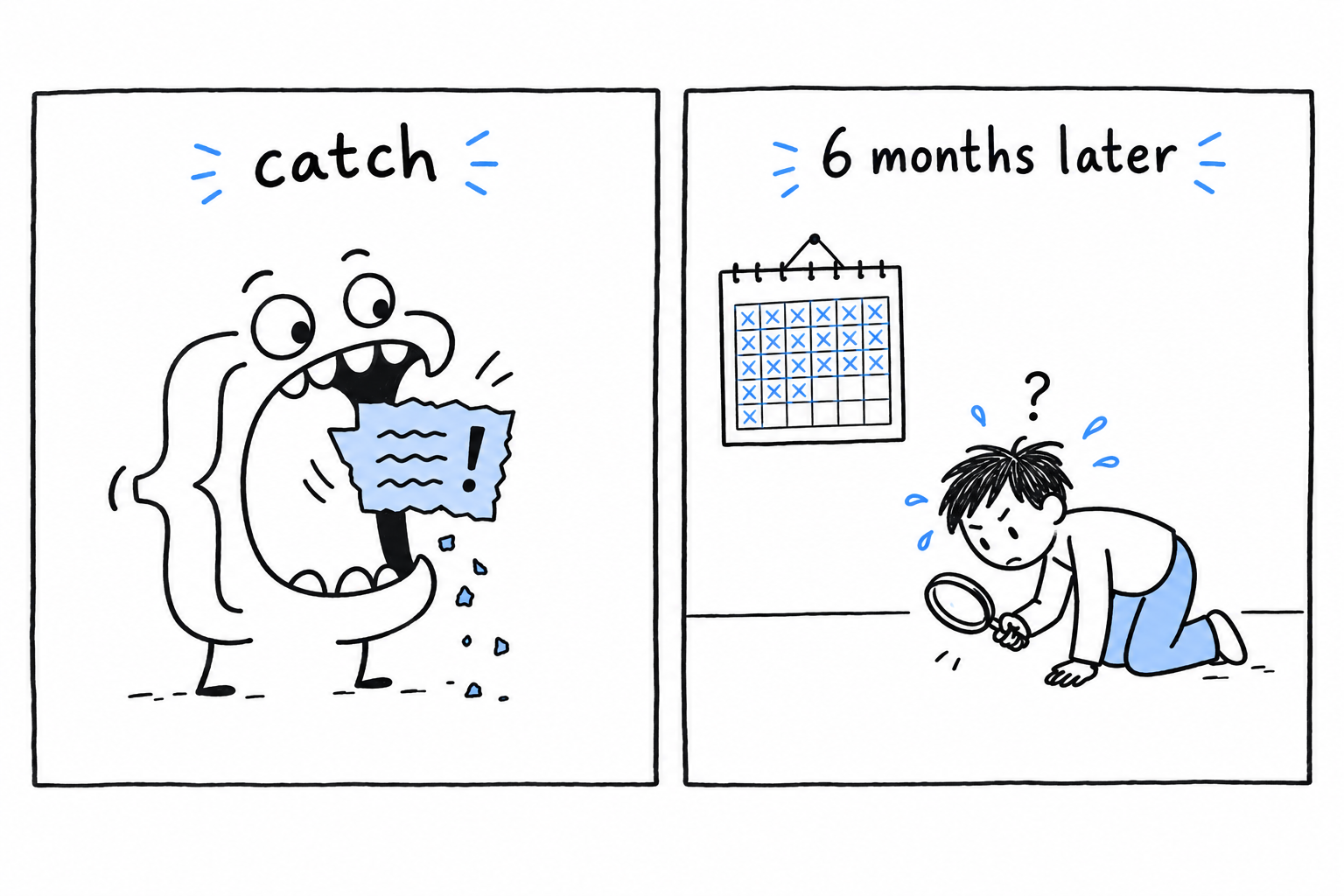
The first try handles a situation that really can happen: JSON from the outside world is sometimes malformed, and falling back to an empty config is a defensible choice. The second try catches the symptom of a bug and hides it behind a plausible number. Six months later, someone is wondering why totals are occasionally zero, with no exception, no log line, no clue, because the catch block ate the only evidence.
Warning
A broad
catch (\Error $e)is not a safety net. It is a shredder for the stack trace you will need later.
Catch Error and its subclasses only with a good reason and a narrow, specific type. If your own code produces a TypeError, the fix is to correct the call, not to wrap it in try. To Throw or Not to Throw draws this line more precisely. For now, read Error as PHP telling you something is broken, and exceptions, next, as PHP telling you something needs a decision.