Controlling Scope and Visibility with Namespaces
A namespace is a prefix. That is the whole concept, said plainly before the syntax makes it look bigger than it is. App\Models\Product is the name Product, living inside App\Models, the same way /home/damien/notes.txt is notes.txt, living inside /home/damien. The class itself does not change. What changes is how you, and PHP, point at it without ambiguity.
Declaring a namespace
The namespace line is the first statement in a file. Only a comment or declare(strict_types=1) may come before it:
<?php

declare(strict_types=1);

namespace App\Models;

class Product
{
    public function __construct(
        public readonly string $name,
        public readonly float $price,
    ) {
    }
}
Everything declared in this file now lives under App\Models: the Product class, and any class, interface or function you add below it. Its full name is App\Models\Product. Inside this file, and inside any other file that also opens with namespace App\Models;, plain Product still works, because PHP resolves a bare name against the current namespace first.
Why bother
Here is the situation namespaces were built for. Your project uses a library that ships a Collection class; plenty do, since it is the natural name for “a bunch of things with helper methods”. You want a Collection of your own as well, for a stamp-collecting app, say. Without namespaces, PHP would meet two classes fighting for one name and refuse to load the second. A fatal error, and not a subtle one.
With namespaces, there is no fight:
<?php

namespace App\Models;

class Collection
{
    // your Collection, entirely unrelated to anyone else's
}
<?php

// Illuminate\Support\Collection, from a package you installed
namespace Illuminate\Support;

class Collection
{
    // their Collection
}

Same short name, two different classes, no collision: App\Models\Collection and Illuminate\Support\Collection are simply two identifiers. Namespaces exist because your project will contain code from people you have never met, and none of you agreed on names in advance. Tidy code organization is a pleasant side effect. Avoiding the collision is the reason.
Fully qualified names
You can always name a class by its full path, whatever namespace you are in. Write it out completely, with a leading backslash, and you have a fully qualified name:
<?php

namespace App\Services;

function makeProduct(): \App\Models\Product
{
    return new \App\Models\Product('Keyboard', 49.00);
}
The backslash is the point. Inside App\Services, a bare Product resolves relative to the current namespace: PHP looks for App\Services\Product, which does not exist. A leading \ says “start from the very top”, the global namespace.
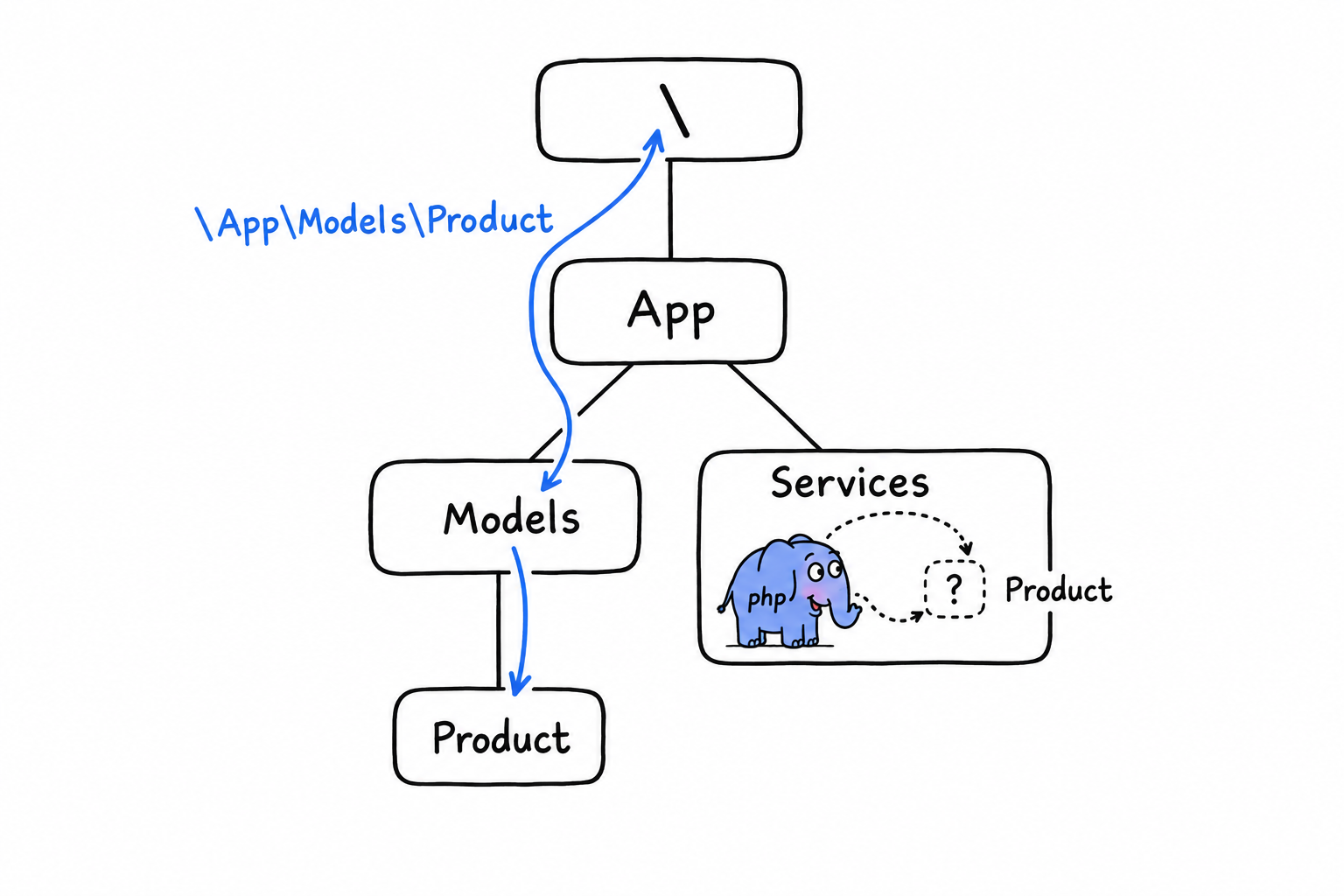
You need the same trick for PHP’s own built-in classes once your file has a namespace:
<?php

namespace App\Services;

function now(): \DateTimeImmutable
{
    return new \DateTimeImmutable();
}
DateTimeImmutable has no namespace. It lives at the top, next to Exception, ArrayObject and every other built-in class, and from inside App\Services the only way to reach it is the leading backslash. Or the use keyword, which imports the name once and spares you the backslash everywhere else. That is next.
A note on functions and constants
Namespaces cover functions and constants too. namespace App\Helpers; followed by function slugify(string $s): string { ... } gives you App\Helpers\slugify(). You will meet this less often than you might expect, for one reason: for a bare function or constant name, PHP falls back to the global namespace when no namespaced version exists. That is why strlen() and array_map() keep working inside a namespaced file without a second thought. Classes get no such fallback. Get the namespace of a class wrong and PHP simply will not find it.