Functions
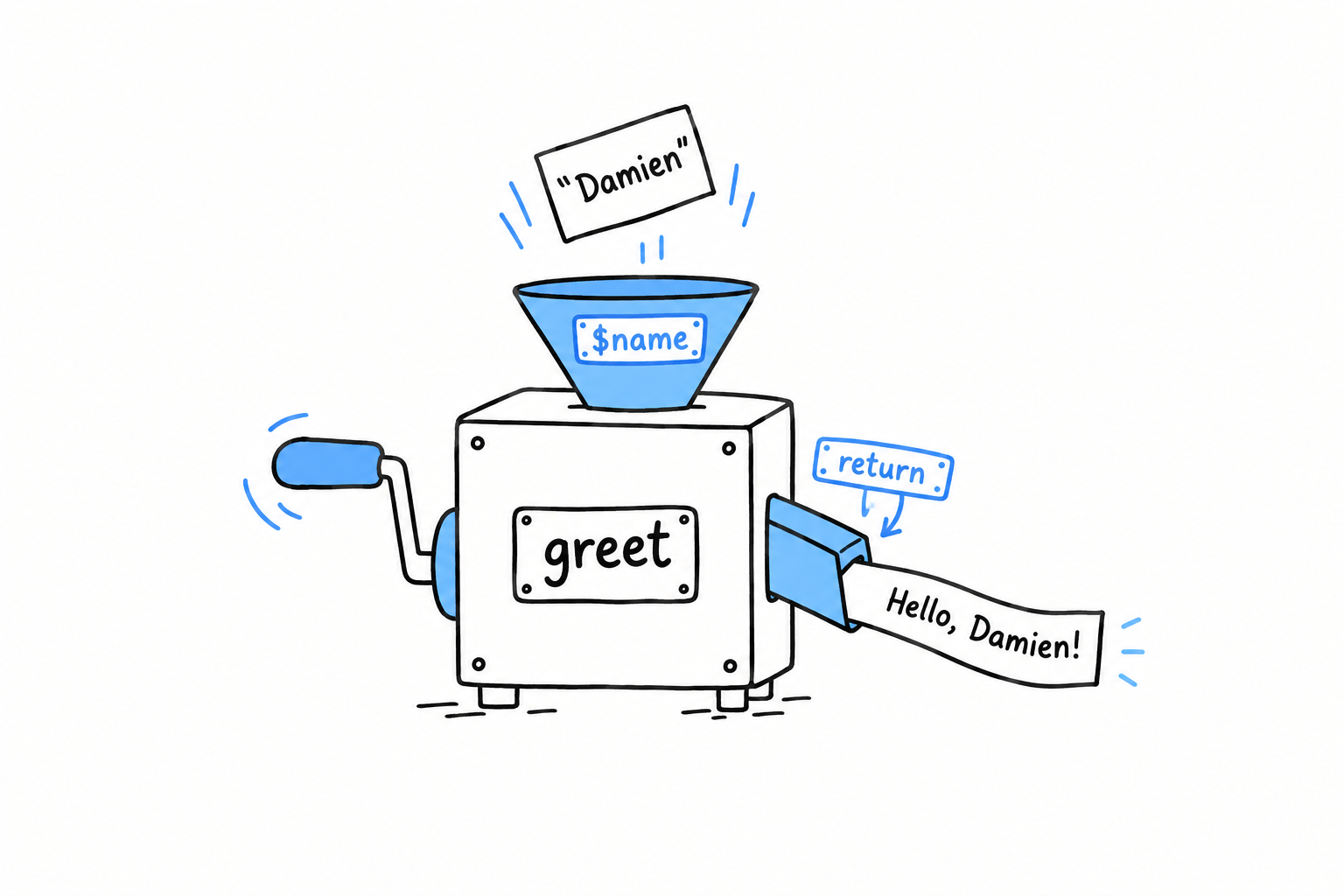
You have been calling functions since the first lines of the game. random_int(1, 100) picked the secret, fgets(STDIN) read a line, trim() cleaned it, is_numeric() checked it. Each one is a piece of work with a name: you hand it something, it hands something back. (echo looks like one, but as Chapter 1 noted, it is not.) Time to write your own.
<?php

function greet($name) {
    return "Hello, {$name}!\n";
}

echo greet("Damien");
function, a name, parentheses for the parameters, and a body in braces: that is the whole shape. Call greet("Damien"), and inside the body $name holds "Damien". Function names are conventionally camelCase. They are also case-insensitive when you call them, unlike variables, so GREET("Damien") would work. Please do not rely on that.
Parameters and types
Give each parameter a type, the way you saw in Data Types, and give the function a return type too:
<?php

function greet(string $name): void {
    echo "Hello, {$name}!\n";
}
: void says this function hands nothing back: it is called purely for its side effect, printing here. A function that does return something should say what:
<?php

function add(int $a, int $b): int {
    return $a + $b;
}

$sum = add(2, 3);
Type every parameter and every return value of every function you write, from here on. It costs a few keystrokes and removes a whole category of bugs where a function quietly receives, or returns, something you did not expect. Combined with declare(strict_types=1), it turns PHP from “dynamically typed and a little too forgiving about it” into a language that stops you at the door when you pass the wrong thing.
Default values
A parameter can have a default, which makes it optional when you call the function:
<?php

function greet(string $name, string $greeting = "Hello"): string {
    return "{$greeting}, {$name}!\n";
}

echo greet("Damien");             // Hello, Damien!
echo greet("Damien", "Bonjour");  // Bonjour, Damien!
Parameters with defaults come after parameters without them. PHP reads arguments left to right, so the required ones need to be settled first.
Named arguments
Argument order stops mattering once you pass arguments by name, and naming arguments is a real comfort as soon as a function has more than two or three parameters:
<?php

echo greet(name: "Damien", greeting: "Bonjour");
echo greet(greeting: "Bonjour", name: "Damien"); // order no longer matters
It shines with functions that have several optional parameters: you jump straight to the one you want to change, instead of spelling out every default in between to reach it by position.
return leaves at once
return exits the function immediately, with a value. Nothing after it runs:
<?php

function classify(int $n): string {
    if ($n < 0) {
        return "negative";
    }

    if ($n === 0) {
        return "zero";
    }

    return "positive";
}
There is no implicit “the last expression is the result” as in some languages. PHP always wants an explicit return. Leave it out, and the function returns null, silently. That is usually a bug rather than a choice, which is why declaring : void on functions that truly return nothing is worth the habit: PHP, and any static analysis tool reading your code, can then flag a value that slips out by accident.
Functions as values
One more thing worth knowing early, even though it only comes into its own in Chapter 15: a function is a value too. You can hold one in a variable and call it from there:
<?php

$operation = 'add';
echo $operation(2, 3); // calls add(2, 3), if add() is defined above
And PHP has real anonymous functions, called closures, for when you need to pass behavior around without giving it a name at all:
<?php

$double = function (int $n): int {
    return $n * 2;
};

echo $double(21); // 42
File that away. It matters a great deal later, once you start handing small pieces of behavior to array functions and generators.