Closures and Arrow Functions
A closure is a function without a name. You met one at the end of Chapter 3, stored in a variable and called like any other function. What Chapter 3 skipped is the part that makes closures useful: a closure can carry variables from the code around it, and PHP gives you two ways to hand those variables over, with two very different results.
Capturing by value with use
Inside a closure, the variables of the surrounding code are invisible by default. You have to name the ones you want to bring along, with use:
<?php
declare(strict_types=1);

function makeMultiplier(int $factor): callable
{
    return function (int $n) use ($factor): int {
        return $n * $factor;
    };
}

$double = makeMultiplier(2);
$triple = makeMultiplier(3);

echo $double(21) . "\n"; // 42
echo $triple(21) . "\n"; // 63
makeMultiplier(2) runs, $factor holds 2, and the closure is created. At that instant, use ($factor) copies the value of $factor into the closure, and the copy is what the closure will use for the rest of its life. It is the same by-value rule you saw in Chapter 4, applied to a function instead of a variable.
That is why calling makeMultiplier() twice gives two closures that behave differently forever. $double left with a copy of 2, $triple with a copy of 3, and nothing that happens later to any variable called $factor, anywhere, can reach either of them. Think of it as a photograph: the closure took a picture of $factor on its way out, and a picture does not change when the subject does.
Capturing by reference with use (&$var)
Sometimes a photograph is not enough. You want the closure to share a variable with the code around it, so that a change on either side shows on the other. That is use (&$var), the same & you have seen on function parameters:
<?php
declare(strict_types=1);

function makeCounter(): callable
{
    $count = 0;

    return function () use (&$count): int {
        $count++;
        return $count;
    };
}

$counter = makeCounter();
echo $counter() . "\n"; // 1
echo $counter() . "\n"; // 2
echo $counter() . "\n"; // 3
$count lives inside makeCounter(), and by every rule you know it should vanish when that function returns. It does not, because the closure holds a reference to it. The closure and the variable are now two labels on the same box, and each call to $counter() adds one to what is in the box. Nobody else can see $count anymore, but it stays alive for as long as the closure does.
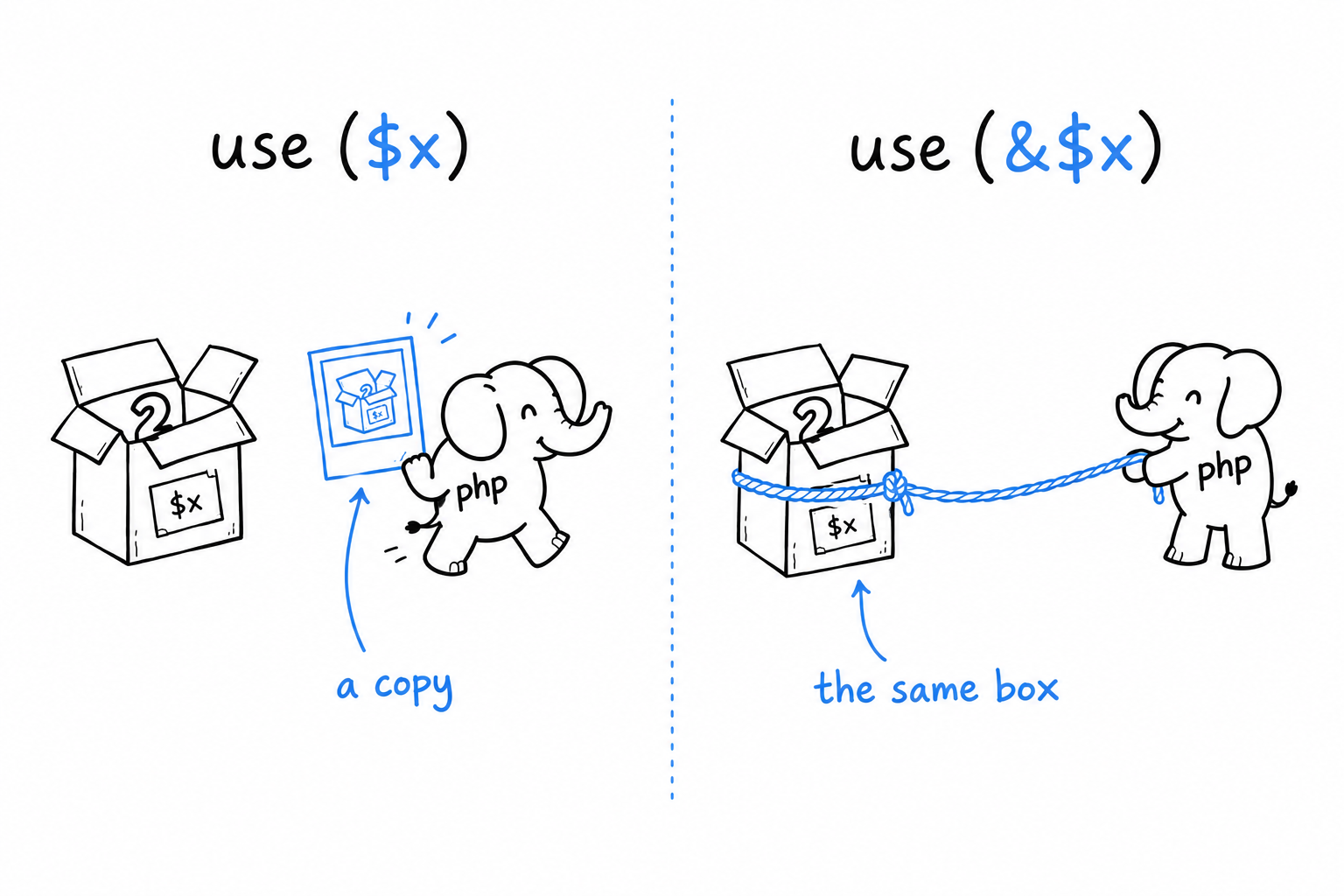
Try it: remove the & and run the file again. Every call now gets its own fresh copy of $count, starting at 0, and the counter prints 1, 1, 1. One character is the whole difference between a snapshot and a shared box.
Arrow functions: capture without asking
Writing use for every variable gets tedious quickly, especially for the one-liners you pass to functions like array_map(). Arrow functions exist for exactly that:
<?php
$factor = 3;
$triple = fn(int $n): int => $n * $factor;

echo $triple(14) . "\n"; // 42
No use anywhere, and $factor is still visible inside. An arrow function automatically captures every variable it mentions from the surrounding code, by value, as if PHP had written use ($factor) for you. That convenience is the reason fn exists.
It comes with two limits. The body is a single expression: whatever follows => is the return value, with no braces, no return, and no statements before it. And the capture is always by value. There is no arrow-function version of use (&$var); when you need a reference, you write a full closure.
A closure declares what it captures. An arrow function captures whatever it uses, always as a copy.
Where this actually gets used
You will write far more arrow functions than closures, because most of the behavior you pass around is short. array_map(), array_filter() and usort() are their natural homes:
<?php
declare(strict_types=1);

$prices = [10.00, 25.50, 3.99, 100.00];

$withTax = array_map(fn(float $p): float => round($p * 1.2, 2), $prices);

$expensive = array_filter($prices, fn(float $p): bool => $p > 20.00);

usort($prices, fn(float $a, float $b): int => $a <=> $b);
array_map() runs the function on every element and returns a new array of the results. array_filter() keeps the elements for which the function returns true, or anything PHP treats as true. usort() sorts the array in place, calling the function to compare two elements at a time; <=>, the spaceship operator, is the standard way to write that comparison, since it returns a negative number, zero or a positive number depending on which side is bigger.
None of the three needed more than a one-line arrow function, which is precisely the case they were designed for. Reach for a full closure when you need to capture by reference, or when the logic takes more than one expression. The rest of the time, the arrow function is the better default.