Performance: Loops vs. Generators vs. Array Functions
Square two million integers and add them up. You can write that as a plain loop, with array_map(), or with a generator, and the three programs print the same number. They do not cost the same, and cost means two things here, time and memory, that do not always move together. Rather than guess, measure.
A small benchmark
The same task, three ways:
<?php
declare(strict_types=1);

const N = 2_000_000;

// 1. plain loop
$sum = 0;
for ($i = 1; $i <= N; $i++) {
    $sum += $i * $i;
}

// 2. array functions
$numbers = range(1, N);
$squares = array_map(fn(int $n): int => $n * $n, $numbers);
$sum = array_sum($squares);

// 3. generator
function squares(int $max): Generator {
    for ($i = 1; $i <= $max; $i++) {
        yield $i * $i;
    }
}
$sum = 0;
foreach (squares(N) as $square) {
    $sum += $square;
}
Run each version in its own process, so that one does not inflate another’s peak-memory reading, and measure with hrtime() and memory_get_peak_usage(). On the machine this book was written on:
loop              ~100 ms   peak memory:   2 MB
array functions   ~140 ms   peak memory:  66 MB
generator         ~170 ms   peak memory:   2 MB
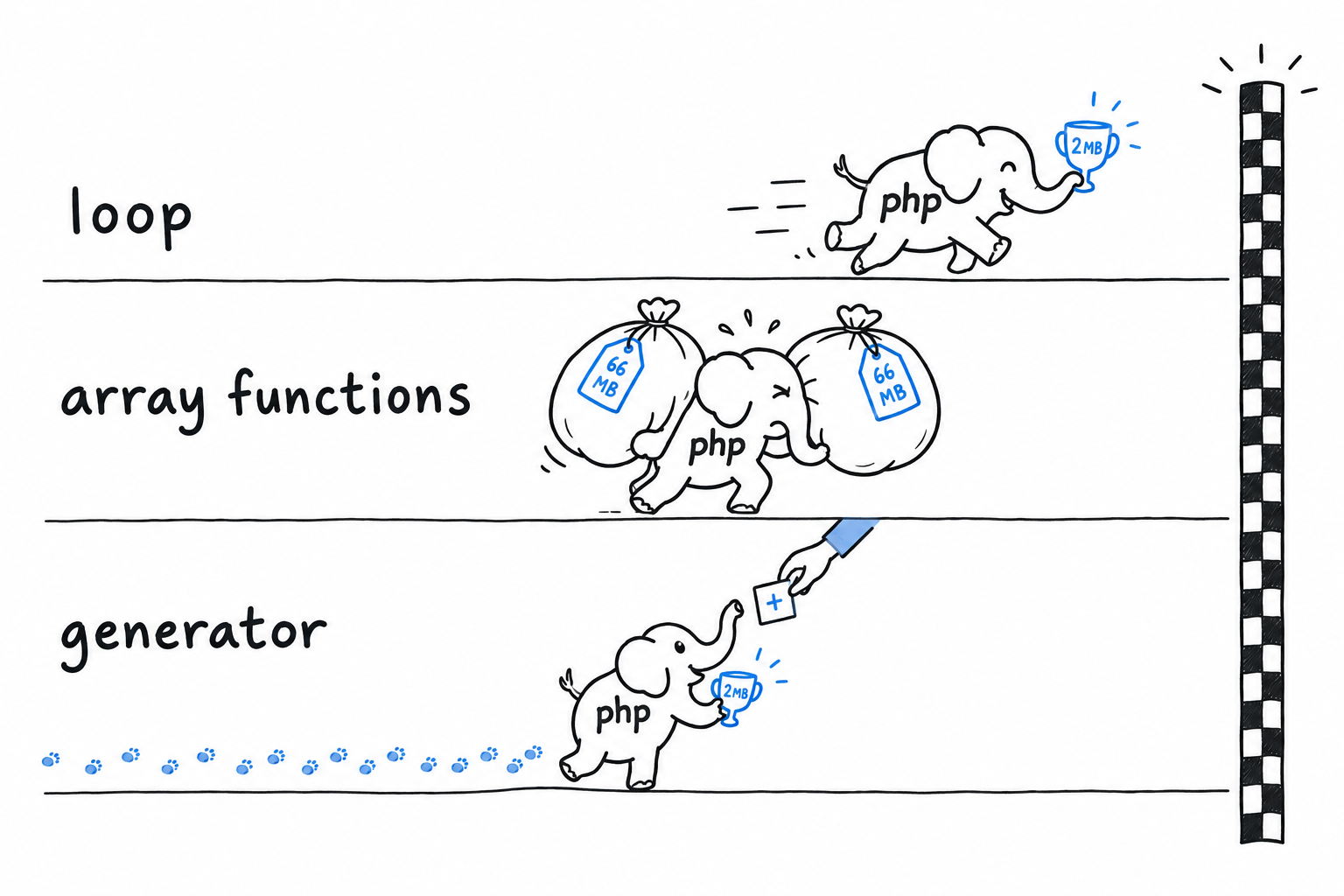
Take the exact numbers with a grain of salt: they shift with your PHP version, your hardware and whatever else is running. The shape of the result is what to trust. The plain loop is the fastest and the leanest, full stop. The array-function version is the slowest and by far the hungriest: range() builds a two-million-element array, then array_map() builds a second one to hold the squares, and both exist at once before array_sum() even starts. The generator lands in between on time, since pausing and resuming a function two million times has a real cost, but it matches the loop’s flat memory use, because it never holds more than one value.
Reading that honestly
None of this means “always write loops”. The three tools are good at different things, and choosing one means knowing which thing you need.
A for or foreach loop is the fastest option, and often the clearest. There is nothing to learn, just a variable changing on every pass. Reach for it when speed matters, when the logic is more than a one-line transformation, or whenever you are unsure. It is rarely the wrong default.
A generator trades a little speed for memory that does not grow with the input. A huge file, an API you page through, an endless sequence: that is its territory. You saw it pay off in phpgrep, printing its first match before the file was finished. If the whole series would comfortably fit in memory anyway, the pause-and-resume overhead buys you nothing.
array_map() and array_filter() are often the most readable option for small and medium data already in memory. A one-line array_map(fn($x) => ..., $items) reads better than the five-line loop it replaces, and that is a real win. What they are not is a memory saving: each one builds a brand-new array on top of the one you gave it. For a hundred items, irrelevant. For millions, it is the 66 MB you just saw.
A decision rule, not a table
If the data is small enough that you would never think twice about holding it all in memory, pick whichever reads best where it is called: usually an array function for a simple transformation, a loop for anything with real logic in it. If the data is large, unbounded or expensive to produce (a big file, a database cursor, anything you page through), pick a generator and accept the modest overhead in exchange for memory that stays put. And if you are chasing raw speed on a hot path, and you have measured that it matters, the plain loop is still, quietly, the fastest thing PHP gives you.
Small data: whatever reads best. Big data: a generator. Hot path: a loop, once you have measured.
Do not guess which case is yours. The benchmark above is a dozen lines. Measure your own, if the question matters enough to ask it.