Variable Scope and Garbage Collection
Functions have their own scope
A variable created inside a function lives inside that function, and nowhere else:
<?php
declare(strict_types=1);

function greet(): void
{
    $message = "Hello from inside greet()";
    echo $message . "\n";
}

greet();
echo $message ?? "no such variable out here\n";
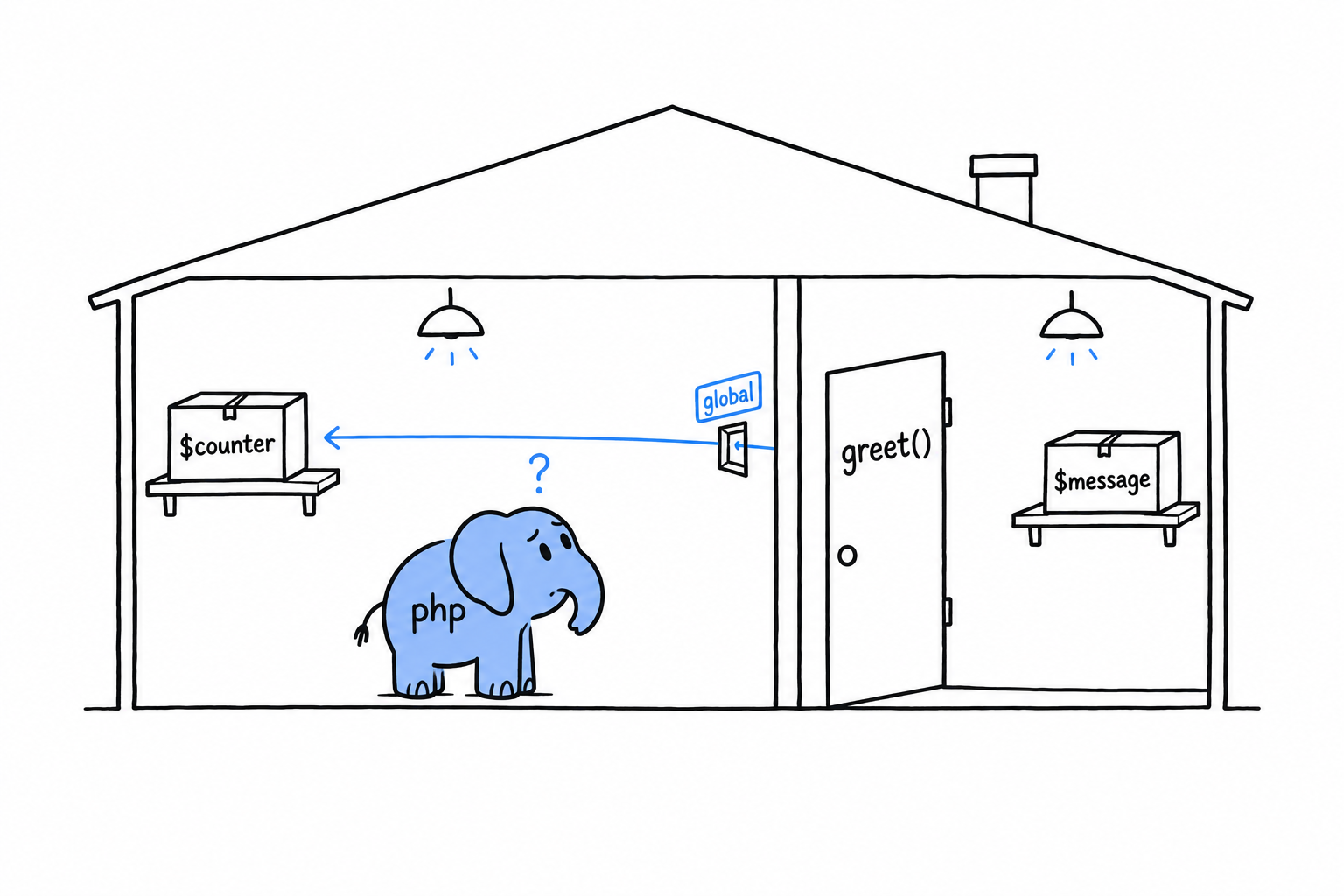
Run it. The second line prints “no such variable out here”: $message inside greet() and any $message floating around outside are unrelated, even though they share a name. Every function gets its own private set of variables, invisible from outside. This is called local scope, and it is the sane default. Without it, every variable name in every function would compete for one shared space, and calling a function you did not write would be a small act of faith that it had not quietly overwritten one of yours.
Picture each function as a room with its own shelves. A box on a shelf in one room does not exist in the next.
global, and why you’ll rarely reach for it
PHP does have a way to let a function read and write a variable from the top-level script: the global keyword.
<?php
declare(strict_types=1);

$counter = 0;

function increment(): void
{
    global $counter;
    $counter++;
}

increment();
increment();
echo $counter; // 2
It works. It is also almost never the right tool. A function that reaches out through global to change state living outside its parameters and return value is a function you cannot understand by reading its signature: you have to find every global $counter in the codebase to know who changes it, and in what order. Invisible in a five-line example, painful in a five-thousand-line application.
Prefer passing values in as parameters and getting results back as return values, or, once you reach Chapter 5, keeping shared state as a property on an object you pass around deliberately. If you feel the pull of global, the function usually wants a parameter instead.
static variables inside functions
There is a better-behaved way for a function to remember something between calls. An ordinary local variable is created fresh and destroyed every time the function runs. A static local variable keeps its value from one call to the next, and only that function can see it.
<?php
declare(strict_types=1);

function nextId(): int
{
    static $id = 0;
    $id++;
    return $id;
}

echo nextId(); // 1
echo nextId(); // 2
echo nextId(); // 3
$id = 0 runs only the first time nextId() is called; every later call picks up where the previous one stopped. Nothing outside nextId() can read or reset $id. There is no global-style leak here, just a function with a private memory of its own. It is a handy pattern for a small counter, a simple cache, or a “have I already done this setup” flag, when a full object would be overkill for one number.
A brief, honest word about garbage collection
You will hear people mention PHP’s “garbage collector”, usually next to the words “memory leak” or “long-running script”. It helps to know roughly what they mean, even though you will rarely think about it.
Every value PHP creates, every array and every object, carries a small counter: the number of variables currently pointing at it. When that count drops to zero, PHP frees the memory immediately. The last variable went out of scope or was reassigned, nobody needs the value anymore, and it is gone. This counter is also what makes copy-on-write work, back in the first section of this chapter: PHP always knows how many places share a given array.
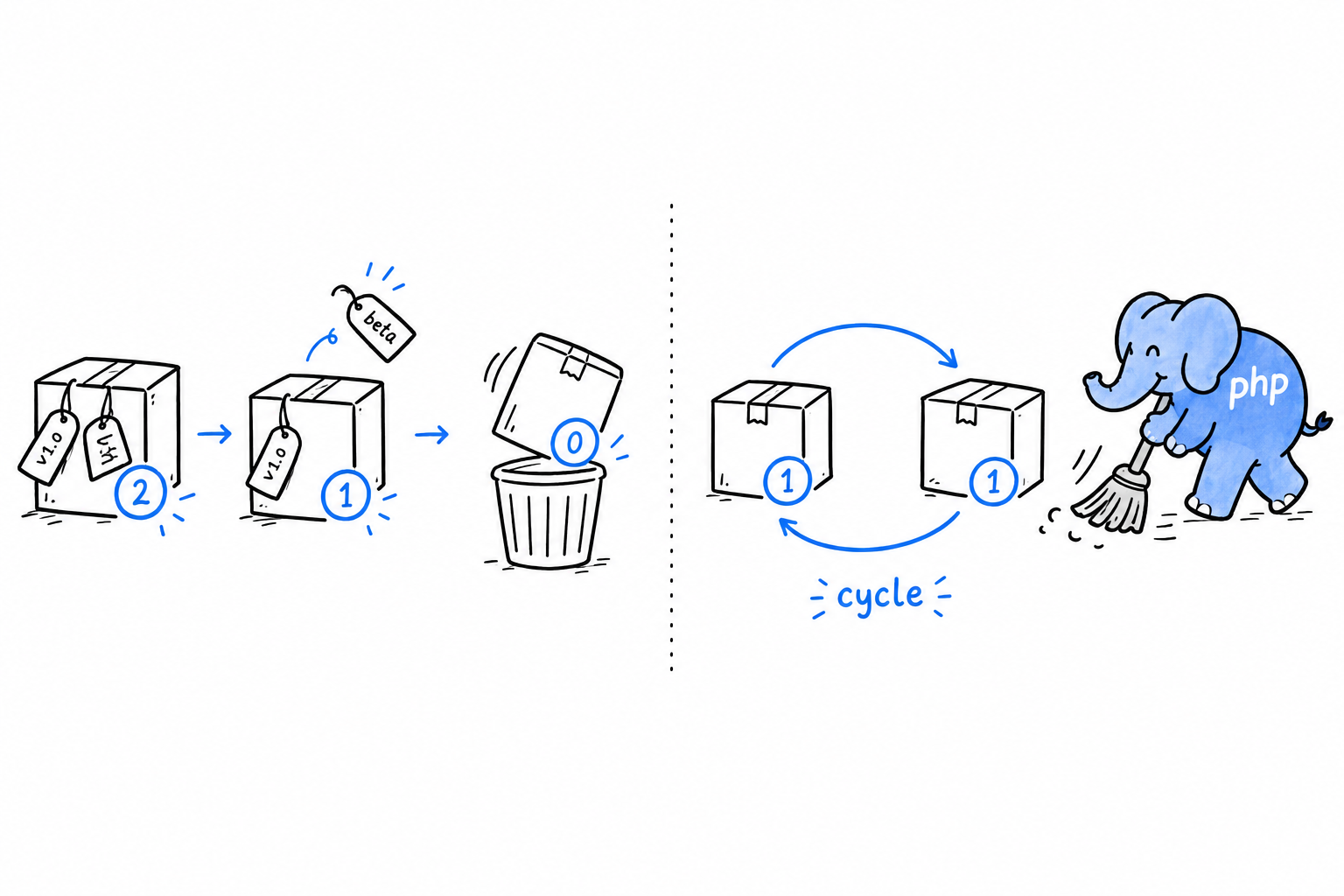
Counting has one blind spot. Two objects that point at each other form a cycle, and a cycle can be forgotten by the rest of the program while its two members still hold on to each other. Their counts never reach zero. PHP runs a separate cycle collector from time to time, finds these orphaned cycles, and cleans them up anyway.
You do not manage memory in PHP. No malloc, no free, no bookkeeping of who owns what. Values disappear when nothing needs them, and PHP works out “nothing needs them” for you, cycles included. That is not a gap compared to languages that make you think about memory; it is the entire point. Keep the vocabulary in your back pocket for the rare day you debug memory growth in a long-running script, and otherwise let it do its job.